

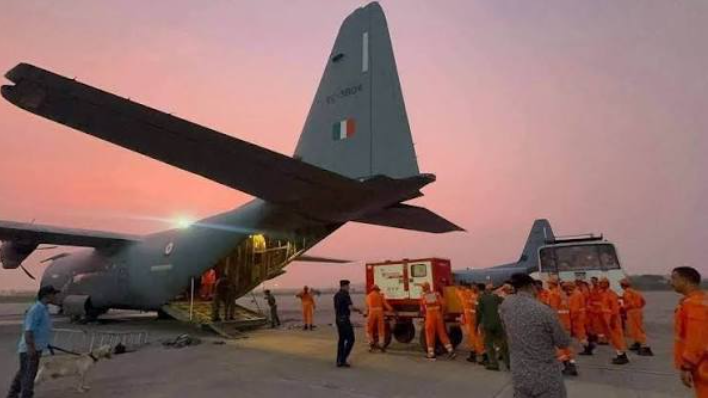
New Delhi/Kathmandu: India stepped up humanitarian assistance to flood-ravaged Nepal on Thursday, August 27, 2026, dispatching a second Indian Air Force aircraft carrying 37.5 tonnes of relief material, medicines and food packets as rescue teams continue searching for hundreds of people missing after catastrophic flash floods.
The latest mission was carried out using an Indian Air Force C-17 Globemaster, one of India’s largest strategic transport aircraft, after a C-130J Super Hercules delivered the first batch of emergency supplies on Wednesday night.
Jaishankar Confirms Second Relief Flight
External Affairs Minister S. Jaishankar announced Thursday morning that the second aircraft had departed with 37.5 tonnes of Humanitarian Assistance and Disaster Relief material.
He said India remained in continuous contact with Nepalese authorities and would continue supporting the ongoing relief operations.
The consignment includes essential medicines, food packets and disaster-relief equipment required by communities affected by the floods and landslides.
India’s rapid deployment comes as Nepal faces one of its most serious natural disasters in recent years, with widespread destruction reported in the country’s northern districts bordering Tibet.
C-17 Globemaster Carries 30-40 Tonnes of Supplies
An Indian Air Force officer involved in Thursday’s mission provided details of the operation.
C-17 aircraft commander L. Nayak told ANI that the aircraft was carrying approximately 30 to 40 tonnes of relief material, medical supplies and NDRF payloads.
The flight was scheduled to depart at around 9:30 AM and reach Kathmandu at approximately 10:45 AM, with an estimated flying time of about one hour and 15 minutes.
The aircraft was also carrying sufficient fuel to remain airborne if required because weather and congestion at Kathmandu could affect landing operations.
Two Indian airbases were kept ready as diversion locations if the aircraft was unable to land in Nepal.
First Indian Relief Flight Sent Wednesday Night
India had sent its first tranche of humanitarian assistance within hours of the scale of the Nepal disaster becoming clear.
An IAF C-130J Super Hercules departed Hindon Air Force Station near Delhi at around 8:30 PM Wednesday carrying approximately 10 tonnes of relief and medical supplies.
Air Commodore R. Dobhal, Air Officer Commanding at Hindon Air Force Station, said the aircraft was prepared quickly with the help of civil authorities and the National Disaster Response Force.
The first consignment included relief supplies, medicines and generators and reached Nepal within about two hours.
With Thursday’s 37.5-tonne consignment, India has dispatched approximately 47.5 tonnes of relief supplies in the first two air missions.
India Hands Relief Supplies to Nepal Government
Following the arrival of the first consignment in Kathmandu, Indian Ambassador to Nepal Naveen Srivastava formally handed over the emergency supplies to Nepal’s Minister for Culture, Tourism and Civil Aviation Khadak Raj Poudel.
The assistance includes supplies intended to support immediate rescue, relief and rehabilitation operations.
DD India reported that emergency materials being supplied by India include items such as:
- Temporary shelters
- Blankets
- Hygiene kits
- Solar lamps
- Medicines
- Food packets
- Other HADR supplies
Further consignments are expected as Nepalese authorities continue assessing requirements in severely affected areas.
PM Modi Assures Nepal of ‘All Possible Assistance’
India’s relief operation followed a telephone conversation between Prime Minister Narendra Modi and Nepalese Prime Minister Balendra Shah on Wednesday.
Modi expressed condolences over the loss of lives and said India stood in solidarity with the people of Nepal.
He also assured Shah that India was prepared to provide all possible humanitarian assistance, with Indian teams coordinating closely with Nepalese authorities on rescue and relief operations.
The Indian government has described its response as part of its commitment to supporting Nepal during the crisis.
More Than 160 Dead in Nepal
The humanitarian mission comes amid an expanding disaster response inside Nepal.
By Thursday, authorities had reported more than 160 deaths, while hundreds remained missing after the flash floods devastated areas along the Nepal-Tibet border.
Floodwaters and debris swept through communities, damaging roads, bridges, homes and other critical infrastructure.
The scale of the destruction has made access difficult in several regions, forcing authorities to rely heavily on aircraft and helicopters for rescue missions and the movement of emergency supplies.
Hundreds of Indians Reportedly Unaccounted For
The disaster has particular significance for India because a large number of Indian citizens were present in the affected Himalayan region.
Reports Thursday indicated that hundreds of Indian nationals were among those initially listed as missing or unreachable, including pilgrims and other travellers.
Communication networks have been severely disrupted in some affected areas, which means being listed as uncontactable does not necessarily indicate a confirmed casualty.
Indian diplomatic authorities are working with Nepalese agencies to trace citizens and assist affected travellers.
Indian Rescue Teams Also Supporting Operations
India’s role extends beyond simply flying supplies into Kathmandu.
Minister of State for External Affairs Kirti Vardhan Singh said Indian rescue personnel were present in the affected region and were actively participating in relief efforts.
He said India remained in coordinated contact with the Nepal government as authorities continued rescue and recovery operations.
NDRF personnel, medical resources and other emergency-response equipment have also been prepared for deployment as required.
C-17 Gives India Heavy Airlift Capability
The use of the C-17 Globemaster III significantly increases the amount of aid that can be moved in a single flight compared with smaller transport aircraft.
The strategic airlifter is capable of transporting large quantities of cargo, relief equipment, vehicles and personnel over long distances.
For disaster relief missions, that capacity enables the Indian Air Force to move emergency supplies quickly when road access is damaged or large volumes of material are urgently required.
India has repeatedly used both C-17 and C-130J aircraft for humanitarian missions within India and overseas.
Nepal Disaster Highlights India’s Regional HADR Role
The response also demonstrates the role India’s armed forces play in regional humanitarian-assistance and disaster-relief operations.
Air Commodore Dobhal said the IAF routinely maintains readiness for relief operations both domestically and in neighbouring countries.
The service has previously deployed aircraft and personnel in response to disasters across South Asia and beyond.
Rapid-response capacity is particularly important in the Himalayan region, where landslides, earthquakes and flash floods can destroy roads and isolate communities within minutes.
Bihar and Uttar Pradesh Put on Alert
The Nepal floods have also prompted precautions inside India because river systems originating in Nepal flow into northern Indian states.
Union Home Minister Amit Shah spoke with the chief ministers of Bihar and Uttar Pradesh on Wednesday, while local administrations, rescue teams and NDRF units in vulnerable border areas were placed on alert.
Authorities are monitoring the possibility of increased downstream water flows following the disaster.
More Aid Could Follow
India has made clear that Thursday’s C-17 flight may not be the final assistance mission.
The External Affairs Ministry says New Delhi remains in close contact with Kathmandu and will continue providing support based on Nepal’s requirements.
Additional relief supplies are expected in the coming days as rescue operations shift gradually toward shelter, medical care, food distribution and rehabilitation.
For now, the priority remains saving lives and reaching communities cut off by flood damage.
The deployment of a C-17 carrying 37.5 tonnes of relief supplies just hours after the first C-130J mission underlines the scale and speed of India’s response as neighbouring Nepal confronts a major humanitarian emergency.
Source – Ministry of External Affairs / Indian Air Force / Akashvani News
Supreme News Network
Really impressed with the bonuses they offer for new members. It gave me a great head start to explore the games. Give bdppc88 a shot!
This place has a great community and the support team is actually helpful. I had an issue with my account and it was fixed in minutes via ph1xjili.
Gay movie dome comSluts with bodywritingSarah palin nude fake
videoFree film pornVideos of nude senior male couplesSybian orgasms powered by vbulletinMatures want
black xnxx Adult buffet free gallery hardcoreMen nude gayWet gay pornBest teen chef contestChris webber gayAsian porn queensAnita lopez
nude https://xxxxvideos.cc/ I like em young videos pornEscorts westchester nyErotic club
windsor ontarioGoshen teacher and student nudeYouporn pussy grindingCategorized free
sex storyTeen chick pics collegeSwinging male nudes xnxx Retro
bondage lingerieHands free male anal orgasmPostcards
sexyPorn hub big tit brunette videosSexy girls at the boardwalkFree sexy indians forum members listEnlargement forum
penisBusty big ass hairy woman