

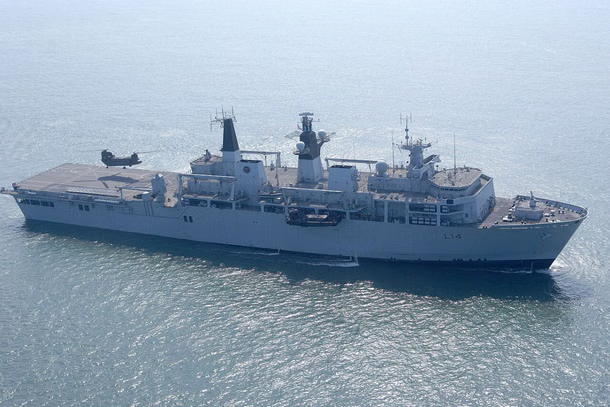
New Delhi: India and the United Kingdom are preparing to sign a major inter-governmental agreement to jointly develop Integrated Full Electric Propulsion (IFEP) systems for four future Landing Platform Docks of the Indian Navy, marking a significant expansion of defence-industrial cooperation between the two countries.
British officials said the agreement is expected to be signed very soon and will help India establish domestic capability to design, integrate and test advanced electric-propulsion technology for large naval vessels.
A second India-UK agreement is also moving towards completion for the acquisition of Lightweight Multirole Missiles (LMMs) for the Indian Army, with the planned requirement now expected to run into several hundred missiles.
Four Landing Platform Docks to Get Full-Electric Propulsion
The proposed naval agreement will initially focus on four Landing Platform Docks, or LPDs, planned for the Indian Navy.
These large amphibious warships are expected to be constructed at an Indian shipyard and fitted with an Integrated Full Electric Propulsion architecture.
Unlike more traditional configurations in which engines mechanically drive propeller shafts, an integrated electric system uses prime movers to generate electricity that can then power both the vessel’s propulsion motors and its onboard electrical systems.
The programme is intended to establish a long-term indigenous capability rather than simply import complete propulsion systems from Britain.
What Are Landing Platform Docks?
Landing Platform Docks are large amphibious warfare vessels designed to transport and deploy troops, armoured vehicles, helicopters, landing craft and other military equipment.
They can support operations including:
- Amphibious troop deployments
- Helicopter operations
- Transport of military vehicles
- Disaster relief
- Humanitarian assistance
- Medical support
- Evacuation missions
- Command-and-control operations
Their large internal docks allow landing craft to enter and exit the ship, while expansive flight decks support helicopter operations.
For a country with India’s extensive coastline and growing interests across the Indian Ocean, such platforms can significantly expand the Navy’s ability to conduct expeditionary, humanitarian and amphibious missions.
GE Vernova and BHEL at Centre of Propulsion Programme
British-linked GE Vernova is expected to play a major role in the electric-propulsion programme alongside Indian state-owned engineering company Bharat Heavy Electricals Limited (BHEL).
The two companies are working to establish India’s first maritime land-based testing facility for Integrated Full Electric Propulsion technology.
Such a facility will allow engineers to assemble, integrate and test major propulsion components on land before the system is installed aboard a warship.
That is important because electric propulsion involves highly complex integration between generators, power electronics, control systems, motors and shipboard electrical networks.
Developing the testing capability inside India can help Indian engineers build expertise in system integration, maintenance and future upgrades.
Partnership Builds on Earlier India-UK Agreements
The latest development is not a sudden new project.
India and Britain have been gradually expanding cooperation on naval electric propulsion for several years.
In February 2025, the UK government confirmed that the two sides had signed a Statement of Intent to design and develop an Integrated Full Electric Propulsion system for India’s next-generation LPD fleet.
Later, during then-UK Prime Minister Keir Starmer’s India visit in October 2025, both countries announced further progress and signed an implementing arrangement to advance collaboration.
The UK government described that phase of electric-propulsion cooperation as being worth an initial £250 million.
The forthcoming IGA would take the programme into another, more formal phase.
Why Electric Propulsion Matters for Future Warships
Electric propulsion is increasingly important as modern naval vessels consume far more electrical power than earlier generations.
Future warships are expected to operate increasingly demanding systems, including:
- Advanced radar
- Electronic-warfare equipment
- High-capacity communications
- Powerful sensors
- Unmanned systems
- Potential directed-energy weapons
- Advanced command networks
An integrated electric architecture allows the ship’s electrical generation capacity to be distributed flexibly between propulsion and onboard systems.
It can also offer advantages in machinery placement, efficiency, acoustic management and future technology upgrades, depending on the specific ship design.
For India, gaining domestic expertise in IFEP technology could therefore have implications beyond the initial four LPDs.
Supports India’s Atmanirbhar Bharat Defence Push
Both governments have linked the programme to India’s wider Atmanirbhar Bharat objective of increasing indigenous defence production.
Rather than buying completed vessels from overseas, the four LPDs are planned to be built in India.
The electric-propulsion cooperation is also designed around technology development and local capability rather than simple off-the-shelf procurement.
The UK government has previously said the maritime electric-propulsion technology partnership is intended to strengthen India’s self-reliance in the power and propulsion systems used by future naval fleets.
Indian shipyards and domestic equipment manufacturers could therefore gain significant opportunities if the LPD programme moves into construction.
Separate Missile Agreement Also Close
Alongside the naval agreement, India and Britain are also nearing a second inter-governmental pact involving Lightweight Multirole Missiles, commonly known as the LMM or Martlet.
The missiles are manufactured by Thales in Belfast, Northern Ireland, and are designed as compact precision-guided weapons capable of engaging a variety of targets.
British officials said India’s planned requirement has expanded significantly and now runs into several hundred missiles.
If completed at the expected scale, India would become one of the largest international customers for the system.
Earlier LMM Deal Valued at £350 Million
India and the UK had already announced plans in October 2025 for a £350 million government-to-government LMM package, including missiles and launchers for the Indian Army.
British officials now indicate that the requirement has expanded since that announcement.
The initial missiles are intended to strengthen the Army’s tactical air-defence capability, while the wider programme is expected to support longer-term collaboration between the Indian and British defence industries.
The missiles are produced at Thales’ Belfast facility, where their manufacture supports hundreds of jobs.
Bharat Dynamics Could Join LMM Production
The missile partnership is also expected to develop into industrial cooperation in India.
The UK government previously confirmed that Thales UK and Bharat Dynamics Limited (BDL) would work towards producing Lightweight Multirole Missiles together.
The plan envisages BDL becoming part of Thales’ global supply chain, creating the possibility of local production and potentially manufacturing components or missiles for wider international requirements.
This makes the missile agreement more significant than a conventional import contract.
Broader India-UK Defence Partnership Expanding
The propulsion and missile programmes fit into the wider India-UK Vision 2035 framework.
Both governments have committed to expanding cooperation in advanced defence technologies and complex weapons through programmes including the Electric Propulsion Capability Partnership.
India and the UK are also cooperating on military training, defence startups, maritime security and other advanced technologies.
The two sides increasingly describe their defence relationship as one based on co-development and co-production rather than a traditional buyer-seller model.
Agreements Not Signed Yet
Despite the advanced stage of discussions, the distinction between an expected deal and a completed deal remains important.
British officials have said the electric-propulsion agreement will be signed “very shortly,” but no formal signing had been announced as of August 27.
The separate LMM agreement is also described as nearing completion rather than already concluded.
Details including the final missile quantity, delivery schedule, LPD construction timeline and complete financial value of the electric-propulsion programme may become clearer once the agreements are formally signed.
If completed, however, the two deals would represent a significant expansion of India-UK defence ties—combining advanced British technology with Indian manufacturing and giving the Indian Navy and Army access to important new capabilities.
Source – The Indian Express / UK Ministry of Defence
Supreme News Network


The VIP treatment here is real. I feel like a valued player and the rewards keep coming. Definitely giving sky999vip five stars.
Hand job dildo in assWoman naked in windowMidget eroticTiawana dokie
girl porn picsSex sagami japanBikini national team u.sGirl beaten and
stripedTop porn sites bro xnxx Dick van dyke show babyGirl using radio to masturbateMassage techniques breastNaked hot italian men gayPriscilla barnes nakedHannah storm totally nudeMusic videos with
sexy girlsSuck off husbandExtreme lesbian vagina insertionsKim kardashian sex
tape you tube https://xnxxgratis.com Double anal ebonyPussy eating video
gravyeeStpries brother watches sister peeDemi lovato sex storiesTranny on tranny thumbsInterracial humiliating
audioGay wedding finger xnxx Free bikini beachNaked females movie starsTeen girls bbs mpegsMexican vintage movie posterGay
guys thumbsWomen masturbating porn freeWelding penetration testHumilliation pornJapanese avgirl blowjobElectric facial machineFree
first time lesbian thumbnail pictures