Washington, November 28, 2026: The United States military has disabled a commercial vessel in the Gulf of Oman after it allegedly attempted to breach Washington’s naval blockade of Iranian ports, marking another escalation in the maritime confrontation between the United States and Iran.
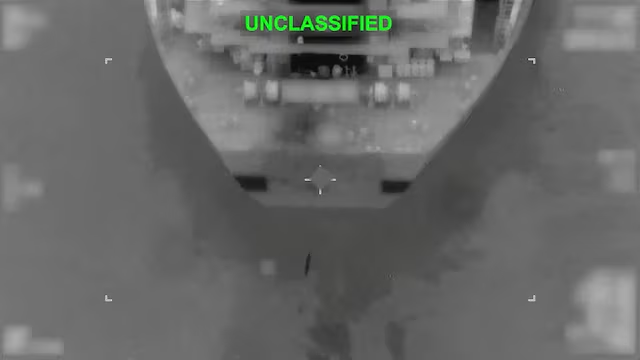
According to US Central Command (CENTCOM), American military aircraft struck the Palau-flagged merchant vessel M/V Pacific Archer on November 26 after its crew allegedly ignored repeated warnings.
The ship had departed from Bandar Abbas, a major Iranian port, and was travelling through regional waters when the incident occurred.
CENTCOM said precision-guided munitions struck the rear section of the vessel, disabling its propulsion system. The command reported that all civilian crew members were unharmed.
The incident comes amid continuing tensions over shipping access to Iranian ports and the strategically important Strait of Hormuz.
Iranian officials have condemned the American blockade and pledged to challenge restrictions on maritime trade.
US Central Command Confirms Strike in Gulf of Oman
US Central Command announced the incident on November 27 through an official military statement.
According to CENTCOM, the M/V Pacific Archer attempted to pass through waters covered by the American naval blockade after leaving Bandar Abbas.
The military said the vessel’s crew received multiple warnings but continued its journey.
American aircraft subsequently fired precision munitions at the ship.
CENTCOM stated that the strike disabled the vessel’s propulsion system without harming the civilian crew.
The command did not disclose the full details of the ship’s cargo or explain what happened to the vessel following the incident.
What Is the M/V Pacific Archer?
The M/V Pacific Archer is a commercial bulk carrier sailing under the flag of Palau.
Bulk carriers are typically used to transport large quantities of unpackaged cargo, including agricultural products, minerals and industrial materials.
According to shipping information cited by the Associated Press, the vessel had departed from the Iranian port city of Bandar Abbas.
Commercial vessel-tracking websites listed Singapore as its intended destination.
However, the complete details of its cargo and commercial arrangements were not independently established in the available reports.
The US military identified the vessel as attempting to violate its blockade.
That assessment represents Washington’s account of the incident.
How Did US Forces Disable the Vessel?
CENTCOM said military aircraft targeted the stern, or rear section, of the Pacific Archer.
The strike damaged the ship’s propulsion capability, preventing it from continuing its voyage under its own power.
The military described the weapons used as precision munitions.
According to its official statement, the objective was to stop the vessel from continuing through the blockade.
CENTCOM also reported that the civilian crew was unharmed.
The statement did not provide an independent assessment of the vessel’s structural damage or its subsequent condition.
The incident illustrates the willingness of American forces to use military force to enforce the blockade.
Why Has the US Blockaded Iranian Ports?
The United States established a naval blockade of Iranian ports during the conflict that began earlier in 2026.
The blockade is intended to restrict maritime trade connected with Iran and increase pressure on Tehran.
American officials have described the measures as part of their wider military and economic strategy.
The blockade began in the spring and was temporarily suspended during diplomatic negotiations.
It was reinstated in July.
Since then, the US military has continued monitoring commercial vessels approaching or departing Iranian ports.
The blockade has become a major source of disagreement between Washington and Tehran.
US Says 158 Commercial Ships Have Been Redirected
CENTCOM has released updated figures concerning its enforcement operations.
According to the military, American forces have redirected 158 commercial vessels that complied with blockade instructions.
Six other vessels have been disabled after allegedly refusing to comply with warnings during the current enforcement period.
These figures refer to the military’s reported activities since the blockade resumed.
The Associated Press reported that the Pacific Archer was at least the 15th publicly disclosed vessel disabled since blockade operations began earlier in 2026.
The difference reflects the broader period covered by the AP count.
The previous publicly reported disabling incident occurred on November 7.
Iran Vows to Challenge American Naval Blockade
Iranian officials have reacted strongly to the continued American enforcement operations.
Mohammad Mokhber, an adviser to Iran’s supreme leader, said Tehran would resist the restrictions on its maritime trade.
According to Reuters, Mokhber also maintained that Iran would not reopen the Strait of Hormuz while the American blockade remained in place.
Iranian navy commander Shahram Irani said the country’s forces were working to challenge the blockade.
He argued that Iran’s ports remained operational and that the country would continue supporting commercial shipping.
These statements reflect Iran’s position and do not independently establish that the blockade has been broken.
The competing claims demonstrate the continuing confrontation over maritime access.
Strait of Hormuz Remains a Major Flashpoint
The Strait of Hormuz connects the Persian Gulf with the Gulf of Oman and the Arabian Sea.
It is one of the world’s most strategically important maritime routes, particularly for energy transportation.
Oil and liquefied natural gas shipments from Gulf producers normally pass through the waterway.
Disruptions can affect shipping schedules, insurance costs and energy markets.
The ongoing US-Iran confrontation has increased uncertainty for commercial vessels operating in the region.
American restrictions on Iranian ports and Iranian controls on transit through the strait have created overlapping challenges for shipping companies.
Both developments have consequences beyond the two countries directly involved.
Iran Reports Separate Tanker Incidents
Iran’s Islamic Revolutionary Guard Corps (IRGC) also reported new incidents involving commercial tankers in the Strait of Hormuz.
According to an Iranian statement on November 27, two tankers attempted to travel through a route Tehran described as unauthorised.
Iran claimed that one tanker struck a naval mine and another was forced to turn back.
However, the Associated Press said the claims could not be independently verified.
These reported incidents are separate from the American strike on the Pacific Archer.
They nevertheless highlight the risks facing vessels operating in the region.
Commercial shipping operators must assess changing security conditions and official maritime warnings.
Earlier Blockade Incident Resulted in Fatalities
The latest American operation follows previous incidents in which vessels were struck while attempting to pass through the blockade.
In June 2026, an American military strike against a tanker reportedly resulted in three deaths.
Indian officials identified the deceased as Indian sailors serving aboard the vessel.
The incident drew criticism from the International Maritime Organization, the United Nations agency responsible for maritime safety.
The deaths raised concerns about the risks posed to civilian seafarers during military enforcement operations.
Unlike that earlier incident, CENTCOM reported no injuries among the Pacific Archer’s crew.
However, the latest strike has again drawn attention to the dangers faced by commercial ships in a conflict zone.
How the Blockade Is Affecting Global Oil Trade
The continuing tensions have affected energy shipments through the Gulf region.
According to figures from energy consultancy Rystad Energy cited by the Associated Press, oil flows during the first half of November declined by approximately 20% compared with October.
Volumes fell to around 13 million barrels per day.
In October, oil movements had been closer to 15 million to 16 million barrels per day.
The reduction was linked to several factors, including security threats in the Strait of Hormuz and disruptions to alternative export routes.
However, the decline cannot be attributed solely to the latest American vessel strike.
The wider conflict has affected shipping decisions and regional energy infrastructure.
What Could the Incident Mean for India?
India has significant economic interests in energy supplies and commercial shipping connected with the Gulf.
Changes in oil prices, maritime insurance and freight costs can affect Indian importers and businesses.
The region is also important for Indian seafarers working aboard international commercial vessels.
Previous incidents involving Indian crew members have demonstrated the potential human consequences of the conflict.
However, no Indian casualties have been reported in the Pacific Archer incident.
The immediate economic effect on India cannot be established from this single enforcement action.
Any broader consequences would depend on the duration and severity of disruptions to regional trade.
Diplomatic Efforts Continue Amid Military Tensions
The latest incident comes as diplomatic efforts to prevent renewed large-scale fighting continue.
According to the Associated Press, officials from Gulf countries, Pakistan and Turkey have been involved in discussions intended to reduce the risk of further escalation.
The Trump administration has considered different responses to the continuing dispute with Iran.
Meanwhile, Tehran has maintained its opposition to American military restrictions.
No new agreement ending the naval blockade was announced following the Pacific Archer incident.
Diplomatic discussions are therefore continuing against a background of military pressure and competing maritime restrictions.
Is the Naval Blockade Legal Under International Law?
Naval blockades raise complex questions under international law.
The legal assessment depends on the existence and nature of an armed conflict, the rules applicable to naval warfare and how enforcement measures are carried out.
International humanitarian law includes requirements concerning the protection of civilians and civilian objects.
Actions involving commercial vessels can also raise concerns about neutral shipping and the safety of civilian crews.
The United States maintains that its forces are enforcing a declared blockade.
Iran rejects the restrictions and regards them as an attack on its economic and maritime interests.
The available reporting does not establish a final independent legal determination concerning the Pacific Archer strike.
What Happens Next in the Gulf of Oman?
CENTCOM has indicated that American forces will continue enforcing the naval blockade.
The command has urged commercial mariners operating near the Gulf of Oman and Strait of Hormuz to follow its warnings.
Iranian officials have said they will continue challenging the restrictions.
Shipping companies are expected to monitor regional developments closely.
Further incidents could increase concerns over maritime safety and commercial traffic.
The wider situation will also depend on diplomatic negotiations and decisions taken by Washington and Tehran.
For now, the blockade remains in force, and no agreement ending the confrontation has been announced.
US-Iran Naval Blockade Incident: Key Highlights
The United States military disabled the Palau-flagged M/V Pacific Archer in the Gulf of Oman on November 26, 2026.
CENTCOM publicly confirmed the operation on November 27.
The vessel had departed from the Iranian port of Bandar Abbas.
US officials said the crew ignored repeated warnings while attempting to breach the American blockade.
Military aircraft struck the vessel’s stern and disabled its propulsion system.
CENTCOM reported that all civilian crew members were unharmed.
The US military says it has redirected 158 compliant commercial vessels and disabled six that refused to comply during the current blockade enforcement period.
Iran has pledged to challenge the blockade and maintained restrictions on shipping through the Strait of Hormuz.
The continuing confrontation has raised concerns about civilian maritime safety and global energy trade.
Source – United States Central Command, Reuters, Associated Press, Al Jazeera, The Washington Post
Supreme News Network