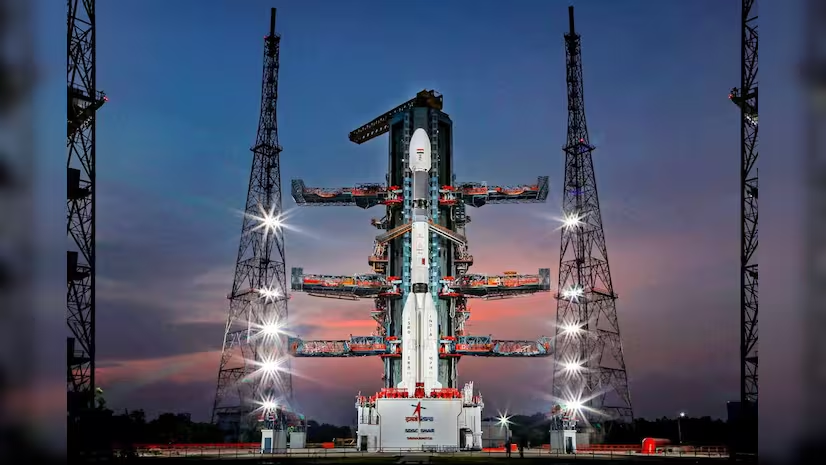
NEW DELHI, September 28: The Indian Space Research Organisation (ISRO) is targeting the launch of its next-generation navigation satellite NVS-03 between October 15 and 20, 2026, a mission expected to strengthen and restore standalone positioning capability to India’s indigenous Navigation with Indian Constellation (NavIC) system.
The mission is particularly important for India’s security forces because NavIC’s encrypted navigation service is designed to provide secure positioning, navigation and timing information without dependence on foreign satellite-navigation networks.
NVS-03 Launch Planned for October
ISRO is preparing to launch NVS-03 aboard a GSLV mission during the second half of October.
The satellite is the third spacecraft in the second-generation NVS series, which has been designed to replace and augment ageing satellites in the existing NavIC constellation.
NavIC Currently Has Three Operational Satellites
India’s standalone NavIC positioning service currently has three operational navigation satellites, below the minimum four-satellite requirement needed for full independent three-dimensional positioning and accurate time correction.
A successful NVS-03 deployment would provide the fourth operational spacecraft required to strengthen standalone navigation services.
Mission Important for Indian Security Forces
NavIC has significant strategic importance because it provides an indigenous navigation system for authorised Indian users.
For defence forces, accurate Position, Navigation and Timing signals can support functions including missile navigation, troop movement, aircraft operations, maritime coordination and precision positioning.
An operational domestic system reduces dependence on navigation networks controlled by other countries during emergencies or conflicts.
NavIC Offers Encrypted Service for Authorised Users
NavIC provides two broad categories of service.
The Standard Positioning Service is intended for civilian users, while an encrypted Restricted Service is available to authorised users, including security agencies.
The system has been designed primarily for India and an area extending approximately 1,500 kilometres beyond the country’s borders.
NVS-02 Mission Faced Technical Failure
The upcoming mission is also important because India’s previous navigation satellite launch did not achieve its intended result.
NVS-02 was launched on January 29, 2025, but a problem involving a pyro valve prevented the spacecraft from carrying out the required orbit-raising manoeuvres.
The satellite consequently failed to reach its intended operational orbit.
NVS-01 Was Successfully Launched in 2023
ISRO successfully launched NVS-01 on May 29, 2023, marking the beginning of the second-generation NavIC satellite series.
The NVS generation has been designed to sustain and strengthen the constellation with enhanced capabilities, including the addition of L1-band signals intended to broaden the range of compatible navigation services and devices.
NVS-04 and NVS-05 Also Being Prepared
India’s NavIC expansion will continue beyond NVS-03.
Two additional navigation satellites, NVS-04 and NVS-05, are already in advanced stages of development.
These satellites are expected to further strengthen the constellation and improve the reliability and availability of India’s navigation services.
Why Four Satellites Are Important
Satellite navigation requires precise calculations using signals received from multiple spacecraft.
Four satellites allow a receiver to determine its three-dimensional position while also correcting timing errors.
With fewer operational satellites, an independent constellation cannot provide the same level of continuous standalone positioning capability.
NavIC Strengthens India’s Strategic Autonomy
Countries increasingly regard indigenous satellite-navigation systems as strategically important because military and critical infrastructure operations depend heavily on accurate location and timing data.
Foreign-controlled systems can potentially impose restrictions or change service availability during geopolitical crises.
NavIC gives India greater control over navigation services required for civilian infrastructure as well as authorised strategic applications.
NVS-03 Could Mark Major NavIC Revival
If the October mission successfully places NVS-03 into its intended operational orbit, it would strengthen the minimum satellite configuration required for NavIC’s standalone positioning services.
The mission would represent an important step in rebuilding and modernising India’s indigenous satellite-navigation network while strengthening navigation support for civilian and security applications.
Further launches of NVS-04 and NVS-05 are expected to add additional resilience to the constellation.
Source – ISRO / Times of India
Supreme News Network