
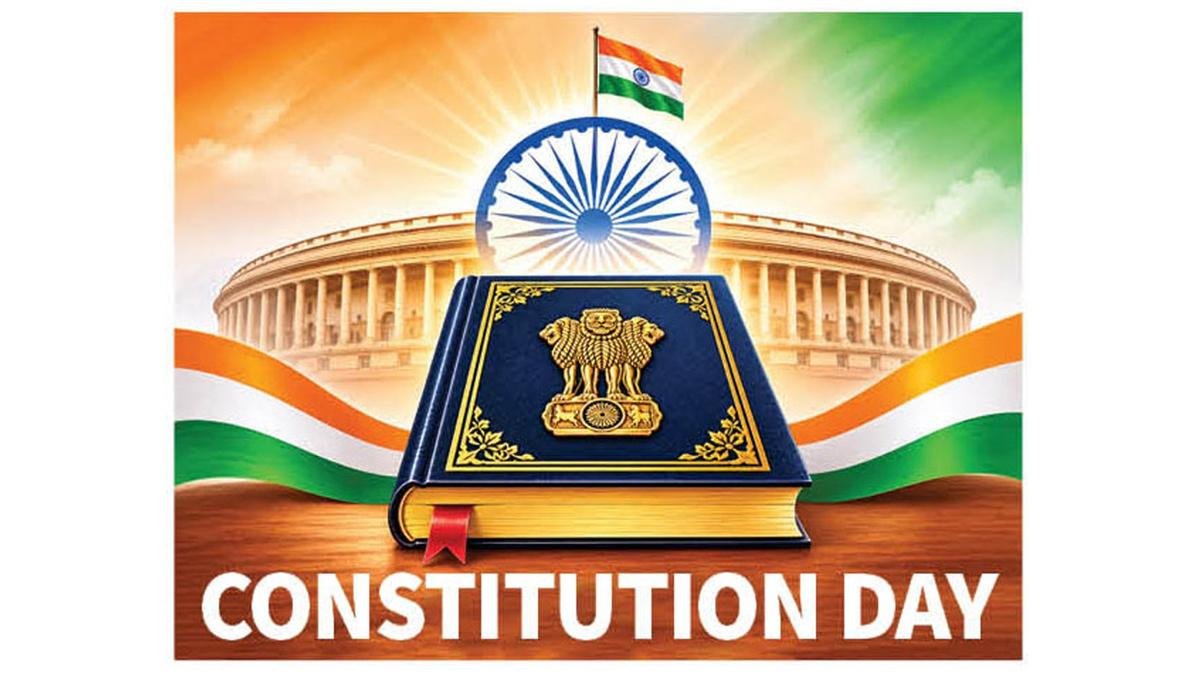
New Delhi, November 26, 2026: India is observing Constitution Day, also known as Samvidhan Divas, on Thursday, November 26, marking 77 years since the Constituent Assembly adopted the Constitution of India in 1949.
Prime Minister Narendra Modi extended greetings to citizens and paid tribute to Dr B.R. Ambedkar, Dr Rajendra Prasad and other members of the Constituent Assembly for their contributions to India’s constitutional framework.
In a message shared on social media and an article published on Constitution Day, the Prime Minister emphasised the importance of constitutional values, citizens’ responsibilities, social justice and India’s goal of becoming a developed nation by 2047.
Government ministries, educational institutions and organisations across the country are marking the occasion through readings of the Constitution’s Preamble, awareness programmes, quizzes and public discussions.
The Ministry of Parliamentary Affairs has also introduced an online Preamble-reading initiative in 23 languages, encouraging citizens to participate in the national observance.
India Marks 77 Years Since Constitution’s Adoption
Constitution Day commemorates November 26, 1949, when India’s Constituent Assembly formally adopted the Constitution.
The document subsequently came into effect on January 26, 1950, establishing India as a republic.
November 26 is therefore associated with the adoption of the Constitution, while January 26 is celebrated as Republic Day.
The government officially designated November 26 as Constitution Day in 2015 to encourage greater awareness of constitutional values.
The 2026 observance marks the 77th anniversary of the Constitution’s adoption.
PM Modi Pays Tribute to Dr B.R. Ambedkar
Prime Minister Narendra Modi began his Constitution Day message by remembering the leaders responsible for framing the Constitution.
He paid special tribute to Dr B.R. Ambedkar, who chaired the Constitution’s Drafting Committee.
The Prime Minister also acknowledged the contributions of other members of the Constituent Assembly.
According to a statement released by the Prime Minister’s Office on November 26, Modi described the Constitution as an invaluable part of India’s democratic heritage.
He said it would continue guiding the country towards its long-term development objectives.
The Prime Minister also encouraged citizens to renew their commitment to the values established by the Constitution.
PM Modi Connects Constitution With Viksit Bharat 2047
In his Constitution Day message, Modi connected constitutional principles with the government’s vision of Viksit Bharat 2047.
The initiative reflects the objective of transforming India into a developed nation by the centenary of its independence.
The Prime Minister argued that the Constitution provides a foundation for national development and social progress.
He emphasised that citizens and public institutions have responsibilities in achieving long-term national goals.
According to Modi, economic progress should be accompanied by efforts to strengthen social justice, equality and opportunities for citizens.
His remarks linked India’s constitutional framework with contemporary development priorities.
Constitutional Rights and Duties in Focus
The Prime Minister emphasised the importance of citizens’ duties alongside their constitutional rights.
In an article published on November 26, Modi discussed the concept of Kartavya, meaning duty or responsibility.
He referred to public participation in activities such as cleanliness, water conservation and environmental protection as examples of collective responsibility.
The Constitution guarantees Fundamental Rights under Part III, including equality before the law, freedom of expression and protection of life and personal liberty.
Fundamental Duties are listed under Article 51A in Part IVA.
The duties include respecting the Constitution, protecting public property and preserving the natural environment.
Fundamental Rights and Fundamental Duties have different legal characteristics, but both are important elements of India’s constitutional framework.
PM Modi Calls for India First and Civic Responsibility
In his Constitution Day article, Modi urged citizens to place national interests and responsibilities at the centre of their efforts.
He presented the principles of India First and Kartavya as guiding ideas for the country’s future.
The Prime Minister argued that India’s democratic institutions and development programmes should be evaluated through their contribution to national progress.
He also highlighted the importance of young people understanding the Constitution and participating in democratic life.
The comments formed part of a broader message encouraging public engagement with constitutional ideals.
Government Organises Preamble Reading in 23 Languages
The Ministry of Parliamentary Affairs announced a nationwide programme allowing citizens to read the Preamble online.
The initiative is available through the MyGov portal in 23 languages, including English and the 22 languages listed in the Eighth Schedule of the Constitution.
Participants can complete the Preamble-reading activity and receive a digital certificate.
The initiative is intended to make constitutional awareness more accessible to people from different linguistic backgrounds.
Government ministries, state administrations, educational institutions and members of the public have been encouraged to participate.
The official Constitution Day participation portal is available at pledge.mygov.in/constitution-day-2026/.
Constitution Day Activities Held Across India
Government departments and educational institutions are observing Constitution Day through different activities.
The Ministry of Parliamentary Affairs has announced collective Preamble readings, seminars, webinars, quizzes and public awareness initiatives.
Schools and universities have been encouraged to organise special assemblies and discussions explaining the making of the Constitution.
Essay-writing, debates, poster-making and cultural programmes are also part of the announced activities.
The objective is to help students and citizens understand the Constitution’s significance beyond legal and political institutions.
The observance also promotes awareness of democratic participation and responsible citizenship.
Youth Programmes Organised Across 786 Districts
A major feature of Constitution Day 2026 is the emphasis on youth participation.
According to the Ministry of Parliamentary Affairs, the Viksit Bharat Yuva Samvad initiative is being organised across 786 districts in all 36 states and Union Territories.
The activities are scheduled between November 24 and November 26.
The programme aims to engage young people in discussions about constitutional values and national development.
Constitution-related quizzes have also been organised through the MyGov and MyBharat platforms between November 18 and November 26.
These initiatives are intended to encourage greater participation among students and young citizens.
Why Is Constitution Day Celebrated on November 26?
The Constitution of India was adopted by the Constituent Assembly on November 26, 1949.
The drafting process involved extensive discussions about democratic institutions, citizenship, rights and governance.
Dr Rajendra Prasad served as president of the Constituent Assembly, while Dr B.R. Ambedkar chaired the Drafting Committee.
The Constitution came into force on January 26, 1950.
The date was chosen to commemorate the Purna Swaraj declaration associated with India’s independence movement.
Constitution Day therefore remembers the adoption of the Constitution, while Republic Day celebrates its commencement.
What Does the Preamble of the Constitution Represent?
The Preamble expresses the fundamental objectives and values of the Indian Constitution.
It describes India as a sovereign, socialist, secular, democratic republic.
The Preamble identifies justice, liberty, equality and fraternity as foundational constitutional ideals.
These principles guide the interpretation of India’s democratic framework and the responsibilities of public institutions.
Justice includes social, economic and political dimensions.
Liberty encompasses thought, expression, belief, faith and worship.
Equality emphasises equal status and opportunity, while fraternity promotes dignity and national unity.
Constitution Day provides an opportunity to revisit these principles and their relevance to public life.
PM Modi Highlights Government Welfare Initiatives
In his article published on November 26, Prime Minister Modi linked several government welfare programmes with constitutional principles.
He referred to Pradhan Mantri Awas Yojana, Ujjwala Yojana and Ayushman Bharat as examples of initiatives intended to promote dignity and social welfare.
The Prime Minister also discussed financial inclusion through MUDRA loans, PM-SVANidhi and digital payment systems.
He argued that such programmes help translate constitutional aspirations into everyday opportunities.
These are the government’s stated assessments of its initiatives.
The actual outcomes of individual schemes can be evaluated through independent data, implementation reviews and public accountability mechanisms.
Prime Minister Discusses Constitutional Amendments
Modi also referred to several constitutional amendments during his Constitution Day reflections.
He highlighted the 101st Constitutional Amendment, which introduced the framework for the Goods and Services Tax.
He also discussed the 102nd Amendment, which granted constitutional status to the National Commission for Backward Classes.
The 103rd Amendment, concerning reservation for Economically Weaker Sections, was another example cited by the Prime Minister.
Modi presented these changes as part of his government’s approach to constitutional reform.
Constitutional amendments, however, remain subject to judicial review and public debate about their interpretation and effects.
PM Modi Criticises Congress Over Constitutional History
The Prime Minister’s Constitution Day article also contained criticism of Congress and earlier governments.
Modi referred to the First Constitutional Amendment of 1951 and the 42nd Amendment adopted during the Emergency.
He also criticised past uses of Article 356, which concerns President’s Rule in states.
The Prime Minister argued that some historical decisions had weakened democratic institutions and constitutional safeguards.
These remarks represent his political interpretation of India’s constitutional history.
Debates over the Emergency, constitutional amendments and the use of executive authority remain significant topics in Indian political and legal scholarship.
Article 370 and Jammu and Kashmir Mentioned
The Prime Minister also discussed the 2019 changes to Jammu and Kashmir’s constitutional status.
He argued that the removal of the special constitutional provisions under Articles 370 and 35A helped extend constitutional protections and opportunities to groups that had previously faced restrictions.
The constitutional changes have been the subject of extensive political debate and legal scrutiny.
In December 2023, the Supreme Court upheld the constitutional validity of the decision to abrogate Article 370.
Modi presented the development as part of his government’s commitment to extending constitutional provisions across the country.
His comments formed part of a wider discussion of national unity, legal equality and governance.
Rahul Gandhi and Opposition Leaders Mark Constitution Day
Leaders from opposition parties also issued messages on Constitution Day.
Congress leader Rahul Gandhi described the Constitution as central to India’s democratic identity and reaffirmed his commitment to protecting constitutional rights.
Congress announced programmes under its Samvidhan Raksha March campaign.
The party has argued that democratic institutions and constitutional freedoms require stronger protection.
The BJP and Congress have offered differing interpretations of recent constitutional and political developments.
Despite their disagreements, Constitution Day provides a common occasion for political leaders to discuss the Constitution’s role in Indian democracy.
Amit Shah Pays Tribute to Constitution Makers
Union Home Minister Amit Shah also extended Constitution Day greetings.
He remembered Dr B.R. Ambedkar, Dr Rajendra Prasad and other members of the Constituent Assembly.
Shah highlighted their contributions to establishing the constitutional framework of independent India.
Senior BJP leaders are participating in Constitution Day programmes in different cities.
These activities are intended to commemorate the Constitution’s adoption and discuss its relevance to governance and public life.
Importance of Constitution Day for Students
Constitution Day provides an opportunity for students to learn about India’s democratic institutions.
Educational programmes help explain the relationship between the legislature, executive and judiciary.
They also introduce the rights and responsibilities of citizens.
Topics such as equality before the law, freedom of expression, voting rights and constitutional remedies can help young people understand democratic participation.
Learning about the Constitution also encourages students to recognise how laws and public institutions affect everyday life.
Schools and colleges have therefore been encouraged to make constitutional education an important part of the November 26 observance.
Why Constitution Day Matters for Indian Democracy
The Constitution establishes the legal foundation of India’s democratic system.
It defines the powers and responsibilities of public institutions and provides safeguards for citizens.
Constitutional principles guide governance, judicial review, elections and the protection of individual rights.
The annual observance encourages people to reflect on how these principles function in practice.
It also provides an opportunity to discuss issues involving social justice, accountability, equality and public participation.
Although political parties may disagree about constitutional interpretation, the Constitution remains the central legal framework governing the republic.
Constitution Day 2026: Key Highlights
India is observing Constitution Day on Thursday, November 26, 2026, marking 77 years since the Constitution was adopted.
Prime Minister Narendra Modi paid tribute to Dr B.R. Ambedkar, Dr Rajendra Prasad and the members of the Constituent Assembly.
He described the Constitution as an important part of India’s democratic heritage and linked its values to the Viksit Bharat 2047 vision.
Modi also emphasised constitutional duties, national responsibility and public participation.
The Ministry of Parliamentary Affairs has introduced an online Preamble-reading initiative in 23 languages.
Youth engagement programmes are being organised across 786 districts in all 36 states and Union Territories.
Schools, universities and government departments are participating in constitutional awareness activities.
Opposition leaders have also marked the day while presenting their perspectives on constitutional rights and democratic institutions.
Constitution Day remains an annual reminder of India’s constitutional foundations and the responsibilities associated with democratic citizenship.
Source – Prime Minister’s Office and Press Information Bureau (November 26, 2026), Ministry of Parliamentary Affairs (November 25, 2026), The Indian Express (November 26, 2026), Business Standard (November 26, 2026)
Supreme News Network