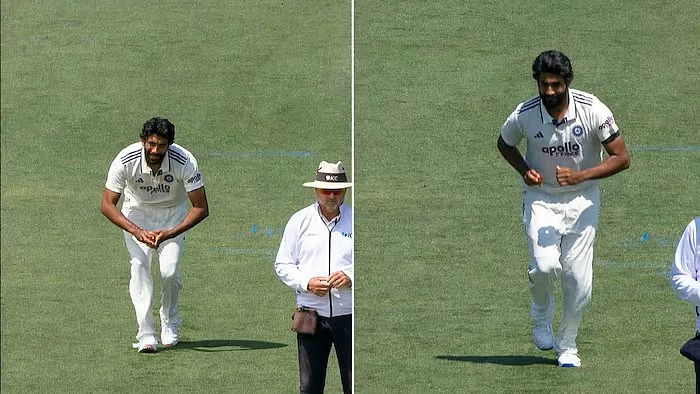
Christchurch, November 28, 2026: Indian fast bowler Jasprit Bumrah experienced an unusually frustrating outing in the second Test against New Zealand at Hagley Oval, finishing the hosts’ first innings without a wicket despite bowling 26 overs.
The Indian pace spearhead returned figures of 0/49, including six maiden overs, as New Zealand posted 356 runs in their first innings on the second day of the match.
Although Bumrah maintained an impressive economy rate of 1.88 runs per over, he could not secure a breakthrough during his extended spell.
The performance equalled his longest wicketless bowling effort in a Test innings, a mark he had previously recorded twice in 2021.
While Bumrah struggled to take wickets, fellow Indian fast bowler Akash Deep delivered an outstanding performance, claiming five wickets for 99 runs to lead India’s bowling effort.
The contrasting performances became one of the biggest talking points of the second Test, which will decide the two-match series after the opening encounter in Wellington ended in a draw.
Bumrah Bowls 26 Overs Without Taking a Wicket
Bumrah bowled a total of 26 overs across New Zealand’s first innings.
His final figures were:
- Overs: 26
- Maiden overs: 6
- Runs conceded: 49
- Wickets: 0
- Economy rate: 1.88
Despite his inability to dismiss a batter, Bumrah remained one of India’s most economical bowlers.
He consistently restricted scoring opportunities and forced New Zealand’s batters to exercise patience.
However, wickets proved elusive throughout his spell.
The innings marked a rare occasion when one of India’s most reliable fast bowlers completed such a substantial workload without taking a wicket.
Bumrah Equals His Longest Wicketless Test Spell
The Christchurch performance equalled Bumrah’s previous record for the most overs bowled without taking a wicket in a single Test innings.
He had bowled 26 wicketless overs on two earlier occasions.
The first came against New Zealand in the 2021 World Test Championship final in Southampton.
The second occurred against England at Lord’s during the same year.
His Christchurch spell therefore matched the unwanted mark rather than setting a new one.
Bumrah’s Longest Wicketless Test Innings
| Opponent | Venue and year | Overs | Bowling figures |
|---|---|---|---|
| New Zealand | Southampton, 2021 | 26 | 0/57 |
| England | Lord’s, 2021 | 26 | 0/79 |
| New Zealand | Christchurch, 2026 | 26 | 0/49 |
Interestingly, the Christchurch spell was the most economical of these three performances.
It demonstrated that Bumrah could still control the scoring rate even without taking wickets.
First Wicketless Overseas Test First Innings in Five Years
The performance was also significant because Bumrah had not gone wicketless in the first innings of an overseas Test since August 2021.
That previous instance occurred against England at Lord’s.
According to India Today, Christchurch represented only the fourth occasion in 38 overseas or neutral-venue Test first innings when Bumrah failed to take a wicket.
In each of those innings, he had bowled more than 20 overs.
The rarity of the statistic reflects his established record as a leading Test fast bowler.
However, the wicketless performance must also be assessed alongside the pressure he created by restricting New Zealand’s scoring.
Bumrah’s Wicketless Run Extends to 45.4 Overs
Bumrah’s difficulty taking wickets extended beyond the Christchurch innings.
According to match statistics reported on November 28, he had bowled 45 overs and four balls without a wicket across his recent spells.
The sequence began after he dismissed New Zealand captain Tom Latham in the second innings of the Wellington Test.
He subsequently bowled 19 overs and four balls without another dismissal in that match.
The 26 wicketless overs in Christchurch extended the sequence.
Although the statistic is unusual for Bumrah, it does not mean he was ineffective throughout the period.
His ability to restrict runs remained valuable to India’s bowling attack.
Tom Latham Survives Early LBW Decision
Bumrah came close to taking a wicket early in New Zealand’s innings.
During his opening over, he appeared to have dismissed captain Tom Latham leg before wicket.
The on-field umpire gave Latham out.
However, the New Zealand batter reviewed the decision, and the television review overturned the dismissal.
The unsuccessful appeal denied Bumrah an early breakthrough.
Latham later contributed 59 runs to New Zealand’s first-innings total.
The incident illustrated how narrowly Bumrah missed taking a wicket despite creating opportunities.
Bumrah Experiments With Bowling Action
Another notable feature of Bumrah’s performance was a visible adjustment to his bowling approach.
During the opening day, observers noticed changes in his run-up and arm position.
Bumrah appeared to separate his hands earlier than usual while approaching the bowling crease.
His familiar delivery stride and release remained largely recognisable.
The Indian Express reported that his bowling speed also dropped into the upper 120 kilometres-per-hour range during parts of the spell.
These observations prompted discussion about whether Bumrah was experimenting with his rhythm and technique.
However, the available reporting does not establish why he made the adjustments.
There has been no verified announcement connecting the changes to a new injury.
New Zealand Continue to Challenge India’s Leading Pacer
New Zealand have historically been among Bumrah’s more difficult opponents in Test cricket.
The Indian Express reported that his bowling average against New Zealand stood above 42, compared with averages below 23 against India’s other Test opponents.
His record in New Zealand has also been less dominant than in several other countries.
These figures highlight the challenges he has faced against New Zealand’s batting line-up.
However, averages can change substantially over a limited number of matches.
Bumrah has also delivered important performances against the Black Caps, including four wickets in the first innings of the preceding Wellington Test.
Akash Deep Takes Five Wickets to Lead India’s Attack
While Bumrah went wicketless, Akash Deep emerged as India’s most successful bowler.
The fast bowler claimed five wickets for 99 runs from 31.3 overs.
His performance helped India prevent New Zealand from building a larger first-innings total.
Akash Deep dismissed captain Tom Latham, Rachin Ravindra, Nathan Smith, Kyle Jamieson and Matt Henry.
He completed his five-wicket haul by removing Henry, who scored 19.
The performance demonstrated India’s ability to take wickets through other members of its pace attack when Bumrah was unable to provide breakthroughs.
Akash Deep Joins Select Group of Indian Pacers
Akash Deep’s five-wicket haul placed him among a small group of Indian fast bowlers to achieve the feat in a Test innings in New Zealand.
India Today identified Zaheer Khan, Ishant Sharma, Madan Lal and Javagal Srinath among the Indian pacers who had previously recorded five-wicket hauls in the country.
Akash Deep’s performance was particularly important because New Zealand had reached a strong position during the first innings.
His wickets helped India regain control during important stages of the match.
It was also his second five-wicket haul in Test cricket.
Tom Blundell Scores 89 for New Zealand
New Zealand wicketkeeper-batter Tom Blundell played an important innings for the hosts.
He scored 89 runs from 211 deliveries, helping New Zealand recover after losing wickets.
Blundell’s patient batting enabled the team to move beyond 300.
He shared important partnerships with the lower order and frustrated India’s bowlers.
His resistance ended when Gurnoor Brar dismissed him.
The innings was one of the main reasons New Zealand managed to reach 356 despite losing wickets at regular intervals.
New Zealand All Out for 356 on Day Two
New Zealand resumed the second day at 246/5.
The hosts continued batting through the morning session before being dismissed for 356 in 116.3 overs.
Tom Blundell top-scored with 89, while captain Tom Latham contributed 59.
Glenn Phillips made 36, and Devon Conway and Daryl Mitchell scored 31 each.
India’s bowlers shared the wickets, with Akash Deep taking five.
Gurnoor Brar and Anshul Kamboj claimed two wickets apiece, while Washington Sundar took one.
Bumrah was the only Indian bowler used in the innings who did not secure a wicket.
India’s Bowling Scorecard
| Bowler | Overs | Runs | Wickets |
|---|---|---|---|
| Akash Deep | 31.3 | 99 | 5 |
| Anshul Kamboj | 22 | 79 | 2 |
| Gurnoor Brar | 28 | 78 | 2 |
| Washington Sundar | 9 | 36 | 1 |
| Jasprit Bumrah | 26 | 49 | 0 |
The scorecard shows that Bumrah had the lowest economy rate among India’s regular bowlers despite finishing without a wicket.
Akash Deep supplied the breakthroughs, while the other bowlers contributed to restricting New Zealand’s total.
Why Bumrah’s Performance Has Attracted Attention
Bumrah is widely regarded as one of India’s most important fast bowlers across formats.
His distinctive action, accuracy and ability to deliver breakthroughs have made him a central figure in India’s Test attack.
Long wicketless spells are therefore unusual compared with the expectations surrounding his performances.
The Christchurch innings attracted particular attention because it matched his longest wicketless Test effort.
However, wicket-taking is only one measure of a bowler’s contribution.
Economical bowling can build pressure, restrict partnerships and help other bowlers take wickets.
In this match, Bumrah conceded fewer than two runs per over.
That control remained valuable even though the wickets did not come.
India and New Zealand Compete for Series Victory
The Christchurch Test is the second and final match of the series.
The opening Test in Wellington ended in a draw after India and New Zealand produced strong batting performances.
India entered the second match seeking a series victory and important progress in the World Test Championship.
New Zealand also had an opportunity to win the series at home.
With the series tied, the Christchurch result carries considerable importance.
Both teams have been seeking an advantage through their pace attacks and batting performances.
New Zealand’s first-innings total of 356 has given India a challenging target to respond to.
What Does This Mean for Bumrah’s Test Career?
The wicketless spell represents an unusual statistical setback rather than a complete assessment of Bumrah’s ability.
The Indian fast bowler has previously recovered from difficult innings to produce match-winning spells.
During the 2021 Lord’s Test against England, he went wicketless in the first innings but claimed three wickets for 33 runs in the second innings.
That performance contributed to India’s 151-run victory.
The example demonstrates how a bowler’s impact can change significantly between innings.
Bumrah’s performance in New Zealand’s second innings will therefore be important when evaluating his overall contribution to the Christchurch Test.
What Happens Next in the Christchurch Test?
India must respond to New Zealand’s first-innings total of 356.
The visitors will look to their batting line-up to reduce the deficit and establish a competitive position.
New Zealand’s bowlers will aim to exploit the Hagley Oval conditions.
Bumrah, meanwhile, will have another opportunity to influence the match when New Zealand bats again.
His ability to regain wickets could prove important as the Test progresses.
The series result remains undecided.
Jasprit Bumrah Wicketless Spell: Key Highlights
Jasprit Bumrah went wicketless in New Zealand’s first innings of the Christchurch Test on November 28, 2026.
He bowled 26 overs, conceded 49 runs and delivered six maidens.
His economy rate was 1.88 runs per over.
The performance equalled his longest wicketless Test innings.
He had previously bowled 26 wicketless overs against New Zealand at Southampton and England at Lord’s in 2021.
It was his first wicketless opening innings in an overseas Test since August 2021.
Bumrah also extended his ongoing wicketless sequence to 45 overs and four balls.
Akash Deep took five wickets for 99 runs.
New Zealand were dismissed for 356 in 116.3 overs.
The match is the second and final Test of the series after the opening game ended in a draw.
Bumrah’s 26 wicketless overs equalled an unwanted personal record, but his economical bowling remained an important part of India’s attack.
Source – The Indian Express, India Today, Reuters, Press Trust of India, The Times of India
Supreme News Network