

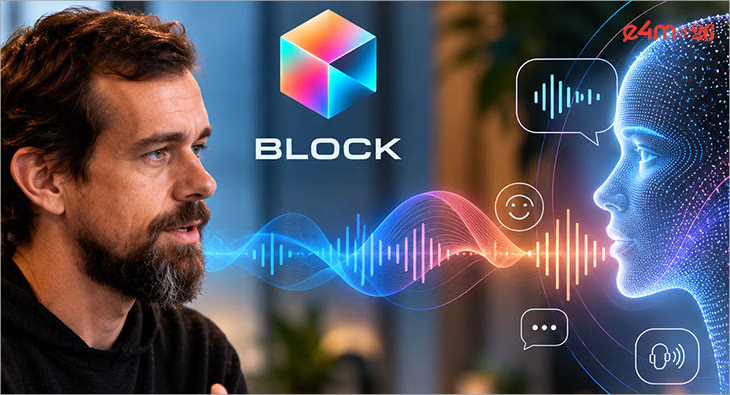
New Delhi, October 24, 2026: Jack Dorsey-led financial technology company Block has unveiled Dessa, a new artificial intelligence voice model designed to hold real-time conversations by listening and speaking at the same time, without first converting speech into text.
Block describes Dessa as a full-duplex speech-to-speech model trained entirely on recordings of human conversation, with no text data or pretrained language models used in its core training process.
Dessa Learns Directly From Human Speech
Unlike many modern voice assistants, Dessa does not rely on the conventional pipeline of speech recognition, text-based language processing and text-to-speech generation.
Instead, Block says the model processes incoming and outgoing audio directly, allowing it to learn language and conversational behaviour from sound itself.
Can Listen and Speak at the Same Time
One of Dessa’s most notable features is full-duplex communication.
This means the model can continue listening while it is speaking, allowing for interruptions, acknowledgements and overlapping conversation that more closely resemble human interactions.
Model Responds to Emotion and Tone
Block says Dessa can recognise and express conversational cues such as laughter, sarcasm, frustration, hesitation and sadness.
Because it works directly with audio rather than stripping speech down to text, the company argues that it can preserve more information about tone, rhythm and emotion.
Dorsey Calls Voice the Natural Interface for AI
Dorsey said voice is the most natural way for humans to interact with intelligent systems.
Block has positioned Dessa as an attempt to make AI conversations feel more spontaneous, emotionally aware and less mechanical than traditional voice assistants.
Trained Without Text or Pretrained Models
According to Block, Dessa was trained from scratch using only human conversations.
The company says the system did not use written text or pretrained models as a foundation, making the project unusual in an AI industry dominated by large language models trained primarily on enormous text datasets.
AI Can Decide When to Speak
Dessa is designed not only to determine what to say but also when to say it.
Block says the system can decide when to interrupt, when to wait, how loudly to speak and how to adjust its delivery depending on the conversation.
Demonstrations Show Laughter and Natural Pauses
Block has released demonstration recordings in which Dessa laughs during conversation, changes speaking volume when requested and reacts emotionally to what users say.
The company says the recordings are live conversations without hidden human steering, although they remain company-selected demonstrations rather than independent tests.
Some Conversations Still Appear Awkward
Dessa is not presented as flawless.
In one demonstration highlighted by technology reporters, the model incorrectly identified a speaker as someone named “Ronaldo,” while another conversation wandered unexpectedly between unrelated film topics.
Such examples indicate that the model can still make mistakes or behave unpredictably despite its more natural voice interaction.
Can Run Locally on a MacBook Pro
Block says Dessa is compact enough to run locally on a MacBook Pro with an M4 Max chip or better.
The company also claims the model can operate faster than real time, which could potentially reduce dependence on cloud infrastructure for future voice-AI applications.
Training Used a Single Nvidia System
According to Block, Dessa was trained using a single NVIDIA GB200 NVL72 system.
The company says the project required substantially fewer words than conventional large language models because speech contains richer acoustic information than plain text.
Potential Uses in Customer Service
If the technology proves reliable, full-duplex speech models could have significant implications for customer service, virtual assistants and call-centre automation.
A system capable of recognising frustration, hesitation or excitement could potentially respond more naturally than traditional scripted or text-based voice systems.
Could Change Voice Commerce and AI Agents
The same technology could eventually be used in voice commerce, personal assistants and autonomous AI agents.
For businesses, the ability to understand not just what a customer says but how they say it could make automated interactions more context-aware.
However, these enterprise applications remain theoretical because Dessa has not yet been released as a commercial platform.
Safety Researchers to Get Early Access
Block says a small group of AI safety researchers will receive early access to the system.
The company wants external researchers to identify risks that its own team may not have anticipated, particularly as voice AI becomes more emotionally expressive and autonomous.
Public Access Remains Limited
Dessa is currently a research preview rather than a generally available AI service.
Block has opened a waitlist, but it has not announced commercial pricing, an API, downloadable model weights or a full public release date.
Important Technical Details Still Undisclosed
Block has not publicly revealed Dessa’s parameter count, complete training dataset or standardised benchmark results.
That means it is still difficult to compare the model objectively with competing voice-AI systems.
For now, most evidence of its capabilities comes from demonstrations released by the company itself.
Dessa Signals New Direction for Voice AI
Dessa represents a broader shift toward AI systems that process speech as a complete form of communication rather than treating it simply as text wrapped in audio.
If speech-native systems can prove reliable, safe and scalable, they could eventually reshape how people interact with AI assistants, customer-support systems and autonomous agents.
For now, however, Dessa remains an experimental research project whose real-world capabilities still need broader testing.
Source: Block, The Economic Times, The Indian Express, India Today, The Verge
Supreme News Network