
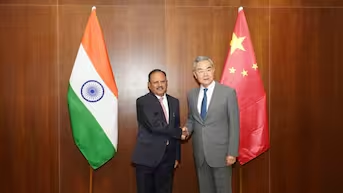
Beijing: National Security Adviser Ajit Doval is in Beijing on Tuesday, August 25, 2026, for the 25th round of Special Representatives’ Talks on the India-China boundary question with Chinese Foreign Minister and Special Representative Wang Yi, as New Delhi and Beijing seek to preserve peace along the Line of Actual Control and build on the gradual improvement in bilateral relations.
China’s Foreign Ministry confirmed that Doval and Wang would co-chair the 25th round of talks in Beijing on August 25. India’s Ministry of External Affairs had earlier said Doval was visiting China at Wang Yi’s invitation.
The talks are expected to focus on border stability, de-escalation, boundary management and maintaining peace and tranquillity along the LAC.
Doval Meets Chinese Vice President Han Zheng
Ahead of the boundary discussions, Doval met Chinese Vice President Han Zheng in Beijing on Tuesday.
According to the Indian Embassy’s account cited in reports, the two discussed ways to strengthen peace and tranquillity in India-China border areas and further improve bilateral relations across economic, political and multilateral platforms.
China’s Foreign Ministry also issued an official account of the meeting.
Han said China and India should approach their relationship from a strategic and long-term perspective, increase strategic trust, explore opportunities for cooperation, manage differences appropriately and promote stable development of bilateral ties.
Doval, according to the Chinese readout, said India was willing to deepen mutually beneficial cooperation, appropriately handle the boundary question and promote further progress in bilateral relations.
25th Round of Special Representatives’ Talks
Doval and Wang Yi are the designated Special Representatives of India and China for negotiations over their long-running boundary dispute.
The Special Representatives mechanism was established in 2003 to explore a political framework for resolving the boundary question.
Tuesday’s meeting is the 25th round under that mechanism and comes as both sides attempt to move from managing immediate military tensions towards developing more stable long-term arrangements along the border.
At the time of publication, the two governments had not yet released a formal outcome statement from the 25th round, meaning any specific agreements reached during the talks remain to be officially confirmed.
LAC Peace Remains Central to India-China Relations
For India, maintaining peace along the border remains closely linked to the wider bilateral relationship.
Relations between New Delhi and Beijing deteriorated sharply following the 2020 military confrontation in eastern Ladakh, particularly the deadly Galwan Valley clash.
Years of diplomatic and military negotiations followed as both countries deployed large numbers of troops, weapons and infrastructure near sensitive areas along the LAC.
Since late 2024, however, India and China have taken several steps aimed at reducing tensions and gradually restoring diplomatic engagement.
The latest talks are expected to explore how that progress can be consolidated while preventing new confrontations.
Preparatory Talks Held Earlier This Month
The high-level Doval-Wang meeting follows the 36th meeting of the Working Mechanism for Consultation and Coordination on India-China Border Affairs (WMCC), held in New Delhi on August 6.
Officials from both countries discussed:
- Boundary delimitation
- Border management
- Development of institutional mechanisms
- Cross-border exchanges and cooperation
- Continued military and diplomatic communication
Both sides agreed to continue maintaining communication and jointly safeguard peace and tranquillity in border areas.
That meeting also served as preparation for Tuesday’s Special Representatives’ dialogue.
Previous SR Talks Produced New Border Mechanisms
The 24th round of Special Representatives’ talks took place in New Delhi in August 2025.
During that meeting, India and China agreed on measures aimed at improving border management, including the creation of an Expert Group under the WMCC to explore possible progress on boundary delimitation in appropriate sectors.
The two countries also discussed establishing additional mechanisms for managing different sectors of the border and continuing de-escalation through military and diplomatic channels.
Tuesday’s meeting provides an opportunity to review progress made since those commitments.
Talks Come Ahead of Expected Xi Jinping India Visit
The timing of the boundary dialogue is particularly significant because Chinese President Xi Jinping is expected to visit New Delhi in September for the BRICS Summit, according to Reuters.
The summit is scheduled for September 12-13, 2026, and would mark Xi’s first visit to India in seven years if the trip proceeds as expected. Final travel arrangements were still being worked out at the time of the report.
Any progress in the Doval-Wang discussions could therefore create a more favourable environment for high-level engagement between Prime Minister Narendra Modi and President Xi Jinping.
Arunachal Pradesh and Border Differences Remain
Despite the diplomatic thaw, significant differences between India and China remain unresolved.
The two countries continue to disagree over the alignment of their Himalayan boundary, while China’s claims regarding Arunachal Pradesh remain firmly rejected by India.
India has repeatedly maintained that Arunachal Pradesh is an integral and inalienable part of the country.
New Delhi has also stressed that peace and tranquillity along the LAC are essential for broader India-China relations to develop normally.
From Crisis Management to Long-Term Stability
The 25th round of Special Representatives’ talks comes at an important stage in the India-China relationship.
After several years dominated by military tensions and disengagement negotiations, both sides are increasingly discussing broader questions of boundary management, economic cooperation and political engagement.
However, progress in other areas will remain heavily dependent on stability at the border.
Tuesday’s meeting between Ajit Doval and Wang Yi will therefore be closely watched for signs that India and China can translate the recent improvement in relations into durable arrangements along the LAC.
Any formal agreements or new mechanisms announced following the talks could shape the next phase of India-China relations ahead of the expected Modi-Xi engagement at the BRICS Summit.
Source – Ministry of External Affairs (MEA) / Ministry of Foreign Affairs of China
Supreme News Network