

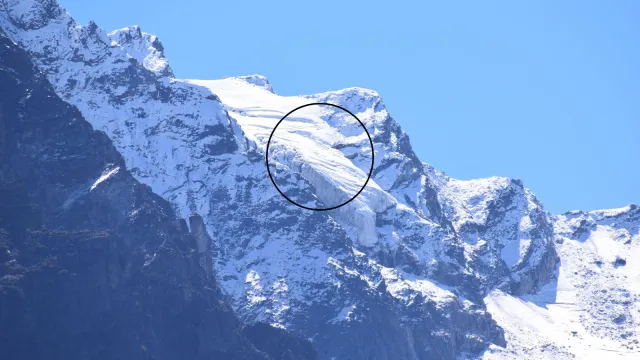
New Delhi, October 30, 2026: A new modelling study has warned that the collapse of hanging glaciers above Badrinath in Uttarakhand could pose a serious threat to buildings, roads and other infrastructure in the Himalayan pilgrimage town. The research assessed three hanging glaciers located above Badrinath and modelled the potential impact of ice avalanches if unstable sections were to detach.
Three Hanging Glaciers Assessed
The peer-reviewed study, published in the journal Landslides on October 28, examined three glaciers situated at elevations ranging from around 4,700 metres to 5,465 metres.
Researchers from the Indian Institute of Science, University of Cambridge and DRDO used satellite imagery, elevation data and avalanche simulations to estimate possible collapse scenarios.
Worst-Case Scenario Could Damage Nearly 400 Buildings
According to the study’s worst-case simulation, the collapse of the most hazardous glacier could affect around 398 buildings, approximately 2.66 kilometres of roads, two bridges, a helipad and a parking area in Badrinath.
The glacier identified as posing the greatest potential damage contains an estimated 5.32 million cubic metres of ice and lies on a slope of about 34.6 degrees.
Avalanche Could Reach High Speeds
Researchers modelled a possible avalanche reaching a peak velocity of about 78.5 metres per second, with flow heights reaching as much as 73.5 metres in parts of the simulated path.
However, the study stressed that these figures represent modelled scenarios rather than a prediction that a collapse is imminent.
Badrinath Temple Not Expected to Take Direct Hit
The simulations indicated that the Badrinath temple itself is not expected to be directly struck by the ice avalanche.
Researchers cautioned, however, that rock, debris and other material mobilised during such an event could still create secondary risks around the shrine and surrounding settlement.
Researchers Call for Buffer Zones
The study recommends identifying avalanche-impact and buffer zones around vulnerable areas and considering restrictions on new construction in locations that fall within high-risk zones.
Researchers said detailed hazard mapping and monitoring would be important as development and visitor numbers increase in high-altitude Himalayan settlements.
Wider Himalayan Risk Already Under Study
A separate 2026 assessment identified 219 hanging glaciers in the Alaknanda basin, with about 30% of the hanging ice mass concentrated in the Upper Alaknanda region around Badrinath and Mana.
That research also found that future avalanche runouts could affect settlements, roads and pilgrimage infrastructure across the region.
Study Highlights Need for Preparedness
Researchers acknowledged uncertainties in their modelling because glacier thickness and release volumes were derived partly from remotely sensed and modelled data rather than direct field measurements.
The findings are therefore intended primarily to support hazard assessment, monitoring and disaster preparedness, rather than to forecast when or whether a specific glacier will collapse.
Source: The Indian Express, npj Natural Hazards, Times of India
Supreme News Network


