
New Delhi, October 23, 2026: The Union government is considering a new set of parameters to distinguish bona fide digital journalists from social media influencers, as authorities grapple with the growing overlap between professional journalism, independent digital reporting and creator-led coverage of political protests and public events.
The criteria under discussion could include factors such as accreditation, source of income, social media following and the nature of a person’s work, according to The Indian Express. The proposal is still at a preliminary stage and no final policy has yet been announced.
Government Examines New Identification Criteria
Officials are considering whether clearer benchmarks are needed to identify who should qualify as a journalist in situations where press access, police facilitation or other media-related privileges are involved.
Possible parameters being examined include whether a person earns primarily from journalism, holds formal accreditation and has an established body of journalistic work.
Social Media Following Could Be Considered
The size and nature of a person’s social media following may also become one of the factors considered under the proposed framework.
However, officials are reportedly aware that follower counts alone cannot determine whether someone is engaged in legitimate journalism, particularly as many independent journalists now operate primarily through digital platforms.
Protest Coverage Triggered Fresh Concerns
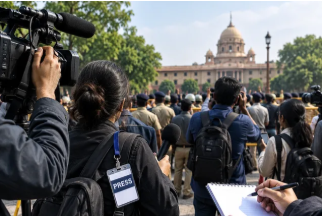
Government concerns intensified during recent protests, where influencers, independent digital creators and traditional journalists were all seen recording demonstrations, police action and political mobilisation.
According to The Indian Express, the issue gained particular attention after protests since July, when several creators produced reels and videos directly from protest sites.
Centre Earlier Raised Issue in Supreme Court
The difficulty of distinguishing between journalists and creators had already surfaced before the Supreme Court.
Earlier this month, Solicitor General Tushar Mehta told the court that authorities often struggle to identify who is a genuine independent journalist and who is simply a “reel maker” while covering protests.
Press Access and Police Treatment Under Scrutiny
The issue has practical implications during protests, elections and other sensitive events.
Accredited journalists are often allowed closer access to restricted areas, while police may treat journalists differently from ordinary protesters or bystanders.
Authorities are now considering whether clearer standards are needed to prevent misuse of press privileges while ensuring legitimate reporters can continue working.
Independent Journalists Could Be Affected
Any new framework could have major implications for independent journalists who do not work for traditional media organisations.
Many digital reporters operate through YouTube, Instagram, X and other platforms and may not hold government accreditation despite regularly producing news and public-affairs content.
This means the government will have to balance verification and accountability with the rights of independent media workers.
Concerns Over Misinformation and Ethical Standards
Officials are also reportedly worried about misinformation, selective editing and content created primarily for virality rather than factual reporting.
The government believes clearer distinctions could help address situations where influencers present themselves as journalists while producing content that may not follow recognised editorial or verification standards.
Freedom of Expression Remains Key Issue
Any formal distinction between journalists and influencers is likely to raise questions about freedom of expression and press freedom.
Independent creators and digital journalists may argue that journalism should not depend entirely on government accreditation or employment with established media organisations.
Legal and media experts are therefore expected to closely watch how any future rules are drafted and implemented.
No Final Rules Announced Yet
The government has not yet announced a final definition or regulatory framework.
The discussion remains at the stage of identifying possible parameters, and any formal policy would likely require further consultation and legal scrutiny.
Digital Media Landscape Forces Policy Rethink
The debate reflects the rapid transformation of India’s news ecosystem, where smartphones, social platforms and independent creators increasingly compete with traditional newspapers and television channels for audiences.
As those boundaries continue to blur, the government is now exploring ways to determine who should receive official recognition and press-related privileges without undermining legitimate digital journalism.
Source: The Indian Express
Supreme News Network