

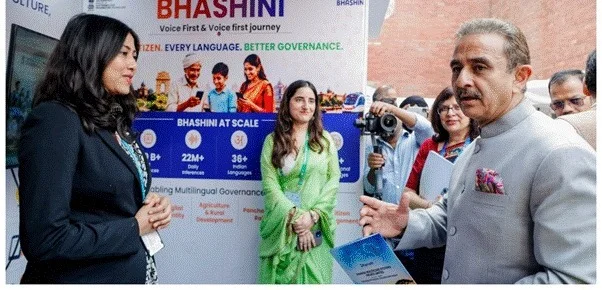
New Delhi, November 19, 2026: The Digital India BHASHINI Division (DIBD), under the Ministry of Electronics and Information Technology (MeitY), showcased its voice-first artificial intelligence and multilingual language technologies at Dakshin Day 2026 in New Delhi.
The two-day policy dialogue, held on November 17 and 18 at the India Habitat Centre, brought together policymakers, diplomats, technology experts and representatives from India, Africa and other partner countries.
According to an official government announcement issued on November 19, BHASHINI demonstrated how artificial intelligence can help overcome language barriers and make digital services more accessible.
BHASHINI Demonstrates Multilingual AI Capabilities
BHASHINI participated in the event through an exhibition stall featuring live demonstrations of its Language AI ecosystem.
The technologies showcased included multilingual translation, automatic speech recognition, speech synthesis, transcription, transliteration and voice-enabled interactions.
These capabilities allow digital platforms to process information across different languages and support communication between users who speak different languages.
The demonstrations highlighted potential applications in public administration, healthcare, education and other sectors.
Voice-First AI to Improve Digital Accessibility
A major focus of BHASHINI’s participation was voice-first artificial intelligence.
Voice-first technology allows people to interact with digital systems using spoken language rather than relying entirely on typing or navigating text-based interfaces.
Such systems can be particularly helpful for people who are more comfortable speaking their regional language.
By combining speech recognition with multilingual translation and speech synthesis, BHASHINI aims to make digital information and services easier to access.
The technology could also assist citizens who face literacy-related barriers when using online services.
Supports 36 Indian Text Languages and 23 Voice Languages
According to the Ministry of Electronics and Information Technology, BHASHINI currently supports 36 Indian text languages, 23 Indian voice languages and 35 international languages.
Its ecosystem provides tools that government departments, developers, researchers and other organisations can integrate into digital applications.
The platform is being developed as part of India’s Language-First Digital Public Infrastructure.
This approach aims to make multilingual technology available as a shared digital resource rather than requiring every organisation to build its own language-processing systems.
Applications in Healthcare, Education and Banking
BHASHINI highlighted how multilingual AI could improve accessibility across several citizen-facing sectors.
In healthcare, language technologies can support communication and help people understand information in their preferred language.
In education, multilingual tools can assist students and educators in accessing learning resources across language barriers.
Banking and financial institutions can use language-enabled interfaces to make digital information easier for customers to understand.
The demonstrations also covered potential applications in legal services, government communication and public service delivery.
These were examples of technology use cases, not announcements of new nationwide deployments in each sector.
Minister Kirti Vardhan Singh Visits BHASHINI Stall
Minister of State for External Affairs Kirti Vardhan Singh visited BHASHINI’s exhibition stall during the event.
He interacted with the BHASHINI team and witnessed demonstrations of the platform’s multilingual artificial intelligence capabilities.
According to the official statement, the minister appreciated the usefulness of the technology and referred to his experience using the platform.
The visit highlighted the relevance of multilingual digital tools in government communication and international cooperation.
Dakshin 2026 Focuses on South-South Cooperation
Dakshin Day 2026 was organised by the Research and Information System for Developing Countries (RIS) in collaboration with the Ministry of External Affairs.
The event brought together representatives from India, Africa and other partner countries to discuss emerging areas of South-South cooperation.
South-South cooperation involves collaboration among developing countries in areas such as technology, research, capacity building and economic development.
BHASHINI’s participation demonstrated how language technology could contribute to knowledge-sharing and digital cooperation across countries.
Multilingual AI Could Strengthen Digital Governance
Government digital platforms often serve people who speak different regional languages.
Language barriers can make it difficult for citizens to understand information, complete procedures or access online services.
BHASHINI’s multilingual infrastructure aims to address these challenges by enabling developers and public institutions to incorporate translation and voice-based interactions into their systems.
The initiative also supports India’s broader efforts to make digital public infrastructure more inclusive.
India’s Language AI Ecosystem Expands
The Digital India BHASHINI Division operates under the Digital India Corporation and the Ministry of Electronics and Information Technology.
Its mission is to build a national ecosystem for artificial intelligence-powered multilingual digital inclusion.
The platform brings together language-processing technologies that can be used in government services, research and public-facing applications.
The development of these capabilities is particularly relevant in India, where a large number of languages are spoken across different regions.
BHASHINI Highlights Future of Inclusive AI
BHASHINI’s participation at Dakshin Day 2026 highlighted the potential of multilingual artificial intelligence to improve communication and digital accessibility.
Through live demonstrations, the initiative presented practical applications of speech recognition, translation and voice-enabled technology.
The event also provided an opportunity for dialogue with international representatives about the role of language AI in public service delivery.
As digital services continue to expand, technologies that support regional languages could play an increasingly important role in making online platforms accessible to more people.
Source – Press Information Bureau (PIB), Ministry of Electronics and Information Technology (MeitY), Digital India BHASHINI Division, Indian Masterminds
Supreme News Network