
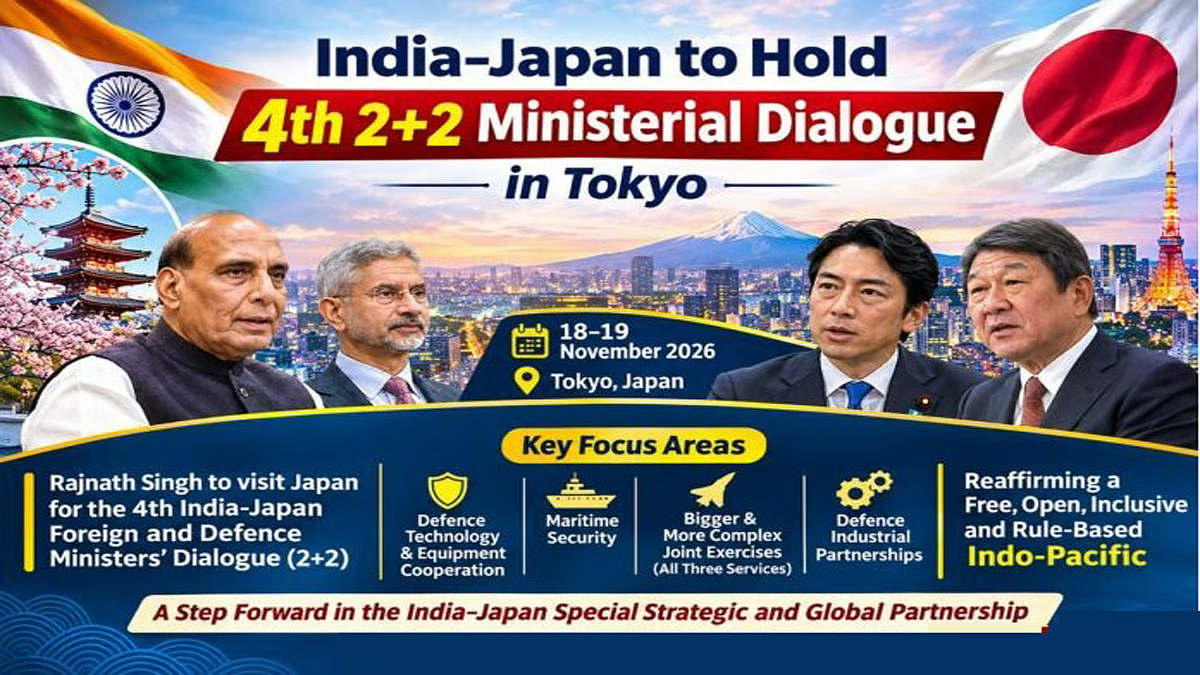
Tokyo, November 19, 2026: India and Japan held their fourth Foreign and Defence Ministers’ Dialogue, commonly known as the 2+2 Ministerial Dialogue, in Tokyo on Thursday, reaffirming their commitment to stronger defence cooperation, maritime security, advanced technology and a free and open Indo-Pacific region.
The high-level meeting brought together India’s External Affairs Minister S. Jaishankar and Defence Minister Rajnath Singh with Japan’s Foreign Minister Toshimitsu Motegi and Defence Minister Shinjiro Koizumi.
According to Japan’s Ministry of Foreign Affairs, the meeting lasted approximately 90 minutes, from 2:40 PM to 4:10 PM local time.
The four ministers issued a joint statement outlining priorities for strengthening the India-Japan Special Strategic and Global Partnership.
India and Japan Hold Fourth 2+2 Ministerial Dialogue
The meeting provided an opportunity for both countries to review developments in bilateral relations and discuss regional and international security challenges.
The ministers acknowledged the growing importance of India-Japan cooperation amid changing geopolitical conditions.
They reaffirmed their support for an international order based on the rule of law, national sovereignty, territorial integrity and peaceful resolution of disputes.
Both countries also agreed to continue regular consultations on security and foreign policy matters.
Defence and Military Cooperation Remains a Priority
Defence cooperation was one of the main subjects discussed during the dialogue.
The ministers reviewed progress in joint military exercises, defence technology cooperation and exchanges between the armed forces.
They welcomed the expansion of bilateral military exercises, including the participation of Japanese fighter aircraft in the Veer Guardian 2026 air exercise in India.
The two sides also agreed to strengthen cooperation through more complex exercises and the integration of unmanned systems.
Japan and India discussed arrangements that could allow the Japan Self-Defense Forces to use firing ranges in India for training.
India and Japan Discuss UNICORN Defence Technology
The ministers reviewed progress on the proposed transfer of the Unified Complex Radio Antenna, known as UNICORN.
The advanced communication system is intended to strengthen defence technology cooperation between the two countries.
According to the joint statement, both sides expressed support for completing the necessary arrangements and advancing India’s Acceptance of Necessity process by February 2027.
They also reaffirmed their interest in cooperation under the framework of “Design with Japan, Make in India.”
The initiative aims to encourage collaboration between Japanese technology providers and India’s defence manufacturing industry.
Maritime Security and Indo-Pacific Stability in Focus
Both countries highlighted the importance of maintaining stability and secure shipping routes across the Indo-Pacific.
The discussions included maritime domain awareness, information sharing, search and rescue operations and humanitarian assistance.
India and Japan welcomed their existing maritime security cooperation arrangements and agreed to work towards practical outcomes involving the Indian Navy and the Japan Maritime Self-Defense Force.
They also discussed cooperation in naval shipbuilding, mine countermeasures and maritime law enforcement.
The ministers reaffirmed their opposition to attempts to change the regional status quo through force or coercion.
Cybersecurity, Artificial Intelligence and Technology Discussed
The dialogue extended beyond traditional defence cooperation to emerging security challenges.
The two countries agreed to strengthen cybersecurity collaboration, including the protection of critical infrastructure and the security of artificial intelligence systems.
Both sides also discussed secure undersea communication cables and the importance of reliable digital connectivity.
India and Japan reaffirmed their commitment to developing trusted and resilient technology infrastructure.
The ministers also identified opportunities for further cooperation in artificial intelligence, space technology and advanced research.
Semiconductor and Critical Mineral Cooperation
Economic security formed another important part of the discussions.
The ministers stressed the need for secure supply chains in strategic industries, including semiconductors, critical minerals, information technology, pharmaceuticals and clean energy.
They discussed the importance of reducing vulnerabilities caused by supply disruptions and excessive dependence on individual suppliers.
The two countries also expressed concern about economic coercion and restrictive trade practices that could affect international supply chains.
The discussions reflected the growing connection between economic stability and national security.
Regional Security and Global Developments Reviewed
The ministers exchanged views on developments in the East China Sea, South China Sea, Korean Peninsula, South Asia, the Middle East and Ukraine.
They also reaffirmed their commitment to counterterrorism cooperation.
Both countries called for coordinated international action against terrorist organisations, terrorist financing and cross-border terrorism.
The ministers additionally reiterated their support for reforms to the United Nations Security Council.
India and Japan expressed mutual support for each other’s aspirations for permanent membership in a reformed Security Council.
Cooperation Through Quad and Regional Partnerships
India and Japan discussed the importance of working with like-minded countries through regional partnerships, including the Quad.
The ministers highlighted opportunities for cooperation in maritime security, emerging technologies, economic resilience and humanitarian assistance.
They also emphasised the importance of strengthening engagement with ASEAN countries.
Both nations agreed that closer regional cooperation could contribute to stability and economic development in the Indo-Pacific.
India-Japan Diplomatic Relations Complete 75 Years in 2027
The ministers discussed preparations to commemorate the 75th anniversary of diplomatic relations between India and Japan in 2027.
Both countries intend to organise cultural and public engagement programmes during the anniversary year.
The celebrations will provide another opportunity to strengthen people-to-people ties, educational exchanges and cultural cooperation.
Next India-Japan 2+2 Dialogue to Be Held in India
At the conclusion of the meeting, both countries agreed to continue their strategic consultations and expand cooperation across defence, security and technology.
The ministers decided that the next 2+2 Ministerial Dialogue would take place in India on a mutually convenient date.
The November 19 meeting highlights the expanding scope of India-Japan relations, with both nations seeking closer cooperation on regional security, economic resilience and technological development.
Source – Ministry of Foreign Affairs of Japan, Ministry of Defence of India, Press Information Bureau (PIB), ANI, The Tribune
Supreme News Network