
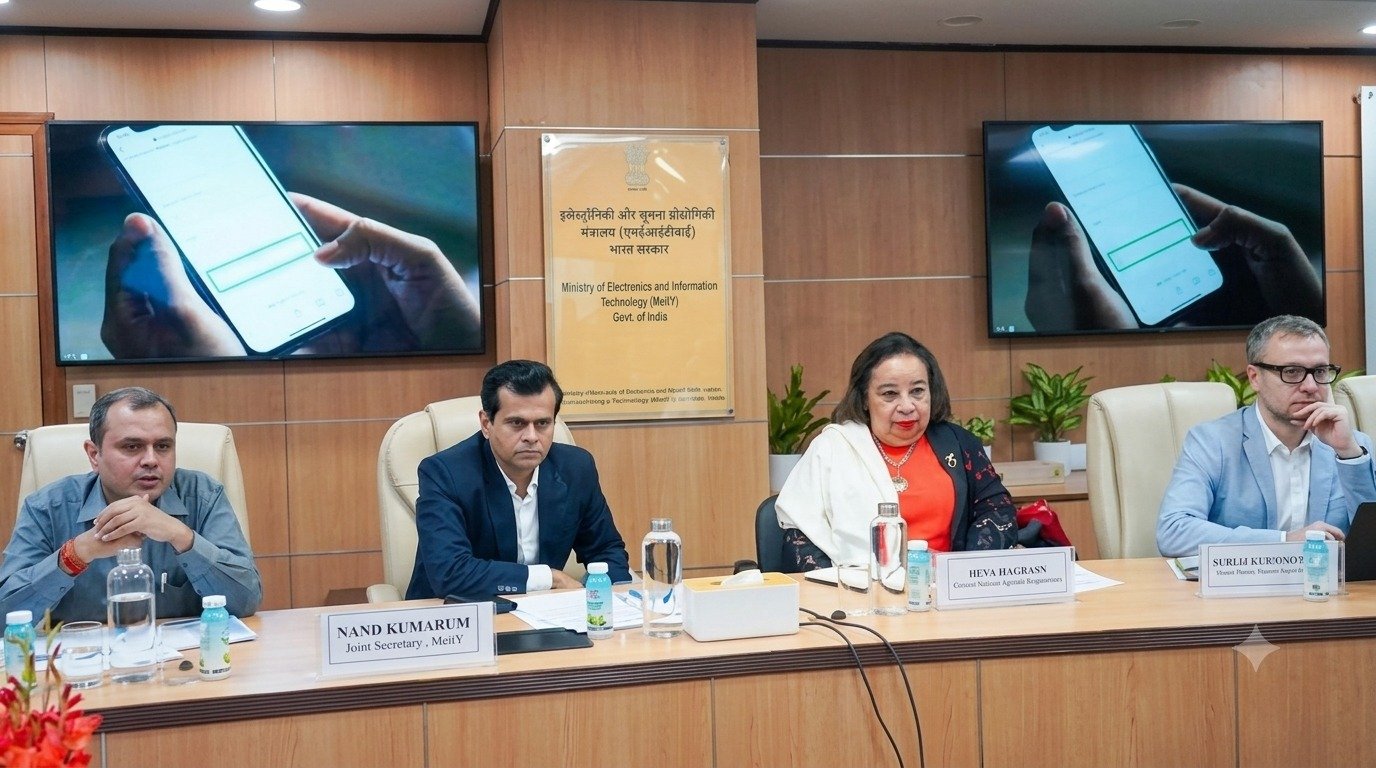
New Delhi, November 20, 2026: The Ministry of Electronics and Information Technology (MeitY) has held discussions with United Nations Special Rapporteur Heba Hagrass on strengthening digital accessibility, artificial intelligence and inclusive government services for persons with disabilities in India.
The meeting, held at MeitY’s CeG Hall in New Delhi, formed part of Hagrass’s official visit to India from November 16 to 25, 2026.
According to an official statement released by the Press Information Bureau on Friday, the discussions focused on accessibility standards, assistive technologies and digital platforms designed to make government services more inclusive.
MeitY Holds High-Level Meeting With UN Representative
Heba Hagrass, the United Nations Special Rapporteur on the Rights of Persons with Disabilities, interacted with senior officials from MeitY and other government organisations.
The session was led by Nand Kumarum, Joint Secretary at MeitY and President and CEO of the National e-Governance Division (NeGD).
Representatives from the Ministry of External Affairs, National Informatics Centre (NIC), Standardisation Testing and Quality Certification (STQC) Directorate and Centre for Development of Advanced Computing (C-DAC) also participated.
The meeting provided an opportunity to discuss India’s progress in making digital infrastructure more accessible to people with different abilities and needs.
India Highlights Digital Accessibility Policies
During the meeting, officials presented India’s legal and policy framework supporting digital inclusion.
India ratified the United Nations Convention on the Rights of Persons with Disabilities in 2007.
The Rights of Persons with Disabilities Act, 2016, includes provisions relating to accessible information and communication technology.
MeitY also highlighted the National Policy on Universal Electronic Accessibility, introduced in 2013.
These measures provide a framework for improving accessibility across digital platforms and public services.
Government Websites Follow Accessibility Standards
MeitY discussed the Guidelines for Indian Government Websites and Apps (GIGW 3.0), which are aligned with the Web Content Accessibility Guidelines (WCAG) 2.1 Level AA.
These guidelines aim to make government websites and applications more usable for people with visual, hearing, physical and cognitive disabilities.
The ministry also highlighted Indian Standard IS 17802, which addresses accessibility requirements for information and communication technology products and services.
The standard was made enforceable through amendments to the Rights of Persons with Disabilities Rules in 2023.
73 Government Ministries and Departments Certified
According to MeitY, 73 government ministries and departments have received STQC certification relating to digital accessibility.
The ministry also presented tools such as SugamyaWeb and SATYA, which help assess the accessibility of websites and applications.
These tools can assist government organisations in identifying accessibility barriers and improving the usability of digital services.
The initiative forms part of efforts to strengthen compliance with established accessibility requirements.
UX4G Supports Over 400 Government Digital Platforms
The meeting also highlighted the User Experience for Government (UX4G) initiative.
According to the official announcement, UX4G has provided user-experience audits and design support to more than 400 government websites and applications.
Its ready-to-use accessibility widget is currently used by more than 1,800 websites.
The initiative aims to improve the design and accessibility of government digital platforms.
By offering reusable design tools, UX4G helps government organisations incorporate accessibility features into their services.
BHASHINI and UMANG Highlight Multilingual Digital Inclusion
MeitY showcased several digital platforms designed to improve access to government services.
BHASHINI, India’s AI-powered language technology initiative, supports multilingual digital interactions.
The platform aims to reduce language barriers through translation and speech-based technologies.
Officials also highlighted UMANG, which provides citizen services in 23 languages.
Multilingual access can make digital services easier to use for people who prefer communicating in regional languages.
Namaste Bharat AI Offers Voice-Based Citizen Assistance
The ministry discussed Namaste Bharat, an artificial intelligence-powered citizen guide.
The platform uses voice-based and multilingual capabilities to help people interact with digital information and services.
Voice-enabled systems can reduce dependence on traditional text-based interfaces.
Such technologies may improve accessibility for people who face difficulties navigating conventional websites or applications.
The discussion highlighted the potential of artificial intelligence to support more inclusive public service delivery.
Divyang Sarthi Uses Virtual Reality for Learning
Another initiative presented during the meeting was Divyang Sarthi.
The platform provides virtual reality-based learning content designed for persons with intellectual disabilities.
Virtual reality technology can create interactive learning environments that support different educational and developmental needs.
The initiative demonstrates how emerging technologies can contribute to accessibility beyond conventional website design.
MeitY Reaffirms Commitment to Accessible Technology
During the interaction, MeitY reiterated its commitment to regularly updating accessibility guidelines in line with international standards.
The ministry also emphasised improving certification processes, strengthening compliance and building the capacity of government officials and technology developers.
Officials discussed the importance of sharing India’s experience with accessible digital infrastructure.
The government intends to continue developing assistive digital solutions that improve inclusion.
Digital Accessibility Remains Central to Inclusive Development
As government services increasingly move online, ensuring that digital platforms are accessible has become an important policy priority.
Persons with disabilities may encounter barriers when websites, applications and digital services are not designed with accessibility requirements in mind.
Technologies such as screen-reader-compatible interfaces, accessible navigation, multilingual communication and voice-based assistance can help address some of these challenges.
The discussions with the UN Special Rapporteur highlighted the need to consider accessibility during the design and development of public digital systems.
India Seeks to Strengthen Inclusive Digital Public Services
The meeting reflects India’s ongoing efforts to improve access to government technology and digital services.
By combining accessibility standards, artificial intelligence, multilingual platforms and assistive technologies, MeitY aims to make digital public infrastructure more inclusive.
The engagement also provided an opportunity for dialogue with the United Nations on disability rights and technology accessibility.
While no new agreement or joint programme was announced, the ministry reaffirmed its commitment to strengthening accessibility standards and developing inclusive digital solutions.
Source – Press Information Bureau (PIB), Ministry of Electronics and Information Technology (MeitY), DD India
Supreme News Network