
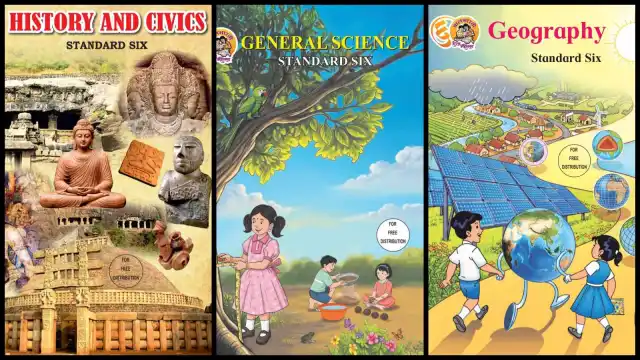
Mumbai, October 28, 2026: Maharashtra’s revised Class 6 textbooks have introduced major changes across history, geography and science, adding references to ancient Indian scholars, Vedic texts and modern Indian achievements while removing or shortening some older passages on caste inequality, priestly privilege and foreign invasions.
Bhaskaracharya Added to Gravity Lesson
The new science textbook discusses Bhaskaracharya II alongside Isaac Newton in its chapter on gravity.
It notes that Bhaskaracharya wrote in Siddhant Shiromani that the Earth pulls objects towards itself.
Vedic Knowledge Enters Geography
The revised geography book now refers to the Vedas, Puranas, Upanishads and Suryasiddhanta while discussing ancient Indian geographical knowledge.
It also includes the concept of “Saptadweep” and places a Vedic account of creation alongside the Big Bang theory.
Ujjain Mentioned Alongside Greenwich
The textbook says ancient Indian astronomers considered Ujjayani, or Ujjain, an important reference point for longitude.
This is presented alongside the modern prime meridian system based on Greenwich.
Aryabhata and Charak Get Greater Space
The science book also highlights Aryabhata, while Charak is introduced in the context of Ayurveda and classification of animals.
References to seasonal diet and routines from the Rigveda have also been added.
History Textbook Changes Caste Discussion
The older textbook included a passage explaining how hereditary varna developed into caste and contributed to inequality.
The new version shortens this to a basic description of the four varnas and removes a separate paragraph on priests controlling ritual knowledge.
Harappan Decline Explanation Revised
The revised history book no longer lists foreign invasion among the proposed reasons for the decline of the Harappan civilisation.
Instead, it focuses on factors such as changing river courses, natural disasters and reduced trade.
Modern Indian Achievements Added
The science textbook now gives more space to contemporary Indian achievements, including Chandrayaan-1, Mangalyaan, Chandrayaan-3, Aditya-L1 and NISAR.
Meteorologist Anna Mani and Chipko movement leader Gaura Devi have also been added.
Changes Follow NEP 2020
The revised books were prepared by Balbharati, Maharashtra’s state textbook bureau, under the National Education Policy 2020.
The changes broadly reflect a stronger emphasis on Indian knowledge systems and national achievements.
Revisions Likely to Spark Debate
Supporters may see the changes as giving greater recognition to Indian intellectual traditions.
Critics, however, are likely to question the removal or reduction of material dealing with caste inequality and other historical issues.
The revised Class 6 books are therefore likely to remain part of the wider debate over how history and science should be presented in school curricula.
Source: The Indian Express, Balbharati
Supreme News Network