

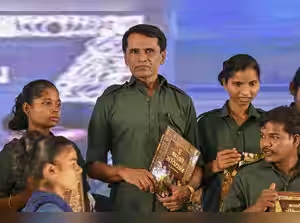
GADCHIROLI, October 14, 2026: Former senior Communist Party of India (Maoist) leader Mallojula Venugopal Rao, widely known as Bhupathi or Sonu, has embarked on a new chapter in civilian life, working with Gondwana University in Maharashtra’s Gadchiroli district. A year after surrendering along with dozens of Maoist cadres, the 70-year-old is now serving as a coordinator under the university’s Ekal programme, helping tribal communities understand their legal rights and navigate administrative procedures.
Bhupathi, who once carried a reported bounty of around ₹6 crore, is now involved in village outreach work focused on forest rights, local self-governance and access to government institutions.
From Maoist Leadership to Civilian Life
Bhupathi spent decades in the Maoist movement and was considered a senior ideologue and strategist within the banned CPI (Maoist).
His surrender on October 14, 2025, alongside more than 60 associates, marked a significant turning point in his life. The development also drew attention to the challenges of rehabilitating former insurgents and helping them reintegrate into civilian society.
Role at Gondwana University
Bhupathi has been appointed as a temporary coordinator under Gondwana University’s Ekal village outreach programme. Rather than being limited to office-based administrative duties, his responsibilities involve engaging directly with gram sabhas and tribal residents across Gadchiroli.
His work focuses on helping communities understand their rights, prepare applications and communicate with the relevant government authorities.
Focus on PESA and Forest Rights
A key part of Bhupathi’s responsibilities is to help villagers understand provisions of the Panchayats (Extension to Scheduled Areas) Act (PESA) and the Forest Rights Act (FRA).
These laws provide frameworks for local self-governance in Scheduled Areas and the recognition of eligible forest rights. Villagers seeking to exercise these rights may face difficulties with paperwork, incomplete applications or errors in official records.
Bhupathi assists residents in preparing documentation, correcting mistakes in claims and coordinating submissions with local authorities.
Connecting Tribal Communities With the Administration
Under the Ekal initiative, Bhupathi is expected to serve as a link between gram sabhas, tribal communities and the district administration.
His familiarity with remote villages and local issues has reportedly been considered relevant to the outreach role. The initiative aims to make information about legal entitlements and administrative processes more accessible to residents.
University Cites Experience and Eligibility
Gondwana University Vice-Chancellor Prashant Bokare said Bhupathi was found eligible for the position and that his experience and knowledge were taken into account during the selection process.
The appointment is contractual, not a permanent university position. Reports indicate that Bhupathi was initially engaged for three months, with a monthly honorarium of ₹30,000. Any continuation is expected to depend on the university’s assessment of his performance.
A Different Daily Routine
Bhupathi’s current routine contrasts sharply with his years spent underground. Reports describe him working with a laptop, official documents and administrative paperwork as part of his university responsibilities.
Security personnel accompanying him continue to reflect the sensitive nature of his past and his transition into civilian life.
Appointment Faces Local Opposition
Bhupathi’s rehabilitation has also prompted objections from some local representatives. Certain gram sabha representatives in Bhamragad have reportedly raised concerns about his appointment and called for greater transparency in the recruitment process.
The objections highlight the complexities of reintegration in areas affected by prolonged conflict, where rehabilitation efforts must also contend with local concerns and the need to rebuild public trust.
From Armed Insurgency to Tribal Welfare Work
After surrendering, Bhupathi had expressed a desire to continue working among the communities with which he had spent much of his life. His current role provides an avenue to engage with tribal residents through constitutional and administrative processes.
His transition from senior Maoist leadership to assisting villagers with legal rights and documentation has drawn wider attention as an example of rehabilitation in a conflict-affected region. The longer-term impact of his work will depend on the programme’s implementation, community engagement and the university’s assessment of his performance.
Source – The Indian Express, The Economic Times, Moneycontrol, Loksatta and reports on Gondwana University’s Ekal programme
Supreme News Network

I was skeptical at first but after a few wins I am totally sold. The transparency here is great. Check out br56w for a top notch experience.