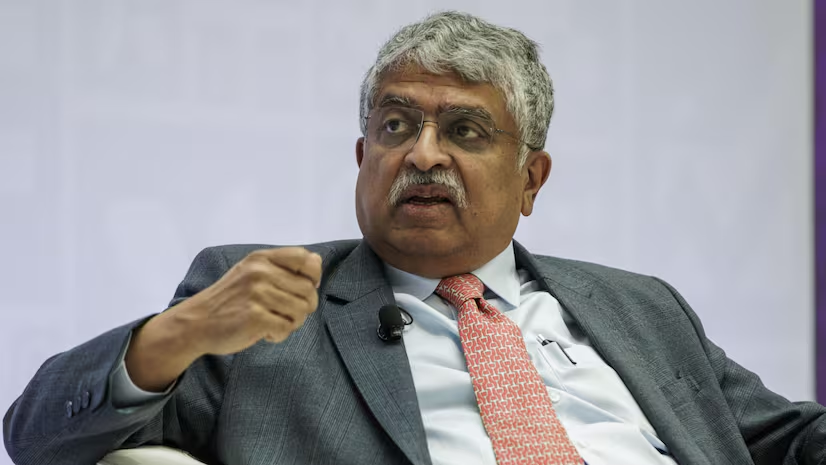
New Delhi, October 13, 2026: Infosys co-founder and chairman Nandan Nilekani has said India is well positioned to become a global leader in the large-scale adoption of artificial intelligence (AI), arguing that the country’s biggest opportunity lies in applying the technology across millions of businesses and everyday activities. Speaking at the Bloomberg New Economy Forum 2026 in Delhi, Nilekani said small businesses could play a significant role in future job creation by using AI to improve productivity and expand operations.
India Can Lead in AI Adoption at Scale
Nilekani described AI as a general-purpose technology, comparable to electricity or the printing press, whose broader economic impact depends on how widely it is adopted.
He argued that India’s experience in deploying digital systems at population scale could help the country extend AI beyond large technology companies and make it useful across sectors such as healthcare, education, finance, agriculture and commerce.
Small Businesses Could Drive New Employment
A central part of Nilekani’s argument is that smaller enterprises could become an important source of employment as AI adoption grows.
Many small businesses rely on customer-facing services, local knowledge and tasks that require human interaction. According to this view, AI could help these businesses become more productive, reach new customers and expand their operations while continuing to employ people.
If millions of enterprises grow and each creates a small number of additional jobs, the combined effect could be significant for the Indian economy.
AI Could Help Businesses Expand With Smaller Teams
AI tools can assist small businesses with customer service, marketing, accounting, logistics, inventory management and routine decision-making.
By reducing the time spent on repetitive tasks, these tools could allow business owners and employees to focus on customer relationships, product development and expansion. Lower operating costs and improved efficiency may also help smaller firms compete with larger companies.
However, the employment impact will depend on how businesses implement AI, the skills available to workers and whether productivity gains translate into increased demand and hiring.
AI Should Be Viewed as an Enabler, Not Just a Threat
Nilekani’s remarks shift attention from concerns about job displacement towards the potential for AI to improve productivity and create new opportunities.
AI can help workers complete certain tasks more efficiently, but its adoption may also change job responsibilities and reduce demand for some types of work. New roles could emerge in AI deployment, system management, supervision and responsible technology use.
The broader challenge for India will be ensuring that workers receive the training needed to adapt as industries change.
Coding Jobs Will Change as AI Advances
Nilekani said software development is likely to become more productive as AI tools increasingly assist programmers with writing, testing and debugging code.
At the same time, demand may grow for skills involving customer requirements, system integration, AI-driven workflows, quality assurance and governance.
Rather than treating coding as a task that will simply disappear, the shift points towards changes in how software is developed and the range of skills needed across technology teams.
India’s Digital Infrastructure Offers an Advantage
India has developed large-scale digital platforms, including Aadhaar and the Unified Payments Interface (UPI), that demonstrate the country’s ability to deploy technology across a vast population.
This experience could provide a foundation for wider AI adoption in public services, financial systems, education, healthcare and small enterprises.
The next challenge will be translating digital infrastructure into practical, affordable AI applications that can be used reliably by businesses and citizens across different regions and languages.
AI Could Improve Education and Access to Information
Nilekani also highlighted the potential for AI to make information and digital services easier to access.
Natural-language interfaces could help people interact with technology without needing advanced technical skills or fluency in English. Tools that support Indian languages could broaden access to learning resources, government services and business applications.
In education, AI could support personalised learning and help teachers with routine tasks, although effective implementation would require reliable systems, appropriate safeguards and human oversight.
India Need Not Dominate Every Frontier AI Model
Nilekani’s position reflects the argument that India can gain substantially from AI without necessarily leading the development of every advanced AI model.
Instead, the country could focus on adapting and deploying affordable systems to solve practical problems in agriculture, healthcare, education, public administration and commerce.
Such an approach would place emphasis on real-world adoption, accessibility and measurable benefits rather than competition over model development alone.
World Bank Highlights India’s AI Readiness
A separate assessment discussed in media reports has placed India among countries with comparatively strong AI readiness, citing its digital public infrastructure, engineering talent and policy environment.
However, important challenges remain, including uneven digital access, limited research and development investment and gaps in workforce skills.
Addressing these constraints will be essential if AI adoption is to extend beyond major cities and large enterprises to smaller businesses and underserved communities.
AI Adoption Could Become India’s Competitive Advantage
India’s large domestic market, technology workforce and established digital infrastructure create opportunities for widespread AI deployment.
If small businesses can use AI to improve productivity, enter new markets and expand employment, the technology could contribute to economic growth while creating new types of work.
The outcome will depend on access to affordable tools, workforce training, responsible deployment and the ability of businesses to turn productivity improvements into sustainable growth.
Sources – The Indian Express, Bloomberg New Economy Forum
Supreme News Network