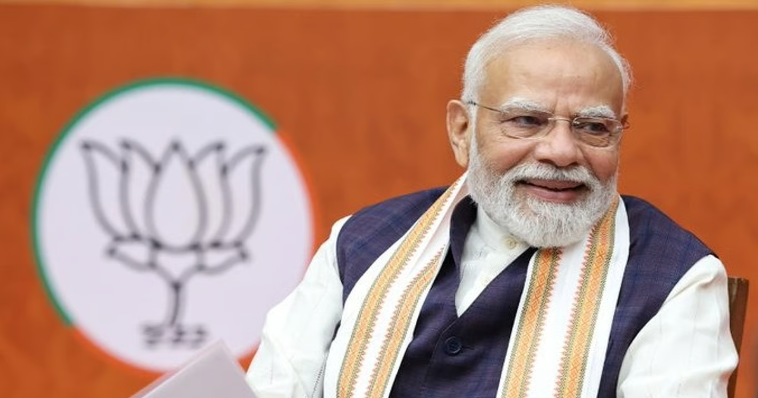
New Delhi: Prime Minister Narendra Modi on Thursday, August 27, 2026, called India’s limited participation across Olympic disciplines a “bitter truth”, arguing that the country must first expand the number of sports in which it competes if it wants to significantly improve its medal tally.
Addressing young athletes, students and volunteers virtually during the Khelo India Dialogue, Modi said India currently does not participate in a large share of the sports contested at the Olympic Games, leaving many medal opportunities effectively out of reach before competition even begins.
The Prime Minister called for a wider grassroots sporting base, scientific talent identification and long-term development of young athletes as India builds towards its broader Olympic ambitions, including its interest in hosting the 2036 Games.
Modi Calls Limited Olympic Participation a ‘Bitter Truth’
Modi highlighted a structural issue in Indian sport: the country continues to focus on a relatively limited group of Olympic disciplines.
He said India does not even field teams or athletes in many sports on the Olympic programme.
At the Paris Olympics in 2024, India participated across 16 sports. It had also competed in 16 sports at Tokyo and 15 at the Rio Olympics.
That leaves a substantial number of disciplines where Indian athletes either do not qualify or have little established competitive presence.
The Prime Minister argued that this has a direct impact on the country’s medal potential.
India cannot realistically compete for medals in events where it does not have athletes on the starting line, he said, stressing the need to identify and develop talent in sports that have traditionally received less attention in the country.
Focus Goes Beyond Simply Winning Medals
Modi also said his sports vision should not be interpreted as a campaign focused only on increasing India’s Olympic medal count.
He connected sport with the wider objective of nation-building, fitness, discipline and youth participation.
The Prime Minister said integrating India’s sporting power and youth power is part of the broader effort to build a developed India.
The official Khelo India Dialogue programme similarly brought together sports, fitness, youth leadership, civic responsibility, volunteering and nation-building on a common platform.
Nationwide Talent Hunt for Children Aged 5–15
One of the most significant elements of the government’s longer-term strategy is early talent identification.
Modi reiterated the need to search for sporting ability among children between approximately five and 15 years of age, including girls, and provide specialised training based on their physical abilities and sporting potential.
The idea is to identify young athletes today who could potentially mature into elite competitors by the time of the 2036 Olympic cycle.
Instead of relying primarily on athletes who enter sport relatively late, the proposed approach places greater emphasis on identifying talent in schools, villages and smaller cities at an early stage.
Scientific Talent Identification for 2036 Olympics
The government’s official programme for Thursday placed the 2036 Olympics among five major themes of the Khelo India Dialogue.
The Ministry said the process would focus on scientific talent identification, transparent selection and long-term athlete development.
This could involve matching children with sporting disciplines based on physical characteristics, skill, endurance, coordination and other measurable abilities.
The government is also emphasising better coaching, facilities, sports science and inclusive participation as part of improving India’s overall sports ecosystem.
More Than 8 Lakh Youth Connected Nationwide
Thursday’s Khelo India programme was organised on a large national scale.
According to the Ministry of Youth Affairs and Sports, more than eight lakh young participants and athletes were expected to connect with the Prime Minister’s virtual address.
The programme was organised across approximately 1,600 locations, with two colleges in every district across states and Union Territories involved in the initiative.
The initiative was organised under Mera Yuva Bharat (MY Bharat) as part of activities linked to National Sports Day.
National Sports Day is officially observed on August 29, marking the birth anniversary of legendary Indian hockey player Major Dhyan Chand, while the nationwide dialogue was scheduled on August 27 as part of the celebrations.
Young People Invited to Suggest Sports Policies
The event was designed as more than a one-way speech.
After Modi’s national address, local interactions were planned involving students, MY Bharat volunteers, sportspersons, public representatives and community leaders.
A dedicated Yuva Samvaad component invited participants to share ideas and recommendations about India’s sports ecosystem.
Young people were also given access to QR codes at venues through which they could submit ideas digitally to the MY Bharat platform.
Key discussion areas included grassroots infrastructure, sports science, Olympic preparation, youth leadership and opportunities for volunteering.
India Wants Wider Olympic Presence
The Prime Minister’s remarks signal that the government is looking beyond sports where India already has an established record.
India has historically achieved Olympic success in disciplines such as:
- Hockey
- Shooting
- Wrestling
- Badminton
- Boxing
- Weightlifting
- Athletics
- Javelin
- Archery-related international competition, though an Olympic medal remains a major target
But the Olympic programme contains dozens of sports and hundreds of medal events.
Modi’s argument is that India’s medal ambitions will remain structurally limited unless the country develops athletes in a significantly wider range of disciplines.
2036 Hosting Ambition Adds Urgency
India has formally expressed interest in hosting the 2036 Olympic and Paralympic Games, with Ahmedabad central to the country’s proposed hosting plans.
That ambition places greater pressure on India to expand both its sporting infrastructure and competitive depth over the next decade.
A host nation is generally expected not only to organise the Games successfully but also to field a strong and diverse national contingent.
Modi has previously said that India must target disciplines in which the country currently has little representation if it wants to be competitive by 2036.
Grassroots Development Becomes Key
The long-term challenge will be translating the ambition into a sustainable athlete-development system.
Finding young talent is only the first stage.
Athletes also require:
- Quality coaching
- Regular competition
- Sports science support
- Nutrition
- Injury management
- International exposure
- Modern training infrastructure
- Transparent selection systems
The government’s Khelo India Dialogue explicitly identified many of these elements as areas requiring continued improvement.
A Different Approach to India’s Medal Problem
Modi’s remarks shift the debate around India’s Olympic performance away from simply asking why existing athletes win fewer medals than competitors from some other major nations.
His argument is that the medal gap begins much earlier — with how many sports India enters, how early athletes are identified and whether pathways exist for them to reach elite competition.
The nationwide Khelo India Dialogue therefore places grassroots participation alongside Olympic ambition.
For India’s 2036 plans, the next decade will be crucial. Expanding participation into new disciplines, identifying children with sporting potential and giving them sustained professional support could determine whether India enters future Olympics with not only a larger contingent, but a substantially broader opportunity to compete for medals.
Source – Prime Minister’s Office / Ministry of Youth Affairs and Sports / Hindustan Times
Supreme News Network