
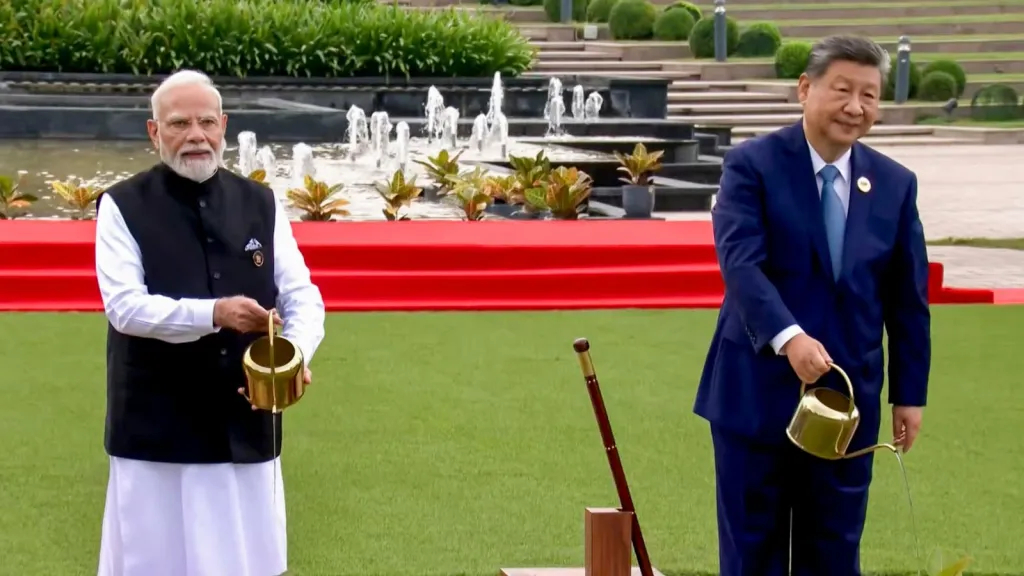
NEW DELHI, September 13: Prime Minister Narendra Modi and Chinese President Xi Jinping have pushed for greater stability along the disputed border and stronger economic and people-to-people ties as India and China cautiously move to rebuild relations damaged by the 2020 military confrontation.
The two leaders met on the sidelines of the BRICS Summit in New Delhi, marking Xi’s first visit to India in seven years and their first bilateral talks in India since relations deteriorated after the Ladakh standoff.
Modi Says Border Peace Essential for Better Ties
Prime Minister Modi stressed that peace and tranquillity along the India-China border remain essential for the overall development of bilateral relations.
Both sides agreed on the need to continue dialogue over the long-running boundary dispute and work toward what they described as a fair, reasonable and mutually acceptable settlement.
The two countries share a largely undemarcated Himalayan frontier spanning about 3,800 kilometres, where significant military deployments remain despite recent disengagement measures.
Xi Says India and China Are ‘Partners, Not Rivals’
President Xi said China and India should view each other as development partners rather than rivals, arguing that stronger cooperation between the two Asian powers would benefit both countries.
The leaders agreed that differences should be managed through dialogue and should not be allowed to develop into broader disputes.
Both sides also emphasised the need for a strategic and long-term approach to bilateral relations.
Trade and Market Access Take Centre Stage
Economic ties formed another major part of the discussions.
India and China recorded bilateral trade of around $155.6 billion in 2025, but the relationship remains heavily tilted in China’s favour. India imported roughly $132 billion worth of goods from China, leaving New Delhi with a large trade deficit.
India raised concerns about structural trade imbalances and sought improved access for Indian products and businesses in the Chinese market.
The two countries also discussed strengthening supply chains, expanding business links and reducing obstacles affecting commercial engagement.
Flights, Visas and Institutional Exchanges Recovering
Relations between India and China have gradually improved since a 2024 agreement helped end the prolonged military standoff at key friction points along the Line of Actual Control.
Since then, both sides have taken steps to restore normal engagement.
These include the gradual resumption of direct flights, easing of some visa restrictions, renewed institutional exchanges and the revival of the Kailash Mansarovar Yatra.
Modi and Xi agreed that stronger cultural and people-to-people exchanges could help support the broader political reset.
Major Differences Still Remain
Despite the diplomatic thaw, several important issues remain unresolved.
Large numbers of troops continue to be stationed near parts of the border, while negotiations on a permanent boundary settlement are progressing slowly.
Trade restrictions, visa difficulties and concerns over market access also remain sources of friction between the two countries.
India and China have also differed on several regional and strategic issues, meaning the current improvement in ties is being viewed as a cautious normalisation rather than a complete reset.
BRICS Provides Platform for Renewed Engagement
The Modi-Xi meeting took place during the 18th BRICS Summit, where leaders from major emerging economies discussed global governance reforms, economic cooperation and ongoing international conflicts.
China will assume the next BRICS presidency and host the 19th BRICS Summit, with Modi conveying India’s support for Beijing’s upcoming chairmanship.
The latest talks signal that both New Delhi and Beijing want to prevent border tensions from again dominating the relationship while expanding trade, connectivity and diplomatic engagement.
However, the durability of the improvement will largely depend on whether both governments can maintain peace along the frontier and translate political dialogue into concrete economic progress.
source – Reuters / The Indian Express
Supreme News Network