

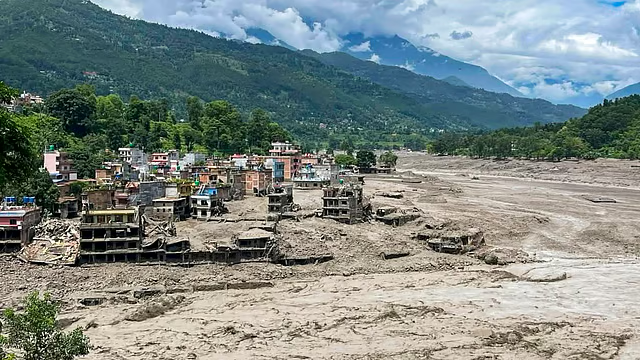
Kathmandu/Beijing: A massive search-and-rescue operation is underway across Nepal and China’s Tibet region on Thursday, August 27, 2026, after catastrophic Himalayan flash floods left at least 165 people dead and nearly 1,500 missing, including hundreds of foreign tourists and pilgrims.
More than 5,000 Nepalese army and police personnel have joined rescue operations, while helicopters are searching isolated valleys and delivering emergency supplies to communities cut off by Wednesday’s disaster. Rescuers recovered 125 survivors on Thursday, including 20 foreign nationals, according to Nepal’s army.
826 Missing in Nepal, 558 in Tibet
The scale of the disaster has become clearer as authorities attempt to account for residents, tourists, pilgrims and workers who were in the affected region when the flood struck.
Nepalese police and tourism officials said 826 people remain missing in Nepal, including almost 500 foreign nationals.
Across the border in Tibet’s Gyirong County, Chinese state broadcaster CCTV reported 558 people missing, including 260 foreigners. China has confirmed three deaths, while Nepal accounts for most of the overall death toll.
Authorities have warned that casualty figures could increase significantly as rescue teams reach areas buried beneath thick layers of mud and debris.
Hundreds of Foreign Tourists Among Missing
The disaster struck a region heavily used by international trekkers and pilgrims travelling between Kathmandu and Tibet.
Among foreign nationals reported missing in Nepal are 177 Indians, 63 Americans, 34 Australians, 33 British citizens and 25 Canadians, according to Reuters.
Malaysia’s foreign ministry has separately said that 55 Malaysian nationals remain uncontactable.
Many travellers in the area were making their way towards Kailash Mansarovar, the sacred pilgrimage destination in Tibet revered by Hindus and Buddhists.
The large number of foreign visitors caught in the disaster has turned the flood into an international emergency, with governments around the world attempting to locate their citizens.
What Triggered the Devastating Flood?
Early assessments indicate that the disaster began with a massive collapse of glacial ice and rock high in the Himalayas.
Satellite analysis showed that a landslide of ice and rock entered the Lhende River, about 20 kilometres northeast of the Nepal-China Rasuwagadhi border crossing, releasing a powerful surge of water, mud and debris downstream.
Initial reports suggested an earthquake may have triggered the collapse.
However, the United States Geological Survey later concluded that the seismic signal initially interpreted as an earthquake was actually generated by the collapse of glacial rock and ice and the resulting debris flow.
Scientists are continuing to study the event and the conditions that made the glacier unstable.
Entire Settlements and Roads Swept Away
The flood travelled with enormous force through mountain valleys along the Nepal-Tibet border.
Verified footage showed torrents of water, rocks and mud sweeping away buildings, vehicles and people near the Gyirong border crossing.
In Nepal, roads, homes, bridges and power infrastructure were destroyed as the flood moved downstream.
Residents in some of the worst-hit areas described entire settlements disappearing under mud.
In places, thick layers of sediment have covered houses, vehicles and trees, making it extremely difficult for rescuers to search for people who may still be trapped.
Helicopters Lead Rescue Effort
With roads and bridges destroyed, helicopters have become crucial to the rescue operation.
Nepal’s army is using aircraft to locate survivors and deliver tents, food, medicines and other emergency supplies to isolated communities.
More than 5,000 army and police personnel are now participating in the rescue effort. By Thursday, teams had successfully retrieved 125 people, including 20 foreigners.
Nepalese Prime Minister Balendra Shah has also travelled towards one of the severely affected districts to assess the situation.
Search operations are expected to continue around the clock wherever weather and terrain allow.
Threat of Another Flood Remains
Authorities are also concerned that the immediate disaster may not be over.
Chinese officials have identified risks associated with a still-dammed lake in Gyirong, upstream from the devastated border area.
If the natural blockage fails, additional water could rush downstream and create another dangerous flood.
Forecast rainfall could further complicate rescue work and increase the risk to both survivors and emergency personnel.
Residents living near vulnerable rivers have therefore been advised to remain alert.
India Sends Emergency Assistance
India has begun sending humanitarian assistance to neighbouring Nepal as the scale of the crisis grows.
Emergency supplies being delivered to affected areas include temporary shelters, blankets, medicines, hygiene materials and other relief equipment.
Nepalese helicopters have already begun dropping some of the supplies provided by India into areas that cannot be reached by road.
The response is especially significant because a large number of Indian citizens and pilgrims are among those still missing.
US and UN Join International Response
International assistance is also expanding.
The United States State Department said Washington is sending a disaster-response adviser and providing $500,000 in assistance.
United Nations teams and humanitarian partners are also deploying personnel and supplies to support Nepalese authorities and affected communities.
Other countries including Australia, Canada, Malaysia and South Korea are monitoring the situation and working to determine the status of their nationals.
Rescue Teams Face Race Against Time
The priority now is locating survivors before conditions deteriorate further.
Destroyed roads, deep mud, unstable slopes, poor communications and the threat of additional flooding are making the operation exceptionally difficult.
Authorities say the confirmed death toll of at least 165 is expected to increase as rescue workers reach more isolated areas.
With almost 1,500 people still unaccounted for across Nepal and Tibet, Thursday’s search operation has become one of the largest disaster-response efforts in the Himalayan region in recent years.
The coming hours will be critical as helicopters, soldiers, police and international rescue teams continue searching devastated valleys for survivors.
Source – Reuters / Nepal Army / Chinese State Authorities
Supreme News Network