
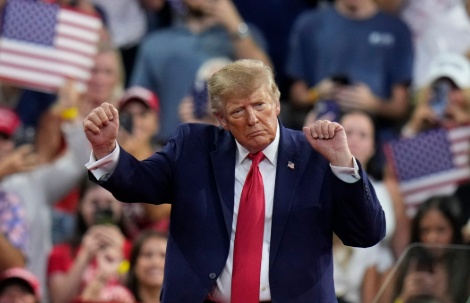
Washington, October 25, 2026: U.S. President Donald Trump has said the United States could launch another military strike against Iran as soon as “tomorrow,” while also keeping open the possibility of reaching a major agreement with Tehran as tensions continue to escalate across the Middle East.
Trump did not announce that a new attack had been authorised. Instead, he said Washington was weighing both military and diplomatic options and refused to disclose when or whether another operation would take place.
Trump Says Strike Could Come ‘Tomorrow’
Speaking to reporters on Saturday, Trump was asked whether the United States was preparing another attack on Iran.
He declined to provide operational details but said there was a possibility that military action could take place soon.
“There’s a possibility I will,” Trump said, while also suggesting that the dispute could instead end through negotiations.
President Also Leaves Door Open for Deal
Trump said Iran’s leadership appeared interested in reaching an agreement with Washington.
He suggested that the United States could secure what he described as a major deal if Tehran agreed to conditions aimed at preventing it from developing nuclear weapons.
The U.S. president, however, questioned whether Iran would comply with any future agreement.
‘Another Little Epic Fury’ Warning
Trump has also warned that Washington could carry out “another little Epic Fury”, referring to the codename associated with the U.S.-Israeli military campaign against Iran that began earlier in 2026.
The remark has heightened speculation that the administration is considering another round of strikes on Iranian targets.
No Confirmation That Attack Has Been Ordered
Despite Trump’s rhetoric, there has been no official confirmation that the U.S. military has received orders to launch a new attack.
Trump has repeatedly avoided providing details about military planning, arguing that publicly revealing the timing of an operation would undermine its effectiveness.
US-Iran Conflict Has Continued for Months
The current confrontation between the United States and Iran has continued for months, involving direct military action, attacks on infrastructure and repeated efforts at diplomacy.
Washington says its primary objective is preventing Iran from developing nuclear weapons, while Tehran has rejected key U.S. demands and criticised American military operations.
Earlier US Strikes Targeted Nuclear Programme
Trump has argued that earlier American strikes significantly damaged Iran’s nuclear-enrichment capabilities.
He has said that ending the military campaign without a broader agreement could allow Tehran to rebuild those capabilities over time.
Iran Says It Is Prepared for Further Conflict
Iranian officials have warned that Tehran is prepared to respond if the United States or Israel launches additional attacks.
Reports have also indicated that Iran has examined various retaliatory options against U.S. interests and infrastructure in the Gulf region.
Strait of Hormuz Remains Major Flashpoint
One of the biggest concerns surrounding any renewed escalation is the Strait of Hormuz.
The narrow shipping route is critical to global oil trade, and any disruption could have significant consequences for energy prices, shipping and the wider global economy.
Houthis Escalate Regional Pressure
Tensions are also rising because of renewed military activity by Yemen’s Iran-aligned Houthi movement.
On October 24, the Houthis said they had targeted military positions in the Yemeni port city of Aden. Yemen’s internationally recognised government confirmed that attacks had taken place.
Missile Debris Reported in Saudi Cities
Saudi authorities have also reported fragments from intercepted missiles falling in Mecca and Jeddah, adding to concerns that the wider regional conflict could increasingly affect civilian areas.
No major casualty figures were immediately reported in connection with those incidents.
Houthis Warn Against Using Riyadh Airport
The Houthis have renewed warnings against using Riyadh’s King Khalid International Airport, describing it as a military target.
The warning came as the airport announced plans to restore some operations following earlier disruptions.
US Military Presence Remains Significant
The United States continues to maintain a substantial military presence across the Middle East.
American forces are positioned in several Gulf countries, giving Washington the ability to respond quickly if the conflict escalates.
The presence of U.S. bases also creates potential targets for Iranian or allied forces in the event of renewed fighting.
Diplomacy Has Failed to Produce Breakthrough
Multiple rounds of diplomatic activity have so far failed to produce a permanent settlement.
Washington and Tehran remain divided over Iran’s nuclear programme, regional military activities and the terms of any ceasefire or broader security agreement.
Trump Says US Would Win ‘Either Way’
Trump said the United States would prevail whether the dispute ended through a negotiated agreement or further military action.
His comments reflect the administration’s strategy of combining military pressure with demands for a diplomatic settlement.
Iran Deal Would Need to Address Nuclear Programme
Any agreement would likely centre on restrictions on Iran’s nuclear activities.
Trump has repeatedly insisted that Tehran must not be allowed to develop a nuclear weapon, while Iranian officials maintain that their nuclear programme has peaceful purposes.
The precise terms of any potential agreement remain unclear.
Regional Allies Push for Restraint
Several U.S. allies in the Gulf have previously urged Washington to avoid another major escalation.
Countries including Saudi Arabia, Qatar and the United Arab Emirates have expressed concern that further conflict could destabilise the region and threaten critical infrastructure.
Oil Markets Closely Watching Developments
Energy markets remain sensitive to developments involving Iran and the Strait of Hormuz.
A major U.S. strike or Iranian retaliation could disrupt shipping, potentially pushing global crude prices higher and increasing transportation and fuel costs worldwide.
Situation Remains Highly Uncertain
Trump’s latest remarks significantly raise the political pressure on Tehran but do not amount to confirmation of an imminent attack.
For now, both possibilities remain open: renewed military action or a diplomatic agreement.
The coming days will be closely watched for signs of additional U.S. military deployment, Iranian responses or renewed negotiations between the two governments.
Source: Reuters, Associated Press, The Indian Express
Supreme News Network