
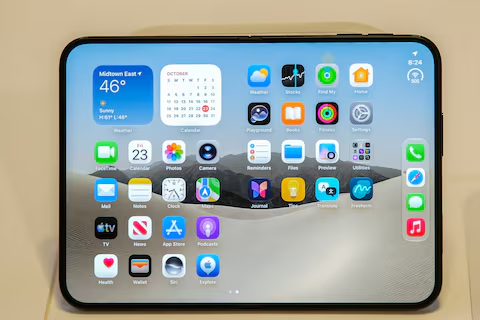
New Delhi, October 25, 2026: Apple’s first foldable smartphone, the iPhone Duo, has officially reached stores worldwide with a starting price of about $2,000, marking one of the company’s biggest changes to the iPhone design in nearly two decades. Demand has been strong, but limited supplies have constrained availability across several major markets.
The foldable iPhone went on sale on October 23 in markets including the United States, India, China, Singapore, Japan and Europe, with Apple limiting purchases in several regions because initial demand significantly exceeded supply.
iPhone Duo Starts at $1,999
Apple has priced the base iPhone Duo at $1,999 in the United States.
The premium pricing places it firmly in the ultra-high-end smartphone segment alongside flagship foldable devices from Samsung and Huawei.
India Price Significantly Higher
In India, the base iPhone Duo is priced at around ₹2,99,900, making it one of the most expensive smartphones Apple has ever sold in the country.
Higher-storage configurations can cost substantially more, with some versions approaching ₹4.5 lakh.
Supply Runs Short Soon After Launch
Apple entered launch weekend with limited physical inventory.
Stores in several markets received relatively small numbers of devices, and many locations sold out quickly as customers arrived to collect pre-orders or try to secure walk-in stock.
Delivery Dates Slip to January
Strong pre-order demand quickly pushed estimated delivery dates for some configurations into late January.
Apple described early demand as “nothing short of extraordinary,” while analysts said the constrained supply made it difficult to measure how much of the initial shortage reflected demand versus limited production.
Apple Limits Purchases
To control availability, Apple capped pre-orders at two devices per customer.
In several markets including India, China, France, Japan and Hong Kong, walk-in availability was particularly restricted, with many buyers required to order online before collecting a device.
Foldable Design Marks Major iPhone Shift
The iPhone Duo uses a book-style folding design that allows the device to function as both a conventional smartphone and a larger-screen tablet-like device.
Its launch represents Apple’s most significant physical redesign of the iPhone since the original smartphone debuted in 2007.
Apple Enters Market Years After Rivals
Samsung and Huawei have sold foldable smartphones for years, giving them an early lead in the category.
Apple’s entry is therefore being closely watched because the company has historically entered emerging hardware categories later and attempted to bring them to a broader mainstream audience.
Early Reviews Praise Hinge Design
Initial reviews have been particularly positive about the iPhone Duo’s hinge and folding display.
Several reviewers have noted that the crease across the internal screen is less visible than on many earlier foldable devices, addressing one of the category’s longstanding complaints.
Camera Compromises Draw Criticism
The phone has also faced criticism.
Some reviewers have questioned the absence of a dedicated telephoto camera and other compromises that appear unusual for a device costing around $2,000.
Software Compatibility Remains a Challenge
Foldable devices require apps to adapt across different screen sizes and orientations.
Some early reviewers have reported that certain applications still do not take full advantage of the Duo’s larger unfolded display, suggesting developers may need time to optimise their software.
Launch Day Queues Return
Although the launch did not recreate the massive queues associated with earlier iPhone generations everywhere, several Apple stores still saw customers lining up overnight.
Queues were reported in cities including New York, Sydney, Singapore, Shanghai and London.
Resellers Target Scarce Inventory
Limited supply also attracted resellers.
In Hong Kong and other Asian markets, some launch-day buyers said they planned to resell their phones at a premium because stock was difficult to obtain.
New CEO John Ternus Faces Early Test
The iPhone Duo is also one of the first major product launches under new Apple CEO John Ternus.
Ternus, previously Apple’s hardware chief, took charge in September and now faces the challenge of proving that the foldable device can become more than a niche luxury product.
China Could Be Crucial Market
China is likely to be particularly important for the Duo.
Apple has regained some share in the country’s premium smartphone market, but faces strong competition from Huawei, Xiaomi and other domestic brands that already sell foldable devices.
Foldable Market Still Relatively Small
Despite years of development, foldable smartphones still represent a relatively small portion of global handset shipments.
High prices, durability concerns and uncertainty over practical benefits have prevented them from becoming mainstream.
Apple is betting that its brand strength, ecosystem and design could accelerate adoption.
IDC Expects Apple to Gain Large Share
Research firm IDC expects Apple to quickly capture a significant share of the foldable market.
According to estimates cited by Reuters, Apple could account for roughly 31% of foldable unit sales and 44% of market value in 2026, with the potential to lead the segment by 2027.
Limited Supply Could Persist
Apple’s decision to restrict walk-in stock and cap purchases suggests availability may remain tight in the near term.
Production challenges are common with foldable displays and hinges, which require more complex manufacturing than conventional smartphones.
$2,000 Price Tests Consumer Demand
The biggest question surrounding the Duo is whether enough consumers are willing to pay nearly twice the price of many premium smartphones.
While early demand has been strong, long-term sales will determine whether the device can move foldable phones from a niche category into the mainstream.
Apple Makes Major Bet on Foldables
The iPhone Duo represents one of Apple’s boldest hardware bets in years.
If the device succeeds, it could reshape the foldable smartphone market and encourage more developers to design applications for flexible displays.
For now, however, Apple’s biggest challenge may simply be supplying enough units to meet demand.
Source: Reuters, The Indian Express, Bloomberg
Supreme News Network