

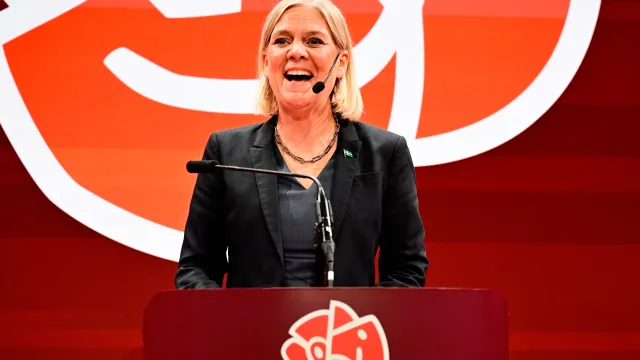
STOCKHOLM, September 14: Sweden’s centre-left opposition, led by former Prime Minister Magdalena Andersson’s Social Democrats, is in a narrow lead after Sunday’s general election, putting it in position to replace Prime Minister Ulf Kristersson’s right-wing government. Preliminary results project the centre-left bloc at 176 seats in the 349-seat parliament, compared with 173 seats for the governing right-wing bloc.
The result is not yet final, however. Hundreds of electoral districts and overseas ballots remain to be counted, with the final count expected on Wednesday.
Centre-Left Holds Three-Seat Advantage
With most votes counted, Sweden’s election authority projected a slim three-seat parliamentary advantage for parties supporting Andersson.
The two blocs were separated by only around 0.4% of the vote on Monday morning, highlighting how closely contested the election remains. Andersson told supporters that Sweden would get a new government if the preliminary result holds.
Kristersson has not conceded, with memories still fresh of Sweden’s 2022 election, when early projections initially favoured the centre-left before later results shifted the outcome.
Forming Government Could Be Complicated
Even if the centre-left majority survives the final count, forming a stable government may not be straightforward.
The Centre Party has ruled out serving in government with the Left Party, while the Left Party has insisted it should be part of any new governing arrangement. The divisions mean Andersson may have to negotiate a complex coalition or support agreement before taking office.
Sweden’s parliamentary speaker, Andreas Norlen, has warned that government formation could become a complicated process.
Sweden Democrats Lose Ground
One of the biggest developments from the election is the projected setback for the Sweden Democrats, which had supported Kristersson’s government and was expected to seek a formal cabinet role if the right-wing bloc won.
Preliminary projections suggest the party could lose around 11 parliamentary seats, marking its first decline in vote share since entering Sweden’s parliament in 2010.
The result could slow Sweden’s recent political shift to the right, particularly on immigration and criminal justice policy.
Immigration Policy Unlikely to Fully Reverse
Kristersson’s government introduced some of Sweden’s toughest immigration measures in decades, contributing to asylum applications falling to a 40-year low.
Although a centre-left government could adopt a somewhat softer approach, analysts do not expect Sweden to return to its earlier, more open immigration policies. Andersson’s Social Democrats themselves support maintaining relatively strict immigration controls, creating differences with the Left and Green parties.
Welfare and Tax Policy Set to Be Key Issues
Andersson campaigned on increased welfare spending, a fairer tax system and stronger social cohesion.
However, the opposition parties disagree over how such policies should be funded. The Left and Greens favour higher contributions from wealthy Swedes, while the Centre Party opposes proposals such as a billionaires’ tax.
Foreign policy is expected to remain broadly stable regardless of the government change, with the centre-left continuing Sweden’s strong pro-NATO, pro-Western and pro-Ukraine stance.
Final Results Expected Wednesday
Sweden will not have a definitive election outcome until remaining districts and overseas votes are counted.
If the current 176–173 projection survives, Andersson would be the clear frontrunner to return as prime minister after four years in opposition. The bigger challenge would then be building a workable centre-left government from parties divided on migration, taxes and economic policy.
source – Reuters
Supreme News Network