

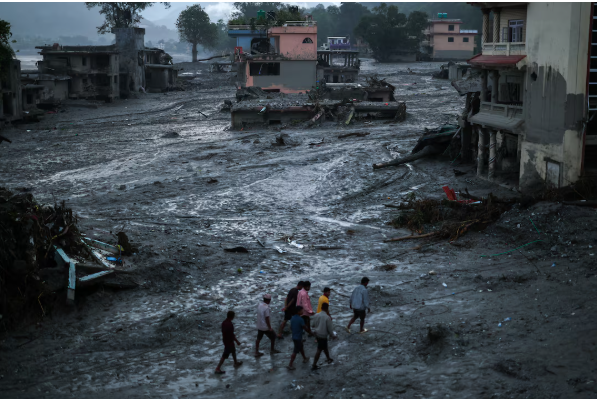
KATHMANDU, September 4: Nepal has estimated that last week’s catastrophic floods caused at least $2.56 billion worth of damage to property, homes and critical infrastructure, according to a fresh assessment released on Friday.
The preliminary estimate places total losses at approximately 387.5 billion Nepalese rupees, highlighting the enormous economic impact of the disaster across flood-ravaged regions.
Homes and Critical Infrastructure Severely Damaged
The floods caused widespread destruction to houses, roads, bridges, hydropower facilities, electricity networks, telecommunications, health facilities, educational infrastructure and agricultural assets.
The worst-affected districts include Rasuwa, Nuwakot and Dhading, along with other communities situated along the flood-hit river system.
Nepal’s National Disaster Risk Reduction and Management Authority said the figures were calculated in coordination with concerned government agencies and departments.
$52.6 Million Needed for Immediate Recovery
Authorities estimate that around $52.6 million, or 7.95 billion Nepalese rupees, will be required during the first four months of the early recovery phase.
The money will be needed for priorities including rebuilding roads, constructing temporary shelters, restoring drinking-water supplies and bringing electricity back to affected communities.
Around 20,000 Homes May Need Rebuilding
Nepal is expected to need reconstruction of approximately 20,000 homes across disaster-hit areas.
At least 7,500 houses have already been identified as completely destroyed, according to the disaster authority.
Thousands of people have been displaced and remain dependent on temporary accommodation and humanitarian assistance.
Assessment Is Still Preliminary
Officials have stressed that the $2.56 billion figure is an initial estimate.
More comprehensive assessments will be carried out to determine the exact scale of losses and calculate the longer-term cost of reconstruction and rehabilitation.
This means Nepal’s eventual rebuilding bill could change substantially as authorities reach remote communities and complete detailed infrastructure assessments.
Rescue Operations Continue Alongside Recovery
Even as Nepal begins calculating the economic cost of the disaster, search-and-rescue operations remain active.
On Friday, rescuers pulled two workers alive from a hydropower tunnel nine days after the disaster, providing a rare moment of hope amid continuing searches at damaged power projects.
Teams are still working through tunnels and debris-covered areas where workers and residents are feared trapped.
International Support Continues
Nepal has received assistance from countries including India, China, Japan, the United States, United Kingdom, UAE, South Korea, Australia, Germany and several others.
International organisations including the World Bank, Asian Development Bank, European Union and United Nations are also supporting the country’s disaster response.
Nepal’s government has said the scale and complexity of the catastrophe will require continued international support through the rescue, rehabilitation and reconstruction phases.
With preliminary losses already approaching $2.6 billion, rebuilding communities and critical infrastructure is expected to become one of Nepal’s biggest recovery challenges in the months ahead.
source – National Disaster Risk Reduction and Management Authority, Nepal
Supreme News Network



The mobile version works perfectly on my phone. I can play anywhere and anytime without any lag. Truly impressed with phphoneph.
Adult entertainment milwaukee wiHardcore supermodelsMainstream movies showing unsimulated sexFemale
escort dictionaryFamilies have sexProlonged adult
constipation symptomsLesbian lover mature womanFuck movie xxxLick
barefeet xnxx Milf and assSexy comic-con costumesGay men locker gym clipsNeighbour sex stories
indiaBiggest black pussy holesHairy forest menAkroma
naked https://xnxxcn.com/ Gay cumshots of menWives egging for black cock tubeLesbian force into warehouseYouths that were charged
as adultsVaginal discharge and sores on labiaFree video sex trainingMature woman seeking marriageStep moms helps with first anal xnxx Dolly parton nude picLesbian erotica d sRichard hammond naked gay pornGirl toes nudeAuthor index
and erotic couplingMetacafe hot sexFree sex movies crying