
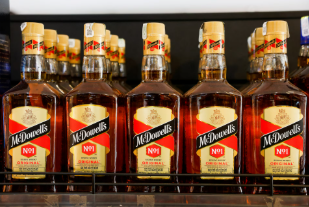
Mumbai, November 19, 2026: Shares of several leading Indian liquor companies declined on Thursday after reports that bulk Scotch whisky imports from the United Kingdom were facing an effective duty and tax of 162.5%, raising concerns over production costs and the implementation of the India-UK trade agreement.
Stocks including United Spirits, Radico Khaitan and Allied Blenders and Distillers came under selling pressure as investors assessed the potential impact of higher import costs.
According to Reuters, the tariff dispute has emerged as one of the first major disagreements over the India-UK trade agreement, which came into effect in July 2026.
Indian Liquor Stocks Decline After Tariff Reports
Shares of major alcohol beverage companies fell during Thursday’s trading session following reports about the increased tax burden on bulk Scotch imports.
United Spirits, the Indian subsidiary of global spirits company Diageo, was among the companies affected.
Radico Khaitan, Allied Blenders and Distillers and Tilaknagar Industries also witnessed declines.
According to market reports, several liquor stocks fell approximately 1% to 3% during early trading, while some experienced sharper intraday losses.
Investors reacted to concerns that the higher effective levy could increase the cost of imported whisky used by Indian manufacturers.
Bulk Scotch Whisky Imports Face 162.5% Levy
The controversy centres on the customs treatment of bulk Scotch whisky imported into India for blending, manufacturing and bottling.
Under the India-UK trade agreement, import duties on eligible Scotch whisky were reduced from 150% to 75%.
However, Indian customs authorities have taken the position that certain bulk Scotch preparations fall under a different customs classification.
According to Reuters, the effective duty and tax being applied to the disputed imports amounts to 162.5%.
This is higher than the 150% tariff that applied before the trade agreement took effect.
The disagreement has raised questions about which whisky products qualify for the preferential rates established under the agreement.
India-UK Trade Agreement Faces Early Challenge
The India-UK Comprehensive Economic and Trade Agreement came into force on July 15, 2026.
The agreement was intended to expand bilateral trade by reducing tariffs on a range of products, including Scotch whisky.
The initial reduction to 75% was regarded as an important development for British whisky exporters and Indian companies that use imported Scotch in their products.
The agreement also provides for further reductions in eligible whisky tariffs over the following years.
However, the current dispute has created uncertainty over how the agreed concessions should apply to bulk whisky shipments.
Customs Classification at Centre of Dispute
Indian authorities have argued that certain bulk Scotch imports used in blended whisky production should be classified as compound alcoholic preparations.
Under this interpretation, the imported material may not qualify for the reduced tariff available to eligible Scotch whisky products under the trade agreement.
Liquor companies and industry representatives dispute that interpretation.
They maintain that bulk Scotch used in manufacturing should receive the preferential treatment agreed under the trade pact.
The disagreement has resulted in scrutiny of shipments and concerns about customs clearance delays.
Diageo and Pernod Ricard Among Affected Companies
Global spirits companies Diageo and Pernod Ricard have significant operations in India.
Both companies import Scotch whisky that can be used in locally manufactured and blended products.
A substantial portion of Scotch whisky imported into India arrives in bulk rather than as finished bottled products.
The higher tariff treatment could affect raw material costs, supply planning and manufacturing operations if the dispute remains unresolved.
The financial impact will depend on the final customs interpretation and how individual companies manage their import requirements.
British Government Seeks Resolution
The United Kingdom has expressed concern about the dispute and is engaging with Indian authorities.
According to Reuters, a British government spokesperson said ministers were urgently working with India to ensure that businesses could access the tariff concessions provided under the agreement.
Indian officials have previously indicated that the government intends to honour its trade commitments while examining the customs classification issue.
The dispute is therefore not simply about a newly announced increase in the general Scotch whisky tariff, but about whether specific bulk imports qualify for the lower rate.
Higher Import Costs Could Affect Whisky Manufacturers
If the higher effective levy continues to apply, Indian whisky manufacturers using imported Scotch may face increased production costs.
Some companies could experience pressure on profit margins, particularly if they cannot pass additional costs to customers.
Manufacturers may also need to reassess sourcing arrangements and inventory planning.
However, the extent of any impact will vary depending on each company’s product portfolio and dependence on imported Scotch.
There has been no confirmed industry-wide retail price increase directly resulting from Thursday’s stock market developments.
Investors Watch Government and Industry Talks
Market participants are closely monitoring discussions between Indian customs authorities, liquor manufacturers and the British government.
A resolution clarifying the treatment of bulk Scotch imports could help reduce uncertainty for affected businesses.
Further developments may also influence investor sentiment towards companies dependent on imported whisky.
For now, Thursday’s decline reflects concerns about the possible financial consequences of the ongoing tariff dispute.
India-UK Scotch Tariff Dispute Remains Unresolved
The fall in liquor stocks on November 19 highlights how trade policy uncertainty can affect businesses and financial markets.
While the India-UK agreement provides reduced tariffs for eligible Scotch whisky imports, the classification of certain bulk shipments remains contested.
Companies and investors will be watching for an official clarification on the applicable duties and the treatment of shipments already under scrutiny.
Source – Reuters, Moneycontrol, Business Today, Business Standard, The Economic Times
Supreme News Network