
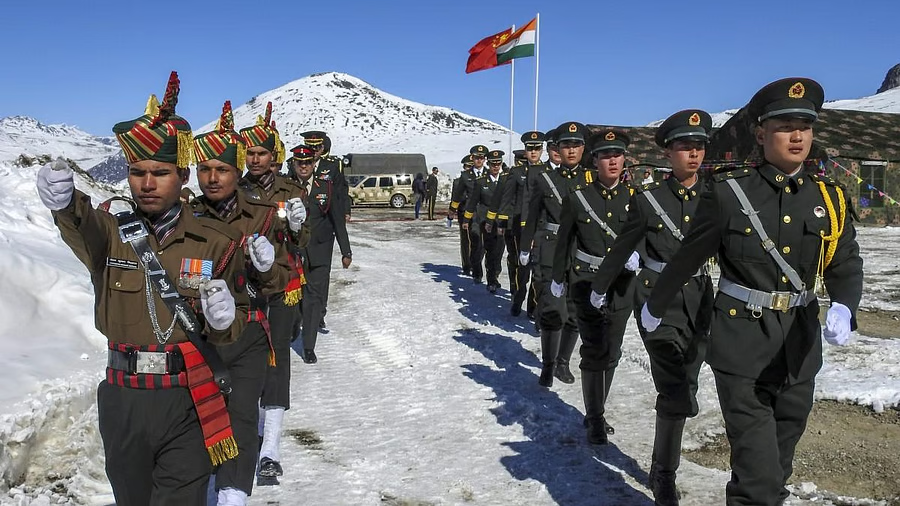
New Delhi, November 26, 2026: India and China have held another round of high-level military talks in the Arunachal Pradesh sector to strengthen border management, address outstanding issues along the Line of Actual Control (LAC) and prevent tensions between troops from escalating.
The Ministry of External Affairs (MEA) officially confirmed the discussions on November 25, describing the engagement as part of ongoing diplomatic and military efforts to maintain peace along the disputed frontier.
The latest round of talks reportedly began on November 8 and continued for nearly 10 days, with a brief interruption.
Lieutenant General Girish Kalia, General Officer Commanding of the Indian Army’s III Corps, led the Indian delegation during the discussions with senior Chinese military officials.
The talks focused on establishing clearer rules for troop interactions, maintaining communication between commanders and preventing misunderstandings during military patrols.
The development comes amid reports of friction along the Arunachal Pradesh border, particularly in the Taksing area of Upper Subansiri district.
Although both sides are continuing dialogue, no final resolution of the outstanding border disputes has been announced.
India and China Hold High-Level Talks in Arunachal Pradesh
Senior military commanders from India and China recently completed another round of discussions concerning the eastern sector of their disputed border.
The talks focused on improving coordination between the two militaries and addressing unresolved issues along the LAC.
According to the Ministry of External Affairs, the discussions were intended to reduce the possibility of confrontations between troops.
The latest meetings represent a continuation of efforts initiated earlier in 2026 to establish more effective military communication mechanisms.
Both countries maintain a substantial military presence along sensitive portions of the frontier.
MEA Officially Confirms Military Discussions
Ministry of External Affairs spokesperson Randhir Jaiswal confirmed the talks during a media briefing on November 25.
Jaiswal said India and China regularly communicate through established diplomatic and military mechanisms.
He confirmed that a meeting involving senior military commanders had recently taken place in the eastern sector.
According to the spokesperson, discussions centred on improving border management and addressing unresolved LAC-related issues.
He also explained that the purpose of such meetings was to maintain peace and tranquillity along the border and prevent escalation.
His statement marked the first official Indian confirmation of the latest round of discussions.
Military Talks Began on November 8
According to reports by The Indian Express and other publications, the military discussions started on November 8, 2026.
The negotiations continued for approximately 10 days, with a short break during the process.
The meetings took place before the onset of more severe winter conditions along the Arunachal Pradesh frontier.
Officials reportedly discussed ways to prevent local military incidents from developing into larger confrontations.
The precise venue of the November meetings and the complete details of the discussions have not been publicly disclosed.
Lieutenant General Girish Kalia Leads Indian Delegation
Lieutenant General Girish Kalia led the Indian military delegation during the latest discussions.
He serves as General Officer Commanding of the Indian Army’s III Corps, also known as the Spear Corps.
The formation is headquartered near Dimapur in Nagaland and has responsibilities associated with India’s northeastern security environment.
Senior Chinese military officers, including Kalia’s counterpart, participated in the discussions.
An official from India’s Ministry of External Affairs was also reportedly present.
The participation of military and diplomatic representatives reflects the importance of coordination between operational and policy-level authorities.
Both Sides Discuss Rules for Troop Engagement
A major focus of the discussions was the establishment of clearer procedures for interactions between Indian and Chinese soldiers.
Troops from both countries operate in areas where their perceptions of the LAC differ.
These differences can lead to encounters during patrols.
The latest talks reportedly examined procedures for managing such situations without confrontation.
Possible areas of discussion included communication between commanders, patrol coordination and procedures for responding to unexpected encounters.
However, the governments have not released a detailed agreement specifying which measures have been adopted.
Tensions in Taksing Area Remain a Concern
The talks followed reports of military tensions in the Taksing area of Arunachal Pradesh’s Upper Subansiri district.
During July and August 2026, Indian and Chinese troops reportedly encountered one another in the region.
The incidents raised concerns about patrol movements and differing territorial perceptions.
Both sides subsequently used diplomatic and military communication channels to address the situation.
The developments contributed to the decision to organise senior commander-level meetings in the eastern sector.
Although dialogue has continued, the precise status of every reported friction point remains unclear.
First Corps Commander-Level Meeting Held in September
The latest discussions followed an earlier meeting held on September 6 and 7, 2026.
That engagement was described as the first Corps Commander-level meeting in the Arunachal Pradesh sector.
The talks took place at the Wacha-Damai Border Personnel Meeting point in the Kibithoo region.
Wacha is located on the Indian side, while Damai is associated with the Chinese side of the meeting arrangement.
The September discussions followed reports of tension in Upper Subansiri.
The November engagement represents a further attempt to establish regular senior-level military dialogue along the eastern frontier.
Why Is the Arunachal Pradesh Border Sensitive?
Arunachal Pradesh forms an important part of India’s northeastern frontier.
India administers the state as an integral part of its territory.
China disputes sovereignty over the region and refers to it as Zangnan, or southern Tibet.
India rejects China’s territorial claims.
The boundary dispute is complicated by differing interpretations of the border and the absence of a mutually agreed demarcation along several sections.
Consequently, military patrols may encounter one another in areas claimed by both sides.
Managing these encounters is an important objective of military-level dialogue.
What Is the Line of Actual Control?
The Line of Actual Control is the de facto line separating territory controlled by India and China in their disputed border areas.
It is generally discussed in three sectors: western, middle and eastern.
The western sector includes Ladakh, while the eastern sector includes Arunachal Pradesh and Sikkim.
India and China do not share an identical understanding of the LAC’s alignment in every location.
These differences have contributed to military confrontations over the years.
Military meetings, flag talks and diplomatic consultations are intended to reduce the risk of such incidents.
However, these mechanisms do not themselves settle the territorial dispute.
McMahon Line Remains Central to Eastern Border Dispute
The eastern sector dispute is closely associated with the McMahon Line.
The line emerged from the 1914 Simla Convention involving British India and Tibet.
India regards the McMahon Line as the basis of its boundary in the Arunachal Pradesh region.
China rejects its legitimacy, arguing that Tibet lacked the authority to conclude the relevant agreement independently.
The differing historical and legal positions remain part of the broader boundary dispute.
Military talks therefore focus primarily on preventing confrontation rather than determining the final territorial boundary.
Winter Conditions Add Urgency to Border Talks
The timing of the discussions is important because winter creates considerable challenges along the Himalayan frontier.
Heavy snowfall and extreme temperatures can affect troop movement, logistics and access to remote areas.
Patrol routes may become difficult or temporarily inaccessible.
Military commanders must also manage communication and supply arrangements in challenging conditions.
Establishing reliable procedures before winter can help reduce the possibility of accidental confrontations.
However, the effectiveness of any new measures will depend on their actual implementation by personnel on the ground.
ITBP Chief Earlier Reported Border Face-Offs
In October 2026, then Indo-Tibetan Border Police Director General Shatrujeet Kapur spoke publicly about encounters between Indian and Chinese troops at multiple locations in Arunachal Pradesh.
His comments attracted attention because they suggested that tensions persisted despite diplomatic engagement.
The Ministry of External Affairs subsequently addressed the issue.
Indian officials said the situation could become disturbed when Chinese troops deviated from established patrolling patterns.
China has presented a different account of its border activities and has called for adherence to existing understandings.
The differing interpretations illustrate why communication between military commanders remains important.
India Emphasises Peace as Basis for Better Relations
New Delhi has repeatedly maintained that peace along the border is essential for improving bilateral relations with China.
The Indian government argues that military stability and broader diplomatic cooperation are closely connected.
According to the MEA, maintaining peace and tranquillity along the LAC is necessary for the continued development of bilateral ties.
This position has been reiterated during military meetings and senior-level diplomatic discussions.
At the same time, India has continued strengthening infrastructure and military preparedness along sensitive border regions.
Ajit Doval and Wang Yi Held Boundary Talks
The latest military discussions follow a series of diplomatic engagements involving senior officials from both countries.
National Security Adviser Ajit Doval and Chinese Foreign Minister Wang Yi serve as Special Representatives for the India-China boundary question.
Their meetings address the broader political and diplomatic dimensions of the dispute.
In August 2026, the two officials participated in another round of discussions on boundary management and bilateral relations.
The Special Representatives’ mechanism operates alongside military meetings and the Working Mechanism for Consultation and Coordination on India-China Border Affairs.
Together, these channels provide opportunities to address both immediate tensions and longer-term disagreements.
India-China Relations Have Gradually Improved Since 2024
Relations between India and China deteriorated sharply following the military confrontation in eastern Ladakh in 2020.
The Galwan Valley clash resulted in casualties and intensified mistrust between the two countries.
Subsequent military and diplomatic negotiations focused on disengagement at disputed locations.
In October 2024, India and China reached an understanding concerning patrolling and disengagement at certain friction points in eastern Ladakh.
That agreement helped create conditions for renewed diplomatic engagement.
However, disagreements along the wider border remain unresolved.
The latest Arunachal Pradesh talks reflect efforts to manage these outstanding concerns while maintaining dialogue.
Border Infrastructure Remains a Security Priority
India has continued developing roads, communication facilities and other infrastructure in border regions.
Such projects are intended to improve connectivity, logistics and the movement of security personnel.
Arunachal Pradesh’s mountainous terrain makes infrastructure particularly important for civilian and military access.
The government has also reviewed security preparedness and development projects in the state.
China has undertaken infrastructure development in areas under its control along the disputed frontier.
These activities form part of the broader strategic context in which the military talks are taking place.
Have India and China Reached a New Border Agreement?
The latest meetings have not resulted in a publicly announced settlement of the Arunachal Pradesh boundary dispute.
Indian officials have confirmed discussions concerning border management and outstanding issues.
However, neither side has released a comprehensive new agreement resolving territorial claims.
The reported objectives include establishing engagement procedures and improving communication.
It remains unclear which specific measures have been finalised or implemented.
The talks should therefore be viewed as a mechanism for managing tensions rather than evidence that the border dispute has been resolved.
What Happens Next Along the India-China Border?
Both countries are expected to continue using military and diplomatic channels to address outstanding concerns.
Implementation of practical border-management measures will be important in determining whether the discussions reduce tensions.
Commanders may need to coordinate patrol arrangements and maintain communication during periods of heightened activity.
Diplomatic engagement will also continue through existing bilateral mechanisms.
For India, the maintenance of peace along the LAC remains a stated requirement for further improvement in relations with China.
Future official briefings will provide greater clarity about any additional agreements or follow-up meetings.
India-China Arunachal Pradesh Border Talks: Key Highlights
India and China have held another round of high-level military discussions concerning the Arunachal Pradesh sector.
The Ministry of External Affairs officially confirmed the engagement on November 25, 2026.
The talks reportedly began on November 8 and continued for approximately 10 days.
Lieutenant General Girish Kalia led the Indian military delegation.
Discussions focused on improving border management, maintaining military communication and addressing outstanding issues along the Line of Actual Control.
The meetings followed reports of troop confrontations in the Taksing area of Upper Subansiri district.
An earlier Corps Commander-level meeting was held in September at the Wacha-Damai Border Personnel Meeting point.
The latest engagement is intended to prevent military escalation, particularly as winter conditions make border operations more challenging.
No final settlement of the Arunachal Pradesh boundary dispute or comprehensive new military agreement has been publicly announced.
Source – The Indian Express, Hindustan Times, The Economic Times, India Today, The Tribune
Supreme News Network