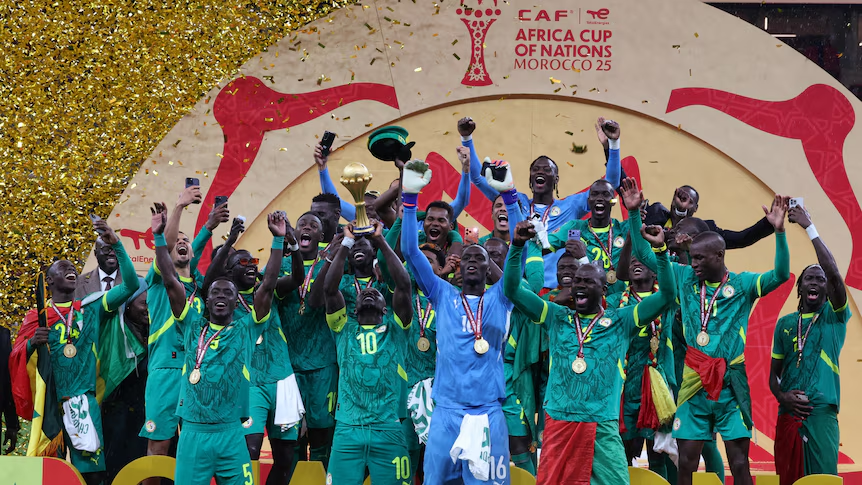
Lausanne, November 25, 2026: Senegal have officially regained their 2025 Africa Cup of Nations (AFCON) title after the Court of Arbitration for Sport (CAS) overturned a controversial decision that had awarded the championship to Morocco following their disputed final in January.
The ruling, announced on Tuesday, November 24, 2026, reinstates Senegal’s original 1-0 extra-time victory over Morocco and confirms the West African nation as continental champions for the second time.
A three-member CAS panel unanimously upheld the appeal filed by the Senegalese Football Federation (FSF) against the Confederation of African Football (CAF) and the Royal Moroccan Football Federation (FRMF).
The legal dispute arose after Senegal’s players temporarily left the pitch during the January 18 final in Rabat to protest a late penalty awarded to Morocco.
Although the match resumed and Senegal won through a goal by Pape Gueye, a CAF appeals panel subsequently declared that Senegal had forfeited the game and awarded Morocco a 3-0 victory.
CAS has now reversed that decision, ruling that the referee had the authority to restart the match and allow the result on the field to stand.
However, Morocco’s football federation has announced plans to challenge the latest ruling.
Senegal Officially Regain AFCON 2025 Title
The Court of Arbitration for Sport confirmed Senegal as the winners of the 2025 Africa Cup of Nations on November 24.
The Switzerland-based tribunal overturned the CAF Appeal Board’s decision that had stripped Senegal of the championship.
The tribunal reinstated the earlier decision of CAF’s Disciplinary Board, thereby restoring Senegal’s 1-0 victory.
The ruling means Senegal are once again officially recognised as the tournament winners.
It also reverses the 3-0 default victory previously awarded to Morocco.
The decision follows months of legal proceedings involving the two national football federations and Africa’s governing football body.
What Happened in the Senegal vs Morocco AFCON Final?
The controversy began during the Africa Cup of Nations final played in Rabat, Morocco, on January 18, 2026.
Senegal and Morocco were level at 0-0 late in regulation time.
Referee Jean-Jacques Ndala awarded Morocco a penalty following a disputed incident.
Senegal’s players protested the decision and temporarily walked off the pitch.
The interruption lasted approximately 14 minutes before the players returned.
After discussions and efforts to restore order, the referee allowed the match to resume.
Morocco failed to convert the penalty, and the game continued into extra time.
Senegal eventually secured victory through Pape Gueye’s decisive goal.
Pape Gueye’s Goal Restored as Championship Winner
Pape Gueye’s extra-time goal was the decisive moment in the original final.
His strike gave Senegal a 1-0 advantage over hosts Morocco.
The team maintained the lead and celebrated winning the tournament.
However, the result later became the subject of a legal dispute after CAF’s Appeal Board declared Senegal to have forfeited the match.
With the November 24 ruling, Gueye’s goal once again stands as the winning goal of the final.
Senegal’s sporting victory has therefore been restored to the official tournament record.
CAF Had Awarded Morocco a 3-0 Victory
On March 17, 2026, CAF’s Appeal Board ruled that Senegal’s temporary withdrawal from the pitch violated tournament regulations.
The board applied Articles 82 and 84 of the Africa Cup of Nations regulations.
Under its interpretation, Senegal’s conduct constituted a forfeiture.
The panel consequently recorded the match as a 3-0 victory for Morocco.
That decision overturned Senegal’s original win and transferred the championship to the tournament hosts.
The ruling was strongly contested by the Senegalese Football Federation, which maintained that the referee had properly resumed the match.
The dispute eventually reached the Court of Arbitration for Sport.
Senegal Challenges CAF Decision at Sports Court
The Senegalese Football Federation registered its appeal with CAS on March 25, 2026.
The federation requested that the CAF Appeal Board’s decision be overturned and Senegal’s original victory recognised.
Senegal argued that the referee’s decision to restart the match was an on-field judgment that should not be reconsidered through disciplinary proceedings.
The Moroccan federation defended the earlier decision, arguing that Senegal’s conduct violated tournament rules.
The case was heard in person at CAS headquarters in Lausanne on October 8.
After examining the arguments, the tribunal issued its unanimous decision on November 24.
CAS Says Referee Had Authority to Resume Match
The central question before CAS was whether the referee’s decision to restart the final could be overturned by CAF’s disciplinary authorities.
The tribunal determined that the referee possessed the authority to decide whether the match should continue.
Once both teams had returned to the pitch and expressed their willingness to play, the referee decided that the conditions for restarting had been met.
CAS found that this decision fell within the referee’s responsibility.
The tribunal also concluded that the referee had not committed an error of law by allowing the match to continue.
This finding became the foundation of Senegal’s successful appeal.
What Is the Field of Play Doctrine?
The CAS ruling relied heavily on a legal principle known as the field of play doctrine.
Under this principle, sporting decisions taken by referees during matches are generally respected by arbitration bodies.
Such decisions are not ordinarily overturned unless there is evidence of arbitrary conduct, bad faith or another legally recognised exception.
In the Senegal–Morocco dispute, CAS found that the referee’s decision to resume the game was covered by the doctrine.
The tribunal also concluded that Articles 82 and 84 applied to circumstances in which a team’s conduct caused a match to be permanently abandoned.
Because the final resumed and reached a sporting conclusion, those provisions did not justify awarding Morocco a default victory.
Three-Member CAS Panel Delivers Unanimous Verdict
The appeal was examined by a three-member arbitration panel.
Professor Gérald Simon of France served as president.
The other members were Professor Dr Ulrich Haas of Germany and Professor Luigi Fumagalli of Italy.
All three arbitrators supported the decision to uphold Senegal’s appeal.
The tribunal acknowledged that the referee had been required to make a decision during an exceptionally tense situation.
However, it found insufficient grounds to characterise his decision to restart the match as arbitrary.
The ruling reinstated Senegal’s original 1-0 win.
Morocco Announces Plans to Challenge CAS Ruling
The Royal Moroccan Football Federation has expressed disagreement with the CAS decision.
According to Reuters, Morocco intends to pursue further legal proceedings.
The federation raised concerns about alleged communications between Senegalese football officials and one member of the arbitration panel before the ruling.
Morocco’s allegations concern the integrity of the proceedings.
However, the Senegalese Football Federation denied the claims.
CAS arbitrator Ulrich Haas also denied having direct contact with the parties involved.
The allegations remain disputed and should not be treated as established misconduct.
Could Morocco Appeal the Decision Again?
Although CAS has reinstated Senegal as champions, Morocco has indicated that it may seek further legal review.
A challenge to a CAS award can be brought before Switzerland’s Federal Supreme Court in limited circumstances.
However, such proceedings generally concern specific legal or procedural grounds rather than a complete reconsideration of the sporting dispute.
Morocco’s federation has said it intends to challenge the decision.
As of November 25, the CAS ruling remains the operative decision confirming Senegal’s championship.
Any further legal developments will depend on the proceedings initiated by Morocco.
CAF Says It Will Respect the CAS Decision
The Confederation of African Football responded to the tribunal’s ruling by confirming that it would respect the award.
CAF indicated that it would take the necessary steps to implement the decision.
The announcement means Senegal’s original victory is once again recognised within the tournament’s official results.
The reversal is significant because CAF’s Appeal Board had previously awarded Morocco the championship.
The case has also raised broader questions about the relationship between tournament regulations and refereeing decisions.
Senegal Football Federation Welcomes Verdict
The Senegalese Football Federation welcomed the tribunal’s ruling as a victory for its legal position.
Federation president Abdoulaye Fall expressed satisfaction with the decision and emphasised the importance of sporting fairness.
He also sought to maintain positive relations with Morocco despite the dispute.
The federation’s response focused on recognition of Senegal’s achievement and the conclusion of the months-long appeal.
The ruling restores the championship that Senegal originally celebrated on the pitch in January.
Sadio Mane Calls for Respect Between Senegal and Morocco
Senegal football star Sadio Mane also reacted to the verdict.
Mane expressed respect for Morocco’s national team and supporters.
He emphasised the close relationship between the two countries and indicated that the dispute should not damage relations between their football communities.
His response came after months of disagreement surrounding the final.
The remarks reflected an effort to distinguish the legal controversy from the wider sporting relationship between Senegal and Morocco.
Senegal Become Two-Time African Champions
With the decision, Senegal’s second Africa Cup of Nations title has been restored.
The national team previously won the competition in the edition played in 2022.
Their latest championship came after defeating Morocco in the final of the 2025 edition, which concluded in January 2026.
The reinstatement therefore confirms Senegal’s place among Africa’s multiple AFCON winners.
The decision also carries symbolic importance for the players, coaching staff and supporters who originally celebrated the victory.
Why the CAS Ruling Matters for African Football
The legal dispute has attracted international attention because it concerns the authority of match officials and the interpretation of tournament regulations.
CAS determined that a completed match should not be declared forfeited under provisions intended for matches permanently abandoned by the referee.
The decision provides a significant example of how sports arbitration addresses disputes involving refereeing decisions.
However, the tribunal did not rule that temporary walk-offs are acceptable conduct.
CAS specifically recognised that separate disciplinary sanctions had already been imposed in connection with the final.
The ruling therefore distinguishes between disciplinary responsibility and the official result of a completed match.
What Happens Next After Senegal’s Reinstatement?
Following the decision, CAF is expected to implement the CAS ruling and maintain Senegal’s original victory in the tournament records.
The Senegalese Football Federation has welcomed the outcome.
Morocco’s federation has indicated that it intends to pursue a further legal challenge.
Any such proceedings would take place through the appropriate Swiss legal process.
The official result currently stands at Senegal 1, Morocco 0.
Further developments will depend on whether Morocco formally files its challenge and whether the competent court accepts any grounds for intervention.
Senegal AFCON Title Appeal: Key Highlights
Senegal have been reinstated as winners of the 2025 Africa Cup of Nations following a unanimous CAS ruling on November 24, 2026.
The decision restores their 1-0 extra-time victory over Morocco in the January 18 final.
CAF had previously declared Senegal to have forfeited the match and awarded Morocco a 3-0 win.
CAS ruled that the referee had the authority to restart the game after Senegal’s temporary walk-off.
The tribunal concluded that the relevant forfeiture provisions did not apply because the match was not permanently abandoned.
Senegal’s appeal was therefore upheld, restoring the nation’s second continental championship.
CAF has said it will respect the decision.
Morocco has announced plans to challenge the ruling, while Senegal has rejected allegations concerning the integrity of the arbitration process.
Source – Court of Arbitration for Sport Official Media Release (November 24, 2026), Reuters (November 24, 2026), Associated Press (November 25, 2026), Agence France-Presse (November 24, 2026)
Supreme News Network