

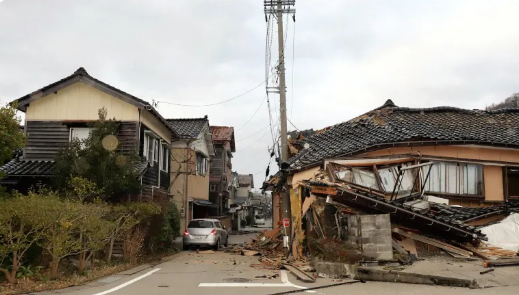
Tokyo, November 8, 2026: A powerful 5.7-magnitude earthquake struck central Japan early Sunday morning, injuring at least 22 people, damaging buildings and prompting emergency response measures across several prefectures.
According to the Japan Meteorological Agency (JMA), the earthquake occurred at approximately 1:04 AM local time, with its epicentre in western Shizuoka Prefecture at a depth of around 41 kilometres.
The strongest shaking was recorded in neighbouring Aichi Prefecture, where the city of Chita experienced an upper-5 intensity on Japan’s seven-level seismic intensity scale.
Earthquake Hits Central Japan Early Sunday
The earthquake struck while many residents were asleep, causing sudden shaking across central Japan.
The JMA initially estimated its magnitude at 5.7, while the United States Geological Survey recorded a slightly lower magnitude of 5.5.
The tremor was felt across Aichi, Shizuoka, Gifu, Nagano and several surrounding prefectures.
Although the strongest shaking occurred in Aichi, the earthquake’s epicentre was located in western Shizuoka, not Aichi itself.
At Least 22 People Reported Injured
According to the Associated Press, at least 22 people suffered injuries during the earthquake.
Some residents were injured while attempting to escape their homes or buildings as the shaking began.
Emergency responders assessed injuries and damage in affected areas.
The casualty figures are preliminary and may be revised as local authorities complete their assessments.
Shops Damaged as Strong Tremors Shake Buildings
The earthquake caused damage to shops and other structures in parts of central Japan.
Television footage showed shattered store windows, broken glass scattered across roads and books falling from shelves inside a bookstore.
Residents reported strong shaking that disturbed household items and furniture.
Authorities began assessing the extent of damage while warning people to remain cautious around damaged buildings.
Aichi Records Upper-5 Seismic Intensity
Japan uses a seismic intensity scale that measures how strongly shaking is experienced at different locations.
The city of Chita in Aichi Prefecture registered upper 5, indicating shaking strong enough to make movement difficult and cause unsecured objects to fall.
Other areas, including Seto in Aichi, Ena in Gifu and Hamamatsu in Shizuoka, recorded lower-5 intensity.
The readings demonstrate that the earthquake’s strongest effects were experienced beyond its epicentre.
No Tsunami Warning Issued
Japanese authorities confirmed that the earthquake did not generate a tsunami.
The JMA did not issue a tsunami warning following the tremor.
However, residents were advised to remain alert for aftershocks and possible hazards involving weakened structures.
Bullet Train Services Face Precautionary Restrictions
The earthquake also affected transportation across parts of central Japan.
Shinkansen bullet trains operating in affected areas were instructed to travel at reduced speeds as a precaution.
Transport operators conducted safety checks to ensure that infrastructure remained suitable for operation.
The precautionary restrictions were intended to protect passengers while officials evaluated the impact of the earthquake.
Japan Meteorological Agency Warns of Aftershocks
The JMA warned that further earthquakes could occur in the affected region over the following week.
Officials advised residents to exercise particular caution during the next two to three days, when the possibility of additional strong shaking may be greater.
Authorities also warned of falling rocks and landslides, especially in areas where rainfall could destabilise slopes.
Smaller earthquakes were recorded after the initial tremor.
Nankai Trough Situation Under Observation
Japan’s central region lies near tectonically active areas, including the Nankai Trough, which is associated with the possibility of major earthquakes.
Following the November 8 tremor, officials said there was no apparent change in the conditions being monitored at the Nankai Trough.
The latest earthquake should therefore not be interpreted as evidence that a larger Nankai Trough earthquake is imminent.
Japan’s disaster management agencies continue monitoring seismic activity throughout the country.
Authorities Urge Residents to Stay Prepared
Emergency officials encouraged residents to check emergency supplies, identify safe evacuation locations and remain cautious around damaged buildings.
People were advised to keep essential items accessible, including drinking water, medication, flashlights and suitable footwear.
Residents were also encouraged to follow official earthquake updates rather than relying on unverified social media reports.
Latest Japan Earthquake Update
As of November 8, 2026, the confirmed earthquake magnitude was approximately 5.7 according to Japan’s Meteorological Agency.
At least 22 injuries had been reported, with damage identified in several areas of central Japan.
No tsunami warning was issued, while transport operators introduced precautionary measures.
The authorities are continuing to assess damage and monitor aftershocks.
The earthquake highlights Japan’s continuing exposure to seismic hazards and the importance of emergency preparedness in vulnerable regions.
Source: Japan Meteorological Agency, November 8, 2026; Associated Press; Jiji Press; Outlook India
Supreme News Network