

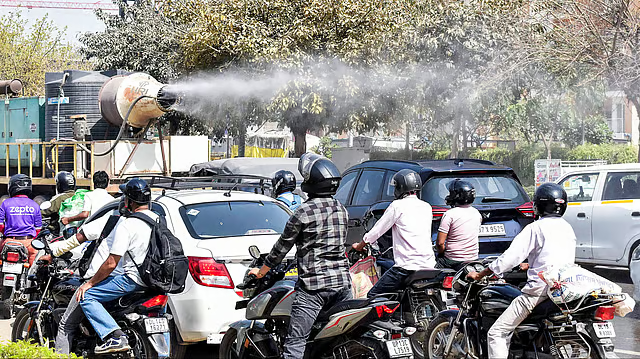
New Delhi, November 7, 2026: The Supreme Court of India has expressed serious concern over worsening air pollution in Delhi-NCR, identifying vehicular emissions and heavy traffic congestion as major contributors to the crisis. During a hearing on Friday, November 6, the court questioned why pollution levels continue to approach the severe category despite several government measures.
The observations came as Delhi’s Air Quality Index (AQI) reached 391 on November 6, prompting authorities to strengthen emergency pollution-control restrictions ahead of Diwali.
Supreme Court Questions Delhi’s Pollution-Control Measures
A three-judge bench comprising Chief Justice of India Surya Kant and Justices Joymalya Bagchi and V Mohana was hearing a suo motu case concerning the regulatory framework for controlling air pollution.
The bench questioned the effectiveness of existing restrictions on vehicles, construction and other pollution-generating activities.
Chief Justice Surya Kant observed that the city’s AQI was approaching 400 despite repeated interventions by authorities.
The court stressed that Delhi needs immediate, medium-term and long-term solutions rather than relying only on temporary restrictions.
Vehicle Emissions Identified as Major Pollution Source
The Supreme Court highlighted the enormous number of vehicles operating across Delhi-NCR.
The bench referred to heavy traffic on roads connecting Delhi with Ghaziabad, Greater Noida, Gurugram and Faridabad.
It noted that bumper-to-bumper congestion contributes significantly to air pollution, particularly when vehicles remain stationary with their engines running.
The Chief Justice also raised concerns about the limited availability of convenient public transport, which encourages greater dependence on private vehicles.
Court Questions Effectiveness of Existing Restrictions
During the hearing, the court asked why pollution continues to worsen despite several regulatory measures.
Additional Solicitor General Aishwarya Bhati, representing the authorities, explained that steps had been taken to control emissions.
These measures include vehicle restrictions, geo-tagging of Pollution Under Control certificates and action against visibly polluting vehicles.
However, the bench questioned whether the existing approach was sufficient to address the scale of the problem.
The court suggested that repeatedly imposing short-term restrictions without addressing underlying causes would not provide a lasting solution.
Delhi’s AQI Reaches 391
Delhi’s air quality deteriorated sharply on November 6, with the overall AQI reaching 391, close to the severe category.
According to official monitoring data, 30 of Delhi’s 59 air-quality monitoring stations recorded severe pollution levels during the morning.
Rohini registered an AQI of 475, while IIT Delhi recorded 472.
The worsening conditions prompted the Commission for Air Quality Management (CAQM) to implement Stage 3 of the Graded Response Action Plan (GRAP).
These restrictions include measures targeting pollution from construction, transportation and other sources.
Supreme Court Raises Concerns Over Stubble Burning
The bench also discussed agricultural stubble burning in neighbouring states.
During the hearing, the court was informed that stubble burning contributed approximately 14% of Delhi’s pollution on November 5.
However, the judges noted that vehicle emissions and other local sources also require significant attention.
The court suggested that farmers should be encouraged to avoid crop-residue burning through practical alternatives and financial incentives.
It proposed that procurement agencies could purchase agricultural residue at predetermined rates, making it economically beneficial for farmers to retain rather than burn it.
Public Transport and Traffic Management Need Improvement
The Supreme Court highlighted the need to improve public transportation infrastructure across Delhi-NCR.
The bench noted that commuters frequently depend on personal vehicles because public transport may not adequately meet their needs.
It also raised concerns about congestion at toll plazas and entry points, where vehicles remain stationary for extended periods.
Senior advocate Aparajita Singh, assisting the court as amicus curiae, pointed out that previous directions aimed at reducing congestion had not been fully implemented.
Improving mass transport and reducing unnecessary vehicle movement could form part of a longer-term pollution-control strategy.
Court Highlights Impact on Poor and Vulnerable Residents
The Supreme Court expressed concern about the disproportionate impact of pollution on economically weaker sections.
The bench observed that daily wage workers and others who spend long hours outdoors face greater exposure to polluted air.
Unlike people who can remain indoors or work remotely, many workers have limited options to avoid hazardous conditions.
The court also acknowledged that restrictions on economic activities can affect livelihoods, particularly during the festive season.
It emphasised the need for practical solutions that address pollution without unnecessarily burdening vulnerable communities.
School Closures and Hybrid Classes Discussed
The court also considered a plea seeking school closures or hybrid learning arrangements when air pollution crosses specified thresholds.
The bench indicated that it would rely on expert recommendations before deciding whether broader restrictions were necessary.
The issue is particularly important because children are more vulnerable to the harmful effects of air pollution.
Authorities have already introduced certain school-related measures under the applicable GRAP restrictions.
Further decisions will depend on pollution conditions and expert assessments.
Court Calls for Greater Public Awareness
The Supreme Court stressed that government orders alone cannot eliminate Delhi’s pollution problem.
The bench highlighted the importance of public participation, changes in commuting habits and greater environmental awareness.
It also discussed the impact of festival-related activities on air quality.
The judges suggested that long-term improvements would require cooperation among residents, businesses, governments and regulatory authorities.
Next Hearing Scheduled for November 16
The Supreme Court is expected to examine the matter again on November 16, 2026, after the Diwali vacation.
The bench indicated that it would consider further directions concerning pollution-control measures and related issues.
Meanwhile, Delhi-NCR authorities will continue implementing GRAP restrictions as air quality remains a major concern.
The court’s latest observations have renewed attention to the need for stronger public transport, effective vehicle-emission controls and sustainable solutions to agricultural waste burning.
The November 6 hearing highlighted a central challenge: Delhi’s air pollution cannot be addressed through emergency restrictions alone without tackling its underlying sources.
Source: The Indian Express, November 7, 2026; PTI; Hindustan Times; The New Indian Express
Supreme News Network