

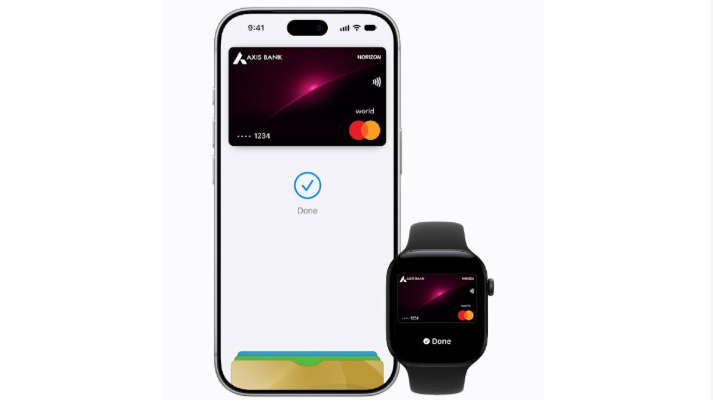
NEW DELHI, October 1: Apple Pay has officially launched in India, marking the entry of Apple’s digital payment service into one of the world’s largest and fastest-growing payments markets. At launch, the service supports eligible Axis Bank-issued Visa and Mastercard credit cards, allowing Apple users to make contactless payments in stores and pay within supported apps and websites.
Axis Bank has become the first Indian bank to offer Apple Pay, while Apple is expected to expand support to additional banks and cards over time.
Apple Pay Makes India Debut
Apple Pay was officially introduced in India on September 30, bringing the service to Indian customers after years of expansion across international markets.
The payment platform is initially available on compatible iPhone, Apple Watch and iPad devices, while support for Mac is expected to be introduced subsequently.
Axis Bank Becomes First Indian Banking Partner
Axis Bank is Apple Pay’s first banking partner in India.
Eligible Axis Bank credit card customers using the Visa and Mastercard networks can add their cards to Apple Wallet and begin making payments through supported Apple devices.
The bank said customers will continue receiving the existing rewards and benefits associated with their eligible credit cards.
RuPay Cards Not Supported Initially
Axis Bank credit cards operating on India’s domestic RuPay network are not included in the initial Apple Pay rollout.
The launch currently focuses on Visa and Mastercard credit cards.
Support could expand as Apple develops additional partnerships in the Indian financial services market.
Users Can Add Cards Through Apple Wallet
Eligible customers can set up Apple Pay directly through the Apple Wallet application.
Users can open Wallet on their iPhone, select the option to add a card and complete the verification process with Axis Bank.
Customers can also initiate the process using Axis Bank’s mobile banking application.
Contactless Payments Available at Stores
Once the card has been added, users can make payments at compatible contactless payment terminals.
To complete a transaction, users can double-click the side button on their iPhone, authenticate themselves and hold the device near the contactless terminal.
Apple Pay can also be used through Apple Watch at supported payment terminals.
Face ID and Touch ID Used for Authentication
Apple Pay relies on device-level security for payment authentication.
Transactions can be authorised using Face ID, Touch ID or the device passcode, depending on the Apple device being used.
This means users generally do not need to manually type their full card information each time they make a payment.
Online and In-App Payments Also Supported
Apple Pay is not limited to physical stores.
Customers can also use the service for purchases within participating apps and websites that display Apple Pay as a checkout option.
Users can review their payment and delivery information before authenticating the transaction through their device.
Apple Pay Does Not Store Actual Card Number
Security and privacy are central features of the payment service.
When an eligible card is added to Apple Pay, the actual card number is not stored on the device or Apple’s servers.
Instead, a unique Device Account Number is assigned, encrypted and stored in the device’s Secure Element.
Card Details Are Not Shared With Merchants
The customer’s actual card number is also not shared with the merchant during an Apple Pay transaction.
Tokenisation technology is used to protect sensitive payment details.
This approach is designed to reduce exposure of card information during both online and contactless transactions.
Apple Pay Works Differently From UPI
Apple Pay’s initial Indian implementation is fundamentally different from services based on the Unified Payments Interface (UPI).
UPI generally enables direct bank-to-bank payments, while Apple Pay in India initially operates using eligible credit cards linked to Apple Wallet.
This means Apple Pay will complement rather than directly replicate the existing UPI payment experience.
UPI Already Dominates Indian Digital Payments
Apple is entering a market where UPI has become the dominant digital payment infrastructure.
Consumers across India already use QR-based and mobile payments extensively for transactions ranging from small retail purchases to online shopping.
Apple Pay will therefore compete for user attention in a market where digital payments are already deeply established.
Thousands of Merchants to Support Apple Pay
Apple says customers will be able to use Apple Pay at thousands of in-store and online merchants across India.
The service can be used wherever a compatible contactless payment terminal or Apple Pay checkout option is available.
Eligible cards may also be used internationally at merchants that accept supported NFC payments.
No Separate Apple Pay App Required
Apple Pay is integrated into Apple Wallet rather than requiring users to install a separate payment application.
Once an eligible credit card has been added, users can access the payment feature directly through their Apple devices.
The integrated system is intended to make checkout quicker for customers already using Apple products.
Existing Axis Bank Rewards Continue
Axis Bank has confirmed that eligible credit card customers using Apple Pay will continue to receive the rewards and benefits attached to their cards.
This means customers do not have to sacrifice card-linked benefits simply because a transaction is completed through Apple Pay.
The exact rewards available will continue to depend on the individual card and transaction conditions.
More Banks Could Be Added Later
Axis Bank is currently the only Indian bank listed as supporting Apple Pay.
Apple’s official support page indicates that its list of eligible banks will be updated as additional financial institutions are added.
The company has also reportedly held discussions with other major Indian banks as it considers expanding the service.
India Becomes Part of Apple Pay’s Global Network
Apple Pay is now available in more than 90 countries and regions.
The platform works with over 11,000 banking and payment-network partners worldwide, making India the latest major market to join Apple’s international payments ecosystem.
The launch also reflects Apple’s broader effort to deepen its presence in India beyond smartphones and computers.
Launch Strengthens Apple Ecosystem in India
India has become an increasingly important market for Apple, with the company expanding retail stores, manufacturing and services in the country.
Adding Apple Pay provides another service designed to keep customers within Apple’s hardware and software ecosystem.
The payments launch could also make Apple devices more attractive to customers who frequently use credit cards for contactless and online transactions.
Competition in Indian Payments Set to Increase
Apple Pay enters a highly competitive Indian market that already includes widely used platforms such as Google Pay, PhonePe and Paytm alongside banks’ own payment services.
However, Apple Pay’s initial card-based approach differentiates it from many UPI-focused services.
Its growth in India will likely depend on how quickly Apple adds more banks, payment networks and participating merchants.
Rollout Begins With Limited Card Support
For now, Apple Pay’s Indian launch remains relatively focused.
Customers need an eligible Axis Bank Visa or Mastercard credit card and a compatible Apple device to use the service.
Expansion to additional banks and card networks could significantly increase its reach in the coming months and years.
Source – Apple / Axis Bank / Reuters / The Indian Express Apple
Supreme News Network