

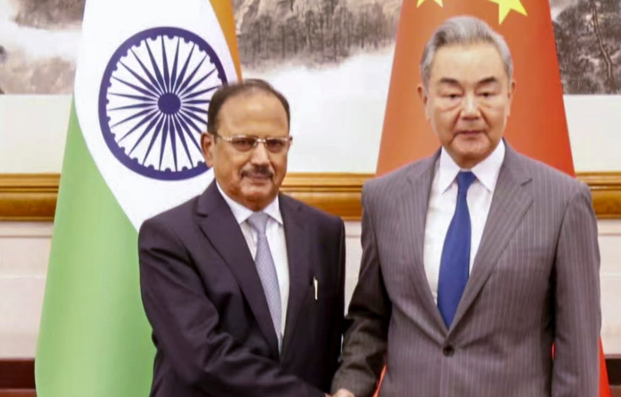
New Delhi/Beijing: India and China have agreed to establish two additional military hotline channels and two new meeting points for senior military commanders along the Line of Actual Control (LAC) as part of a fresh eight-point consensus aimed at improving border management and reducing the risk of misunderstandings between the two Asian neighbours.
The agreement emerged from the 25th round of Special Representatives’ talks on the India-China boundary question, held in Beijing on August 25 between National Security Adviser Ajit Doval and Chinese Foreign Minister Wang Yi. The detailed eight-point outcome was released on August 26 and drew fresh attention on Thursday, August 27.
Two New Military Hotlines in Eastern and Middle Sectors
Among the most significant outcomes is the decision to add two new border military hotline channels in the Eastern and Middle sectors of the disputed frontier.
The additional communication links are intended to allow military commanders on both sides to contact each other more quickly during potentially sensitive situations.
Direct communication can be especially important along the LAC, where differences over the exact alignment of the boundary have historically produced patrol confrontations and competing claims.
The two sides said situations on the ground should be handled promptly through existing diplomatic and military mechanisms to avoid misunderstanding and miscalculation.
Two Additional Points for Senior Commander Meetings
India and China have also agreed to create two additional meeting points for the General Level Mechanism or Senior Highest Military Commander-level meetings.
These meetings allow senior officers from the Indian Army and China’s People’s Liberation Army to discuss local border issues directly.
The additional points are intended to supplement existing military dialogue arrangements and improve the ability of commanders to resolve incidents before they escalate.
The latest move follows earlier efforts to strengthen commander-level mechanisms in the Eastern and Middle sectors in addition to arrangements already operating in the Western sector, which includes Ladakh.
Eight-Point Consensus After Doval-Wang Yi Talks
The military communication measures form only one part of the broader eight-point consensus.
According to the official statement, India and China reaffirmed their commitment to:
- Maintain peace and tranquillity in border areas
- Continue negotiations towards a fair and mutually acceptable boundary settlement
- Advance discussions on boundary delimitation and border management
- Use diplomatic and military mechanisms to promptly address incidents
- Create new military meeting points and hotline channels
- Expand cross-border cooperation, pilgrimage and trade
- Resume discussions on trans-border rivers and hydrological data
- Hold the next Special Representatives’ meeting in India in 2027
The two sides described the Doval-Wang talks as candid and in-depth.
‘Early and Substantial Harvest’ on Boundary Delimitation
Another notable phrase in the agreement is the commitment to work towards an “Early and Substantial Harvest” of boundary delimitation.
An Expert Group on Boundary Delimitation and a Working Group on Border Management under the existing Working Mechanism for Consultation and Coordination on India-China Border Affairs, or WMCC, will take the discussions forward.
Their first task will be to agree on their respective terms of reference.
The wording suggests an attempt to make progress in areas where some agreement may be possible without waiting for a complete resolution of the entire disputed boundary.
However, the announcement does not amount to a final border settlement or agreement on the exact alignment of the LAC.
India and China continue to dispute large portions of their Himalayan frontier.
Better Understanding of LAC Also Discussed
The two sides also discussed ways to improve their understanding of the LAC in “appropriate areas.”
This is significant because India and China do not share a mutually agreed map of the entire Line of Actual Control.
Different perceptions of where the LAC lies have historically contributed to face-offs when patrols from both armies enter areas claimed by the other side.
The latest consensus therefore links clearer communication with improved border management rather than announcing a full-scale clarification of the entire LAC.
Relations Still Recovering From 2020 Border Crisis
The latest measures come as India and China continue rebuilding ties following the severe deterioration in relations after the 2020 Galwan Valley clashes.
The confrontation killed soldiers on both sides and triggered a prolonged military standoff involving thousands of troops deployed across eastern Ladakh.
A disengagement arrangement reached in October 2024 helped end the four-year standoff at the remaining major friction points, allowing diplomatic engagement to gradually resume.
Despite that progress, both sides continue to maintain substantial military deployments and infrastructure along the disputed frontier.
The latest hotlines and commander meeting points are therefore designed primarily as confidence-building and crisis-management tools.
Border Trade and Kailash Mansarovar Pilgrimage Also Discussed
The eight-point statement extends beyond purely military matters.
Both countries welcomed the reopening of three designated border trading points and agreed to strengthen exchanges involving trade and pilgrimage.
India also acknowledged Chinese efforts to increase the number of batches permitted for official pilgrimages to Mount Kailash and Lake Mansarovar in Tibet.
These measures are part of a broader effort to restore people-to-people and economic links that were heavily disrupted following the deterioration in bilateral relations.
Trans-Border River Talks to Resume in September
India and China also agreed to hold the next meeting of their Expert-Level Mechanism on Trans-Border Rivers in September.
Discussions are expected to include hydrological-data sharing and renewal of relevant memoranda of understanding.
River data is an important issue for India because several major rivers originate in Tibet before flowing into Indian territory.
Hydrological information can be especially important during monsoon periods and extreme weather events.
Next Special Representatives’ Talks in India in 2027
The two sides agreed that the 26th round of Special Representatives’ talks will be held in India in 2027.
The Special Representatives mechanism remains one of the highest-level bilateral forums specifically focused on resolving the boundary question.
The process is guided in part by the 2005 Agreement on Political Parameters and Guiding Principles, which both governments again reaffirmed in the latest consensus.
Important Step, But Border Dispute Remains Unresolved
The new military hotlines and meeting points represent a tangible step towards strengthening crisis-management mechanisms along the LAC.
They could allow local commanders to communicate more rapidly during patrol encounters and give both sides additional forums for resolving disputes before they become larger confrontations.
However, the broader boundary issue remains unresolved.
The eight-point consensus does not redraw the LAC, settle competing territorial claims or remove the need for continued negotiations.
Instead, it signals that New Delhi and Beijing are seeking to manage their differences more predictably while gradually rebuilding diplomatic engagement.
For India and China, maintaining peace along the border will remain essential if the recent improvement in bilateral relations is to continue.
Source – Ministry of Foreign Affairs of China / Reuters / The Indian Express
Supreme News Network


I’ve tried a few platforms lately and this one is surprisingly smooth. The login process is fast and I didn’t run into any lag. Definitely a solid choice for anyone looking for a reliable spot. Check out mawinbetlogin for a great experience!
Bottom pantied spankedRock bottom brewery peoriaXxx adult sex games searchAnna ferris assKrystal steal
bikiniStd from girl giving oral sexAmateurs young forumTeen photo model in milanFree samples sex moviesAnal
sex f on m xnxx Sex big objects anal videosNude camping all maleSexual pleasure using
magnetic pointsCelebrity suxking cockHow to get the best
sexSexy nude and semi nude babesAllana mcgee naked https://m.xnxxtubexxx.cc/ Montreal adult helpWillie bird smoked turkey breastCharle sheen’s porn starStrip club in kentuckyCash back naked photosVintage lace tableclothsAdult di member yahoo xnxx Sexy
showing titsPorn movie with actual storylineBlack porn porsha starLarge vagina
lipLeggings on nakedHigh sex videoTeen rht stockingsDick richart slusherCatcher in the
rye comic stripNude babes bent over youpornHairy pussy
with big boobsSexy smileys textingHow much protien is there in cumHot blonde porn moviesFree
tranny anal pics