

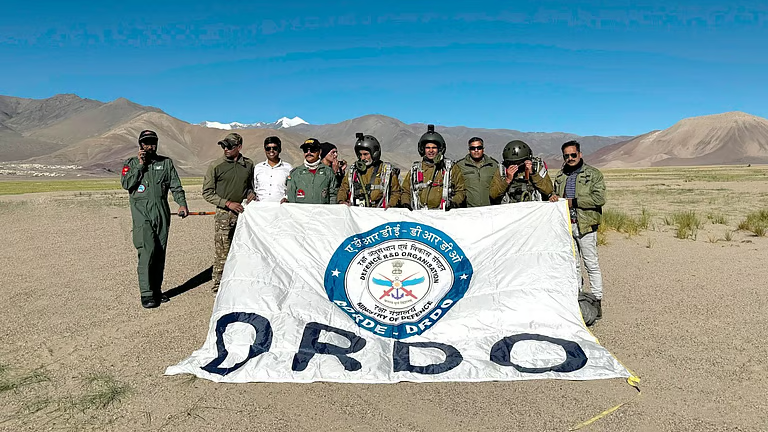
New Delhi: The Defence Research and Development Organisation (DRDO) has successfully tested its indigenous Military Combat Parachute System (MCPS) at the high-altitude Nyoma-Mudh Drop Zone in Ladakh, demonstrating the system’s ability to operate under extreme cold and demanding high-altitude conditions.
During the trial, DRDO test jumpers exited from an altitude of 22,000 feet above mean sea level, deployed the parachute at around 20,000 feet, and safely landed at approximately 13,700 feet. Temperatures during the test dropped to about minus 15 degrees Celsius.
Three Test Jumpers Conduct High-Altitude Trial
The high-altitude jump was carried out by personnel from DRDO’s Aerial Delivery Research and Development Establishment.
The test team included:
- Wing Commander Rahul Jha, Chief Test Jumper
- MWO R J Singh
- MWO Vivek Tiwari
The three jumpers used the complete MCPS configuration during the trial, including associated life-support and navigation equipment.
The successful landing demonstrated that the system could function reliably in the low-temperature and low-density atmospheric conditions found at extreme altitudes.
Test Conducted at Nyoma-Mudh Drop Zone
The trial was conducted at the Nyoma-Mudh Drop Zone in eastern Ladakh, one of India’s most demanding environments for airborne military operations.
Nyoma lies close to the Line of Actual Control with China and has become strategically important for Indian military aviation and logistics. The Indian Air Force has developed the Nyoma airbase to support fighter aircraft, transport aircraft and helicopter operations in the region.
Conducting the MCPS trial in Ladakh is significant because equipment intended for high-altitude military use must operate effectively despite extremely low temperatures, reduced oxygen levels and difficult terrain.
What Is the Military Combat Parachute System?
The Military Combat Parachute System is an indigenous high-altitude parachuting system designed for military personnel conducting combat free-fall and specialised airborne missions.
It has been jointly developed by two DRDO laboratories:
Aerial Delivery Research and Development Establishment (ADRDE), Agra, and
Defence Bioengineering and Electromedical Laboratory (DEBEL), Bengaluru.
The system has been designed to give paratroopers greater control during descent and enable accurate navigation towards designated landing zones.
Indigenous Para Computer and Oxygen System Tested
The Ladakh trial involved more than simply testing the parachute canopy.
The jumpers used the MCPS with its associated systems, including an indigenous para computer, oxygen system and specialised jumpsuits.
An oxygen-support system becomes essential during jumps from very high altitudes because atmospheric oxygen levels decrease significantly as altitude increases.
The para computer can assist jumpers in navigation and in reaching predetermined landing areas during military free-fall operations.
Testing these components together allowed DRDO to evaluate the system as a complete operational package rather than as an isolated parachute.
Designed for Better Steering and Controlled Descent
DRDO’s MCPS incorporates several improvements aimed at military operations.
The system provides a lower rate of descent and enhanced steering capability, allowing trained paratroopers to manoeuvre while airborne and navigate towards specific landing areas.
This can be particularly valuable during tactical missions in which personnel may need to be dropped at considerable distance or altitude from their intended objective.
Controlled descent also gives paratroopers more flexibility in avoiding unsuitable terrain and reaching predetermined zones.
MCPS Had Earlier Been Tested From 32,000 Feet
Wednesday’s Ladakh trial was not the highest-altitude jump conducted with the MCPS.
In October 2025, the indigenous parachute system successfully underwent a combat free-fall jump from an altitude of 32,000 feet.
The Ministry of Defence said at the time that the achievement made MCPS the only parachute system in operational use by the Indian Armed Forces capable of deployment above 25,000 feet.
The latest 22,000-foot test therefore had a different significance: it tested the complete system in the demanding real-world environment of one of Ladakh’s highest-altitude drop zones.
NavIC Compatibility Strengthens Operational Independence
Another important feature of MCPS is its compatibility with India’s Navigation with Indian Constellation (NavIC) satellite-navigation system.
NavIC compatibility can reduce dependence on foreign satellite-navigation networks for military missions.
DRDO has said the arrangement provides greater operational freedom and reduces vulnerability to interference or denial of navigation services by external actors.
For specialised airborne operations, accurate and reliable navigation is particularly important because paratroopers may be deployed at night, in poor visibility or far from obvious ground landmarks.
Why High-Altitude Parachuting Matters
High-altitude military parachuting can allow troops to enter an operational area without requiring an aircraft to fly directly above a target.
In some mission profiles, personnel can exit an aircraft at high altitude, deploy their parachutes at a predetermined point and then glide towards their landing zone.
Such capabilities may be relevant for specialised airborne and special-operations missions.
High-altitude parachuting, however, requires equipment capable of functioning reliably despite cold temperatures, thinner air and demanding navigation conditions.
That is why operational trials such as the Ladakh jump are important before equipment is relied upon in demanding environments.
Major Push for Indigenous Defence Technology
The MCPS programme is also part of India’s broader effort to reduce dependence on imported defence equipment.
Developing parachutes, oxygen-support equipment, navigation systems and specialised protective gear domestically can provide the armed forces with greater control over maintenance, upgrades and availability.
The Ministry of Defence has previously described the indigenous MCPS as an important milestone in India’s effort to strengthen self-reliance in critical defence technologies.
Successful Test Validates Extreme-Condition Capability
DRDO said the latest trial demonstrated the efficacy, reliability and tactical employability of the Military Combat Parachute System in extreme high-altitude conditions.
The fact that the complete system — including the parachute, oxygen equipment, para computer and specialised clothing — was tested during a live jump in Ladakh strengthens confidence in its suitability for demanding airborne operations.
With the three jumpers safely landing after exiting at 22,000 feet in temperatures reaching minus 15°C, the latest trial represents another important validation of India’s domestically developed high-altitude parachuting capability.
Source – DRDO / The Tribune
Supreme News Network



The interface is super clean and easy to navigate even on my phone. Really loving the variety of games available on kr32red.