

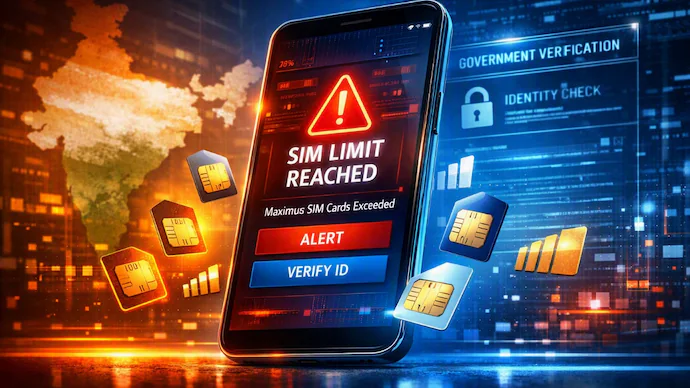
New Delhi: India is set to strengthen enforcement of its mobile connection limits from August 24, 2026, with telecom operators required to identify subscribers who already hold the maximum permitted number of SIM cards and prevent them from obtaining additional connections.
Under directions from the Department of Telecommunications (DoT), telecom service providers will begin checking the total number of mobile connections registered in an individual’s name before allowing further connections.
The move is aimed at improving subscriber verification, preventing misuse of mobile connections and strengthening safeguards against fraud and other illegal activities involving SIM cards.
How Many SIM Cards Can One Person Have?
Under existing DoT rules, an individual can hold a maximum of nine mobile connections in their name across telecom operators and licensed service areas in most parts of India.
However, a lower limit of six mobile connections applies in the telecom service areas of:
- Jammu & Kashmir
- Assam
- North-East
The nine-connection ceiling has existed under earlier DoT instructions. The major change from August 24 is that telecom operators will now be required to enforce this limit through a more systematic verification mechanism.
What Changes From August 24?
From August 24, telecom companies will have to identify customers applying for a new mobile connection despite already having the maximum number of permitted connections registered in their name.
If a subscriber has already reached the applicable limit, the telecom operator must decline the request for an additional connection.
During the initial phase, the checking system can operate on a post-facto basis, meaning verification may take place one day after the connection is enrolled.
If a connection is activated beyond the permitted limit during this transitional period, it will have to be suspended until the issue is resolved.
Real-Time Verification Coming by November 30
The government has directed telecom operators to move from post-facto checks to a real-time verification system by November 30, 2026.
Once implemented, the system is expected to check a subscriber’s existing mobile connections during the enrolment and activation process itself.
This means that if a person has already reached the permitted limit, the system should be able to detect it immediately and prevent another connection from being issued.
The real-time system is expected to make enforcement faster and reduce the possibility of multiple connections being issued beyond prescribed limits.
Why Is the Government Enforcing the SIM Limit?
Mobile numbers have become closely linked with critical digital services in India, including banking, UPI payments, Aadhaar-linked services, online accounts and one-time passwords.
SIM cards obtained using fraudulent or misused identities can therefore be used in cybercrime, financial fraud, impersonation and other unlawful activities.
Stricter verification is intended to improve accountability by ensuring that mobile connections can be correctly linked to legitimate subscribers.
The government has increasingly focused on telecom cybersecurity and subscriber identification as part of its broader efforts to fight digital fraud and prevent misuse of telecommunications networks.
What Existing SIM Users Need to Know
For most users, the change should not require any action.
People who hold fewer than the permitted number of connections can continue using their existing SIM cards and can obtain additional connections until they reach the applicable ceiling.
However, subscribers who already hold the maximum permitted number of connections will not be allowed to obtain another SIM in their name.
Consumers should therefore be aware of how many active mobile numbers are registered using their identity, particularly if they have changed operators or accumulated several connections over the years.
Existing Connections Are Not Automatically Being Cancelled
The August 24 change should not be interpreted as a blanket cancellation of mobile connections.
The primary purpose of the new system is to prevent additional connections from being issued beyond the permitted limit and to improve enforcement of subscriber-verification rules.
Telecom companies will initially perform post-facto checks before shifting to real-time verification by the November 30 deadline.
Stricter SIM Verification Ahead
With mobile numbers increasingly serving as digital identities for financial and online services, authorities are placing greater emphasis on ensuring that SIM cards are issued only to properly verified subscribers.
The enforcement system starting August 24 marks another step in India’s efforts to strengthen telecom security and reduce the misuse of mobile connections.
For consumers, the key rule is straightforward: a maximum of nine mobile connections in most of India and six in Jammu & Kashmir, Assam and the North-East, with telecom operators now required to enforce those limits more strictly.
Source – The Times of India
Supreme News Network



I’ve been playing here for a few weeks and the payouts are surprisingly fast. Definitely one of my new favorite spots to hang out and win. Check it out at phjlj555