

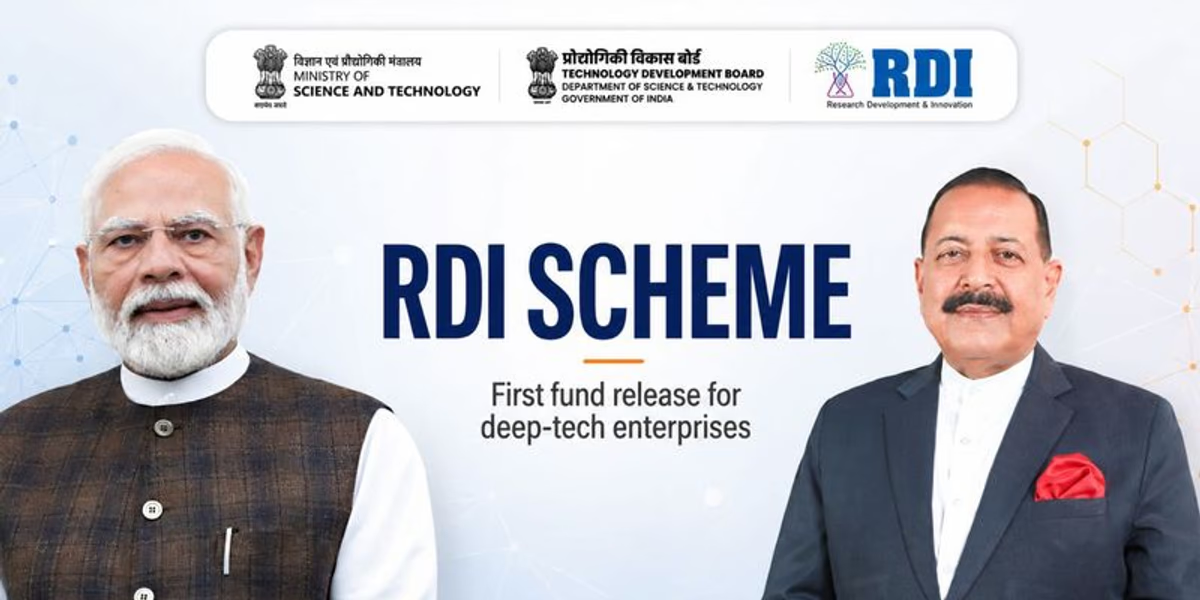
The Centre has defended the implementation of India’s Research, Development and Innovation (RDI) Fund, saying that strong institutional safeguards are in place to address concerns over potential conflicts of interest.
The clarification comes after an investigation raised questions about the allocation of funds to private companies that have links to members of the panel involved in selecting beneficiaries. The government said the fund’s framework contains specific provisions to prevent members with financial or operational interests from participating in decisions involving those companies.
Government Says Conflict Safeguards Are in Place
Officials from the Ministry of Science and Technology said the RDI Fund operates under an established institutional framework.
According to the government, conflict-of-interest safeguards go beyond simply requiring panel members to disclose their investments. Companies in which selection-panel members have an operational role can be excluded from applying, while members with relevant financial interests are required to stay away from related decisions.
The government said these measures are designed to maintain the integrity of the selection process while allowing experienced industry professionals to participate in evaluating technology proposals.
Why the RDI Fund Is Under Scrutiny
The controversy emerged after an investigation examined the first round of funding from the government’s ambitious technology-support programme.
The ₹1 lakh crore RDI Fund was created to encourage private-sector investment in research, development and innovation, particularly in areas involving deep technology and strategic technologies.
An investigation reported that a significant portion of the first round of approximately ₹2,192 crore in funding went to companies that had investment connections with members of the selection panel. This prompted questions about transparency and possible conflicts of interest.
Centre Says Industry Experts Are Necessary
The government has maintained that the involvement of industry experts is important because RDI projects often require specialised technical and commercial knowledge.
Officials said excluding experienced professionals simply because they have investments or industry connections would make it difficult to build an effective evaluation mechanism.
Instead, the framework uses disclosure, recusal and eligibility restrictions to manage potential conflicts.
What Is the RDI Fund?
The Research, Development and Innovation Fund was established under the Anusandhan National Research Foundation (ANRF) with a corpus of ₹1 lakh crore.
Its objective is to encourage private companies and startups to develop and scale technology-intensive innovations.
The fund is intended to support areas such as:
- Deep technology
- Artificial intelligence
- Advanced energy technologies
- Space technology
- Strategic technologies
- Biotechnology
- New industrial technologies
The official RDI framework says the programme is designed to provide long-term financing to companies developing technologies that require substantial investment and may take years to reach commercial scale.
Two-Level Funding Structure
The RDI Fund uses a two-level funding structure.
The first level is managed through an independent business unit under the ANRF. Funds are then provided to selected Second Level Fund Managers, which can invest in eligible technology companies and startups.
This structure is intended to combine government funding with professional investment and technology evaluation expertise.
Focus on India’s Deep-Tech Ecosystem
The government sees the RDI Fund as an important part of India’s strategy to strengthen its domestic innovation ecosystem.
The programme aims to reduce the financial risks faced by companies working on technologies that require long development cycles and significant capital.
By providing relatively affordable long-term financing, the government hopes to encourage more private investment in research and technology development.
Transparency Remains a Key Issue
Despite the Centre’s defence, the controversy has renewed calls for greater transparency in the distribution of public funds.
Critics have questioned whether disclosure and recusal mechanisms are sufficient when selection-panel members have financial connections with companies receiving government-backed funding.
The government, however, maintains that the existing rules provide adequate safeguards and that panel members are required to follow conflict-of-interest provisions.
Parliamentary Attention
The RDI Fund has also attracted attention in Parliament.
A parliamentary committee had earlier recommended speeding up the appointment of additional fund managers from the private sector, financial institutions and venture-capital firms to broaden the scheme’s reach and strengthen project evaluation.
The latest controversy is therefore likely to keep the implementation and governance of the fund under scrutiny as more companies receive financial support.
Looking Ahead
The RDI Fund is expected to play a major role in India’s push to expand private-sector research and develop globally competitive deep-tech companies.
The immediate challenge for the government will be to demonstrate that the fund can deliver its technology and innovation objectives while maintaining transparent, credible and conflict-free funding decisions.
As the scheme expands, greater disclosure of funding decisions and stronger monitoring mechanisms could become increasingly important for maintaining public confidence.
Source: Ministry of Science and Technology and latest reports published on August 7–8, 2026.
Original Report: The Centre has rejected conflict-of-interest concerns surrounding the RDI Fund and said stringent safeguards govern the participation of selection-panel members.
Supreme News Network



[9735]Linebet Official Login BD | সেরা অনলাইন ক্যাসিনো এবং অ্যাপ ডাউনলোড,linebet-এ যোগ দিন এবং বিকাশ দিয়ে সহজ পেমেন্টের মাধ্যমে সেরা অনলাইন ক্যাসিনো গেম উপভোগ করুন। অ্যাপ ডাউনলোড করে আজই খেলা শুরু করুন। visit: linebet