
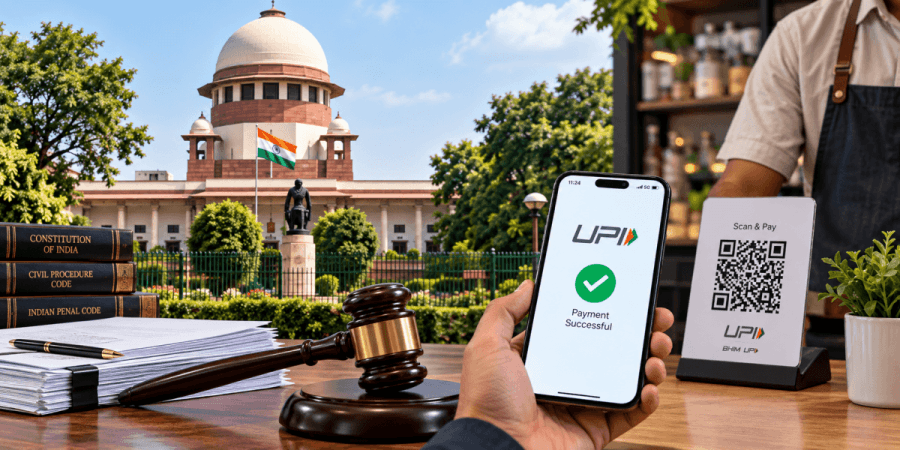
NEW DELHI, September 29: The Supreme Court has refused to grant an interim stay on the Centre’s decision to introduce a 0.4% Merchant Discount Rate (MDR) on specified UPI person-to-merchant transactions above ₹2,000, allowing the new framework to remain on course for implementation from October 15, 2026.
At the same time, the court has sought detailed responses from the Centre, the Reserve Bank of India and the National Payments Corporation of India on a petition challenging the legal basis of the new charge.
Supreme Court Refuses Interim Stay
A three-judge bench headed by Chief Justice of India Surya Kant, along with Justices Joymalya Bagchi and V Mohana, considered a petition challenging the new UPI merchant-payment framework.
The petitioner sought an interim stay before the MDR comes into force.
The court declined to halt implementation at this stage but agreed to examine the legal questions raised in the case.
New MDR Scheduled From October 15
The new framework is scheduled to take effect from October 15, 2026.
Specified person-to-merchant UPI transactions exceeding ₹2,000 will attract a 0.4% MDR.
The charge applies within the merchant payment ecosystem rather than being imposed directly on an individual making a UPI payment.
What Is Merchant Discount Rate?
Merchant Discount Rate is the amount paid within the digital-payment ecosystem for processing merchant transactions.
The money can be distributed among entities involved in processing payments, including banks and payment-service participants.
UPI had operated under a zero-MDR framework for nearly six years for these transactions before the latest policy change.
Person-to-Person UPI Transfers Remain Free
Regular person-to-person UPI transactions will continue to remain free regardless of the amount transferred.
This means sending money to family members, friends or another individual through UPI is not covered by the new MDR framework.
The changes primarily concern specified commercial person-to-merchant transactions.
Payments Up to ₹2,000 Remain Outside New Charge
UPI merchant payments of ₹2,000 or less will remain outside the 0.4% MDR.
This is intended to keep the majority of small everyday digital transactions unaffected.
The government told the court that approximately 96% of users or transactions routed through the payment gateway would remain exempt under the framework.
Small Merchants Also Receive Exemption
Certain small merchants will remain protected from the new charge.
Merchants receiving up to ₹1 lakh per month through UPI QR payments into their bank accounts are expected to remain exempt from MDR.
The measure is intended to reduce the impact on smaller businesses that rely heavily on UPI for daily payments.
Maximum MDR Capped at ₹300
The government has introduced a maximum ceiling on the MDR for larger transactions.
For transactions of ₹75,000 and above, the charge will be capped at ₹300, regardless of how large the transaction amount becomes.
This means the MDR will not continue rising indefinitely with the value of a transaction.
Essential Services Get ₹5 Flat Charge
Certain essential and low-margin sectors will face a lower fixed MDR.
Transactions above ₹2,000 involving sectors such as railways, telecom, insurance, fuel and agricultural inputs will attract a flat charge of ₹5 per transaction.
This is significantly below the standard 0.4% rate applicable to other eligible merchant transactions.
Securities Transactions Get Lower MDR
Transactions involving areas such as mutual funds, securities, stockbrokers and dealers will also receive separate treatment.
These transactions are expected to attract an MDR of 0.02%, subject to the overall ₹300 cap.
The differentiated structure is intended to reflect the nature and margins of different industries.
Court Questions Legal Basis of Charge
During the hearing, the Supreme Court asked the government to clarify the exact legal character and statutory basis of the MDR.
The Centre maintained that the MDR is neither a tax nor a government fee and that the government itself does not collect the money.
The court asked the government to place its explanation and supporting details formally on affidavit.
Centre, RBI and NPCI Asked to Respond
Notices have been issued to the Central Government, RBI, NPCI and other respondents connected with the UPI framework.
The respondents have been asked to provide their positions as the court examines the challenge.
The petition questions whether the MDR framework has an adequate legal foundation and whether sufficient safeguards and transparency accompanied its introduction.
Customers Should Not Be Charged Directly
The framework is structured so that the MDR is borne within the merchant-payment ecosystem.
Banks have been advised to ensure that merchants do not directly transfer the MDR charge to customers.
UPI application providers have also been prohibited from introducing hidden platform fees or additional charges linked to the new MDR.
Retailers Raise Concerns Over New Cost
Some merchant organisations have expressed concern that the 0.4% MDR could increase operating costs for businesses that process a large share of their sales through UPI.
Retail representatives argue that even a relatively small percentage charge can become significant when applied across high monthly transaction volumes.
They have called for continuation of the zero-MDR system for merchant UPI payments.
Government Says Framework Supports Payment Ecosystem
The government’s position is that payment infrastructure involves costs for banks, payment processors and other participants.
The MDR is intended to create a more sustainable funding model for the UPI ecosystem while ensuring that most ordinary users and small payments remain unaffected.
The Centre has emphasised that it will not directly receive the MDR collected under the system.
UPI Has Become Central to India’s Digital Payments
UPI has become one of the most widely used payment systems in India, handling billions of transactions every month.
Its rapid adoption has been driven partly by instant payments and the absence of transaction charges for users.
The introduction of MDR on selected merchant payments therefore represents a significant change in the economics of India’s digital-payment infrastructure.
Final Decision Still Pending
The Supreme Court has not yet ruled on the validity of the MDR framework itself.
Its current decision only means that the court has refused to stop the policy from taking effect while the legal challenge continues.
Unless there is another intervention or policy change, the new 0.4% MDR framework for eligible UPI merchant payments is scheduled to begin on October 15, 2026.
Source – Supreme Court Proceedings / Indian Express / Economic Times / Times of India The Indian Express
Supreme News Network