

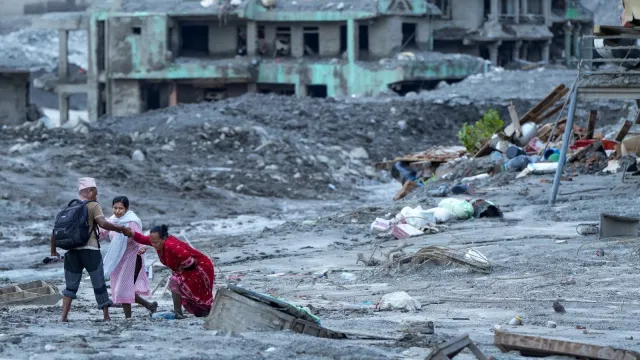
Nepal intensified its massive rescue operation on Monday, August 31, as emergency teams raced to reach hundreds of workers feared trapped inside blocked hydropower tunnels following the catastrophic Himalayan floods.
Nepalese authorities said 903 people have died and 4,247 remain missing, making the disaster one of the deadliest natural calamities to hit the country in recent years.
Among those still unaccounted for are 933 workers from 11 hydropower projects across the badly affected Rasuwa and Nuwakot districts.
Many of the missing workers are believed to be trapped inside large underground tunnels that were filled or blocked by massive quantities of mud, rocks and flood debris.
Rescue crews are using excavators, controlled blasts, search lights and heavy digging equipment to clear tunnel entrances and create access points for specialist teams.
The Nepal Army said rescuers have managed to enter two tunnels and recover three bodies, while several other tunnel sections remain buried beneath thick layers of debris.
Army spokesperson Raja Ram Basnet said the huge amount of deposited debris remains one of the biggest obstacles facing rescuers, with opening the blocked tunnels now the mission’s primary focus.
Nearly 21,000 Nepalese security personnel, along with civilian workers and volunteers, are involved in search-and-rescue operations across the disaster-hit region.
Nepal is also receiving specialised assistance from India and China, particularly in tunnel-rescue operations requiring technical expertise and equipment.
Although Nepal has said it does not require broad foreign search-and-rescue assistance, authorities have sought help from neighbouring countries for highly specialised tunnel missions.
Rescue efforts have repeatedly been disrupted by bad weather, rising river levels and the threat of further landslides and flooding.
Authorities are also monitoring newly formed lakes and unstable geological zones created by the glacier collapse, amid fears that additional landslides could block rivers and trigger secondary floods.
The disaster began on August 26, when a glacier collapse near the Nepal-Tibet border unleashed a massive torrent of ice, rock, mud and water through valleys and settlements.
The flooding devastated villages, roads, bridges and hydropower infrastructure across northern Nepal and parts of Tibet.
On the Chinese side of the border, authorities have reported 16 deaths and 546 people missing, while more than 2,100 rescue workers have been deployed.
With hundreds of hydropower workers still unaccounted for, Nepal’s rescue mission has now entered a critical phase as teams work against time to reach tunnel sections where survivors may still be trapped.
source – Reuters
Supreme News Network



This site has a great variety of games and the community is awesome. I had a big win last night and it was credited instantly. Cheers to pkfafa855.
Finally found a place that treats its members like actual VIPs. The rewards are generous and the customer support is always on point. Give 17krvip a try
Very satisfied with the withdrawal speed. No long waiting times or weird requirements. Truly a professional platform at vn123win12.