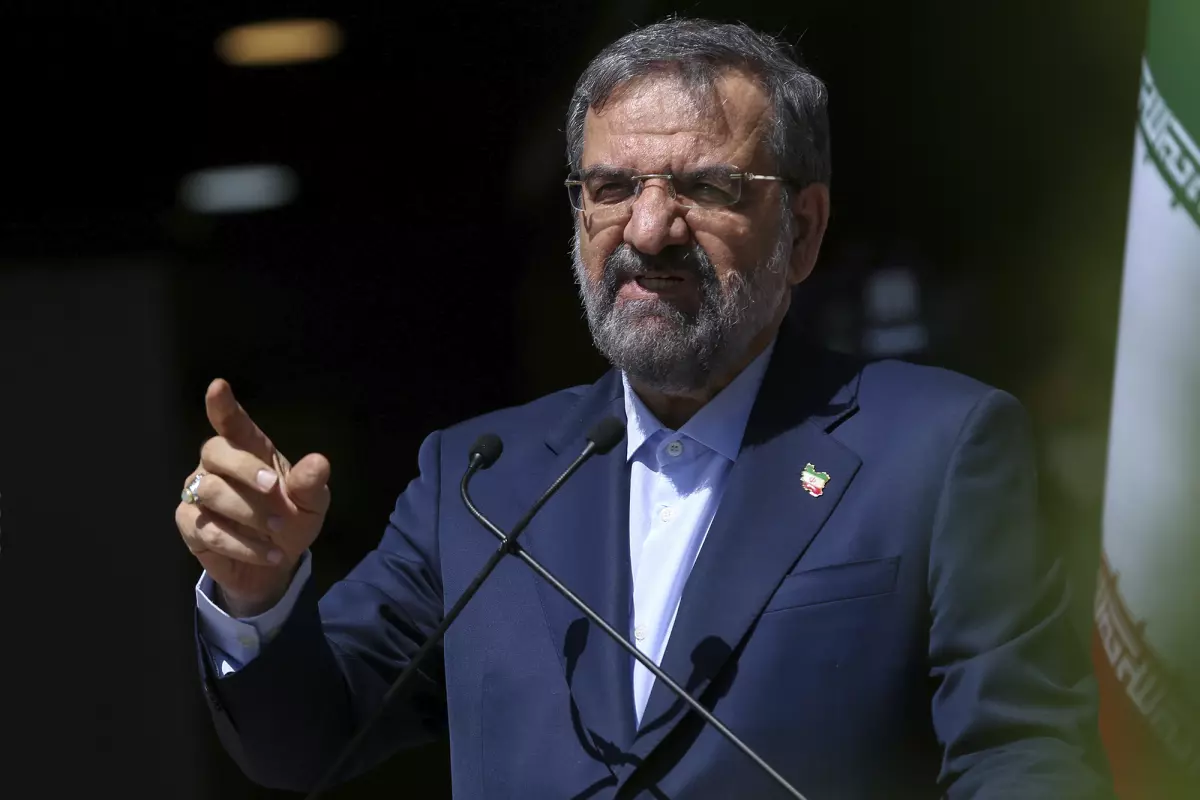
Tehran: Iran’s newly appointed top security official Mohsen Rezaei has issued a sharp warning to neighbouring countries against supporting a new US-led campaign of economic pressure on Tehran, threatening retaliation against countries that participate in what Iran describes as an “economic war.”
Rezaei, the new head of Iran’s Supreme National Security Council, said Tehran could target the economic interests and alternative oil-shipping routes of neighbouring states if they assist Washington’s efforts to further isolate Iran. His warning comes as the United States prepares to announce another major package of sanctions against Tehran.
Iran Issues Strong Warning to Neighbouring Countries
In an interview with Iranian state broadcaster IRIB, Rezaei warned that Iran would respond strongly if regional countries joined US measures designed to damage the Iranian economy.
He said countries participating in such economic pressure could be considered hostile to Iran, adding that Tehran could target their interests in response.
Rezaei also warned that Iran could disrupt oil-shipping routes outside the Strait of Hormuz if neighbouring states supported Washington’s economic campaign.
The remarks represent some of the toughest rhetoric from Tehran since Rezaei was appointed to lead the country’s top national security body earlier this month.
US Preparing Tough New Sanctions
The warning comes as US President Donald Trump’s administration increases economic pressure on Iran.
US Treasury Secretary Scott Bessent has said Washington is preparing what he described as the toughest sanctions imposed on Iran so far, with further details expected to be announced on Monday.
Bessent said the strategy would combine economic sanctions with an existing US naval blockade, arguing that intense financial pressure could reduce the need for another major military escalation.
Trump has also warned countries against providing financial, commercial or logistical support to Iran.
According to Reuters, Trump threatened significant economic consequences against countries whose financial institutions, businesses, airports or government entities provide what Washington considers a “lifeline” to Tehran.
Strait of Hormuz Remains at Centre of Tensions
The Strait of Hormuz remains one of the most sensitive issues in the confrontation.
The narrow waterway is one of the world’s most important energy corridors, historically carrying a major share of internationally traded crude oil and natural gas.
Iran has asserted greater control over shipping through the strait during the conflict, while negotiations with Oman over management and transit arrangements have continued.
Rezaei said discussions with Oman were still underway and suggested that fees could be imposed on vessels using the strategic route.
Iran and Iraq have also said that Tehran recently facilitated the passage of some vessels carrying Iraqi oil through the Strait of Hormuz.
Any further disruption to maritime traffic could have serious implications for global energy prices and international supply chains.
Iran Threatens Alternative Oil Routes
One particularly significant part of Rezaei’s warning concerned alternative shipping infrastructure developed by Gulf countries to reduce dependence on the Strait of Hormuz.
He indicated that if neighbouring nations became part of Washington’s economic pressure campaign, Iran could target routes used to export oil outside the Persian Gulf.
Saudi Arabia, the United Arab Emirates and other regional energy producers have invested in pipelines and alternative export routes designed to maintain oil shipments if traffic through Hormuz is disrupted.
France and Saudi Arabia are also discussing additional trade and energy routes that could reduce reliance on the strait, according to AP.
Iran’s President Takes More Diplomatic Tone
The aggressive warning from Rezaei comes as Iranian President Masoud Pezeshkian has taken a comparatively more diplomatic position.
On Sunday, Pezeshkian defended a memorandum of understanding reached with the United States, describing it as the best available route out of the current situation of prolonged instability.
He argued that Iran needs to reduce geopolitical risk in order to attract investment and improve its economic position.
The contrast highlights differing tones within Iran’s leadership: while the president continues to defend diplomacy, senior security officials are simultaneously warning of retaliation if economic pressure increases.
Egypt and Pakistan Push for Diplomacy
Regional governments are also attempting to prevent another major escalation.
Egyptian Foreign Minister Badr Abdelatty has discussed efforts to restart US-Iran negotiations with Iranian Foreign Minister Abbas Araghchi.
Pakistan is also maintaining diplomatic engagement with Tehran, with Army Chief Field Marshal Asim Munir expected to visit Iran as Islamabad continues efforts to support regional peace initiatives.
These diplomatic moves come amid fears that tougher sanctions, disrupted oil routes or military retaliation could deepen instability across the Middle East.
Regional Tensions Remain High
Iran has been under extensive international sanctions for decades, but the latest US strategy is intended to apply an even greater level of pressure on the country’s economy and oil exports.
Washington says stronger economic measures could force Tehran towards concessions while reducing the likelihood of renewed large-scale military operations.
Iran, however, has described the sanctions campaign as economic aggression and insists it will retaliate against countries that actively participate.
With Washington preparing to reveal its latest sanctions package and Tehran warning regional governments against cooperation, attention is now focused on how Gulf countries and other major trading partners respond.
The situation places the region at another sensitive point, where economic sanctions, energy security, shipping routes and diplomacy are increasingly intertwined.
Source – Associated Press (AP) / Reuters
Supreme News Network
I really appreciate the stability of this site. No more annoying crashes during big wins. Just a solid and trustworthy platform at jilimaxlogin.
Great selection of games and the payouts are handled very efficiently. I trust this site for my leisure time. Check out bigobet899 if you want a fair game.
[706]12bet লগইন করুন – বিকাশ দিয়ে ক্যাসিনো ও স্লট গেম খেলুন,12bet অ্যাপ ডাউনলোড করে অনলাইনে স্লট গেম খেলা শুরু করুন। বিকাশ দিয়ে ক্যাসিনো ডিপোজিট এবং লাইভ ক্যাসিনো গেম নিয়ম জানতে আজই লগইন করুন। visit: 12bet