
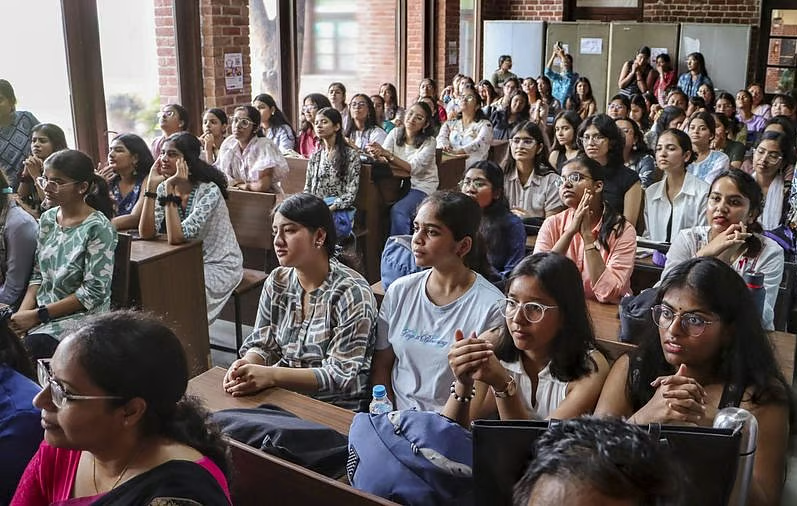
New Delhi, October 26, 2026: Around 4,000 students from Delhi University’s first four-year undergraduate batch remain uncertain about their academic future after failing to secure seats in the university’s new one-year master’s programme introduced under the National Education Policy.
Many of the affected students say they continued into the fourth year of their undergraduate degrees believing it would allow them to complete a master’s degree in just one additional year. Instead, limited seats and a priority-based admission system have left thousands without a regular postgraduate seat for the 2026–27 academic year.
Around 14,000 Applied for One-Year PG Programme
According to Delhi University Dean of Admissions Haneet Gandhi, approximately 14,000 students applied for the one-year postgraduate programme.
However, DU has only around 3,000 seats, including those available through the School of Open Learning.
About 1,800 students have been admitted to regular one-year postgraduate courses, while nearly 4,000 have joined through SOL.
Thousands Still Want Regular Master’s Seats
Students challenging the admission process before the Delhi High Court say approximately 4,000 to 5,000 students remain without the regular one-year postgraduate seats they had hoped to obtain.
Many have already lost the 2026–27 academic year while waiting for clarity over admissions.
DU’s First NEP Batch Entered in 2022
Delhi University introduced its four-year undergraduate structure under NEP 2020 in 2022.
Students were given the option to exit after three years with a bachelor’s degree or continue into a fourth year for an Honours, Honours with Research or multidisciplinary degree.
Those completing four years were expected to become eligible for a one-year postgraduate programme.
Around 23,000 Continued Into Fourth Year
DU officials say around 23,000 students continued into the fourth year in 2025 rather than exiting after three years.
The university says it did not anticipate that such a large proportion would subsequently seek admission to the one-year postgraduate route.
Students Say Fourth Year Was Sold as Faster Academic Path
Several affected students say professors and university messaging encouraged them to continue into the fourth year because it could save them a year while pursuing a master’s degree.
For students hoping to pursue NET, PhD programmes or academic careers, the one-year postgraduate route appeared particularly attractive.
Now, some say the lack of seats has effectively erased that advantage.
Priority System Becomes Major Point of Dispute
The dispute centres partly on how DU ranked applicants for the one-year PG programme.
Students with a four-year Honours degree with Research or Entrepreneurship in the relevant subject were placed in the P1 priority category.
Students who completed a four-year multidisciplinary programme with a Major in the relevant subject were placed in P2.
P1 candidates are considered before P2 applicants, even where a P2 student may have a higher CGPA.
Multidisciplinary Students Challenge Criteria
Students from multidisciplinary programmes argue that the system disadvantages them despite completing substantial academic coursework during the fourth year.
Some say they had no clear warning when choosing to continue beyond their third year that Honours students would later receive priority in postgraduate admissions.
DU Defends Difference Between Academic Pathways
Delhi University has defended the admission structure.
Its Grievance Redressal Committee held that the Honours and multidisciplinary routes involve differences in academic rigour and admission requirements and therefore can be treated differently for postgraduate selection.
Students Also Question Use of CGPA
Some affected students have criticised the use of undergraduate CGPA as an admission criterion.
They argue that grading practices can vary between colleges, meaning students from different institutions may not be directly comparable purely on the basis of CGPA.
They have questioned why a common entrance examination was not used instead.
DU Initially Offered Around 1,000 Seats
When DU formally opened its first one-year postgraduate admissions on July 4, it initially offered around 1,000 seats to its four-year graduates.
The university later revised the seat matrix to around 2,500 seats on July 31 after concerns were raised over the gap between applicants and available places.
Students Say Information Came Too Late
Several students say they learned about the detailed admission criteria only after completing their final undergraduate examinations.
They argue that had they known earlier about limited seats and the priority system, they might have exited after three years and appeared for CUET-PG instead.
DU Disputes Claim of Late Notification
Delhi University says the relevant information was available much earlier.
According to DU, the bulletin was uploaded in December 2025, the seat matrix was published in November 2025 and the Executive Council resolution on eligibility and seats was uploaded on January 2.
The university says departments were also informed in January.
Students Move Delhi High Court
At least 50–60 affected students have approached the Delhi High Court challenging the admission criteria and seeking additional accommodation.
Their petitions argue that the priority-based allocation discriminates against some four-year graduates and has disrupted their academic progression.
Court Looking for Equitable Solution
The Delhi High Court is now examining whether more students can be accommodated without disturbing the admissions of approximately 2,500 students already enrolled.
Those students are already approaching the end of their first semester.
The matter is scheduled to come up again on October 27.
Grievance Committee Earlier Upheld DU Policy
On August 31, the Delhi High Court directed DU’s Grievance Redressal Committee to examine the broader concerns.
On September 9, the committee upheld the priority system and CGPA-based criteria.
Students subsequently returned to court to challenge that decision.
SOL Offered as Alternative
Delhi University has pointed to its School of Open Learning as another option.
Nearly 4,000 students have already been admitted through SOL, and university officials say applicants seeking such seats are generally being accommodated.
However, several students argue that an open-learning qualification does not provide the same academic environment or career pathway they expected when choosing a four-year research-oriented undergraduate degree.
Private Universities Too Expensive for Many
Students who failed to get DU seats say private universities can charge significantly higher fees for one-year master’s programmes.
One student cited by The Indian Express said some private institutions were asking around ₹3 lakh, compared with the much lower cost of completing undergraduate studies at DU.
DU Introduces Direct PhD Route
DU has also introduced a route allowing eligible four-year undergraduate students to apply directly for PhD programmes without first completing a master’s degree.
Admission will still require an entrance process and other university criteria, and the final number of PhD seats has not yet been decided.
Direct PhD Option May Not Suit Everyone
While the direct PhD route provides an alternative for research-focused students, it may not address the concerns of those who specifically require a master’s degree for professional, academic or competitive-exam purposes.
Many students therefore continue to seek expansion of regular one-year postgraduate seats.
Fourth-Year Enrolment Already Falling
The controversy may also influence younger batches.
The Delhi University Principals’ Association said around 30% of students opted for the fourth year in 2025–26, while early interest for 2026–27 was reportedly lower.
Teachers have warned that uncertainty over postgraduate progression could discourage students from staying for the fourth year.
Future of NEP Pathway Under Scrutiny
The dispute has become an important test of how the four-year undergraduate structure under NEP works in practice.
The model was designed to offer greater flexibility, multiple exit options and a faster path from a four-year degree to a one-year master’s.
But the mismatch between demand and available postgraduate seats has raised questions over whether universities have sufficient capacity to deliver that pathway at scale.
October 27 Hearing Could Be Crucial
The Delhi High Court’s next hearing could determine whether DU must propose additional ways to accommodate students who were left out.
For thousands of graduates, the outcome could decide whether they can resume their postgraduate studies this academic cycle or face an additional year of uncertainty.
Source: The Indian Express, Delhi University, Delhi High Court proceedings
Supreme News Network