

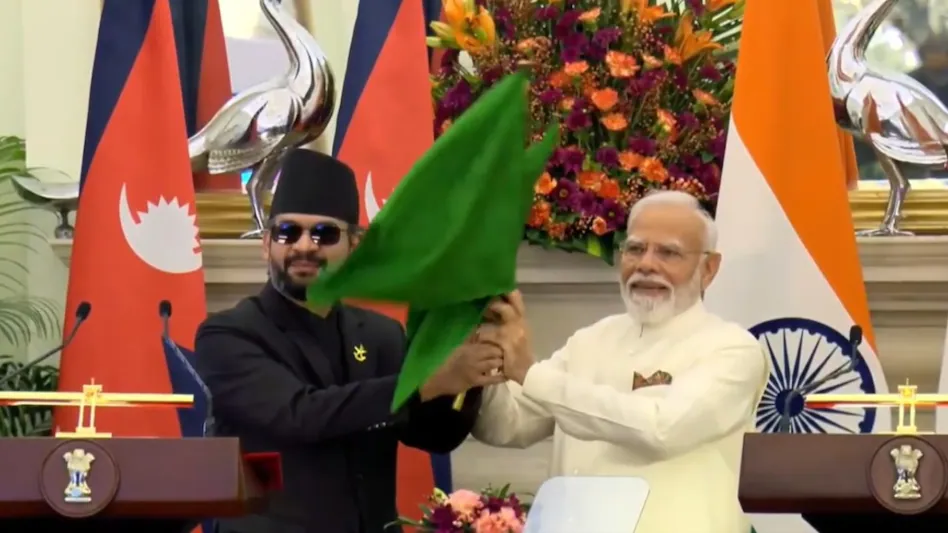
New Delhi, November 23, 2026: India and Nepal have signed eight Memorandums of Understanding (MoUs) covering space technology, security cooperation, healthcare, governance, sustainable urban development and agriculture following bilateral talks between Prime Minister Narendra Modi and Nepalese Prime Minister Balendra Shah in New Delhi.
The agreements were exchanged during delegation-level discussions at Hyderabad House on Monday, marking a significant development in bilateral relations between the neighbouring countries.
The two leaders also launched and advanced several infrastructure and connectivity projects, including a new cross-border railway service connecting Ayodhya in Uttar Pradesh with Janakpur in Nepal.
Prime Minister Modi announced a development assistance package worth ₹15,000 crore for Nepal, intended to support post-disaster reconstruction, infrastructure development and energy projects.
The announcements came during Balendra Shah’s two-day state visit to India from November 22 to 23, his first bilateral foreign visit since assuming office in March 2026.
India and Nepal Sign Eight MoUs During Bilateral Talks
Prime Minister Narendra Modi and Nepalese Prime Minister Balendra Shah held high-level discussions at Hyderabad House in New Delhi on November 23.
The two leaders reviewed bilateral cooperation in trade, energy, security, technology, healthcare and infrastructure.
Following the talks, representatives from both countries exchanged eight agreements aimed at strengthening institutional cooperation and supporting development projects.
The agreements cover satellite communications, police training, forensic science, civil service capacity building, healthcare, traditional medicine, sustainable urban development, and livestock and fisheries.
Both governments emphasised the importance of expanding cooperation in sectors that could deliver practical benefits to citizens.
The discussions also addressed regional connectivity, economic development and long-term bilateral engagement.
ISRO and Nepal Sign Satellite Communication Agreement
One of the major agreements involves cooperation between the Indian Space Research Organisation (ISRO) and Nepal’s Ministry of Information and Communication.
The MoU provides for establishing a satellite communication network using the South Asia Satellite.
The initiative is intended to strengthen Nepal’s access to satellite-based communication services and support technological cooperation.
Satellite communication systems can provide connectivity in geographically challenging areas, including remote mountain regions.
The partnership also creates opportunities for further cooperation in space technology and related applications.
The broader joint vision between the two countries includes satellite development, remote sensing, disaster management and capacity building.
India and Nepal Strengthen Police and Security Cooperation
Security cooperation formed another important component of the agreements.
India’s National Forensic Sciences University in Gandhinagar signed an agreement with the Crime Investigation Department of Nepal Police.
The partnership focuses on academic cooperation, research and capacity building in forensic sciences.
A separate agreement was signed between India’s Rashtriya Raksha University and Nepal’s National Police Academy.
The arrangement is intended to strengthen professional training and institutional exchanges involving law enforcement personnel.
These agreements are expected to provide opportunities for cooperation in modern policing, forensic research and security education.
Civil Service Training and Governance Cooperation Expanded
India and Nepal also signed an agreement to improve training opportunities for Nepalese civil servants.
The National Centre for Good Governance, under India’s Department of Administrative Reforms and Public Grievances, will cooperate with Nepal Administrative Staff College.
The partnership focuses on capacity building, administrative training and sharing governance practices.
The initiative aims to strengthen professional skills among government officials and improve public administration.
Both countries have also identified digital governance and technology-enabled public services as areas for future cooperation.
Healthcare and Traditional Medicine Agreements Signed
Healthcare cooperation is another major area covered by the bilateral agreements.
India’s Ministry of Health and Family Welfare signed an MoU with Nepal’s Ministry of Health and Food Safety to strengthen cooperation in health and medicine.
The two governments also concluded an agreement covering Ayurveda and other traditional systems of medicine.
These partnerships are intended to support institutional exchanges and collaboration in healthcare-related fields.
The broader bilateral vision includes improving healthcare infrastructure, strengthening medical research and increasing access to affordable medicines.
India and Nepal have also agreed to explore cooperation between medical institutions and health research organisations.
Sustainable Urban Development and Agriculture Included
The remaining agreements focus on sustainable urban development and agriculture-related cooperation.
India and Nepal signed an MoU on technical cooperation in sustainable urban development.
The partnership provides a framework for sharing knowledge and technical expertise related to urban planning and development.
Another agreement covers livestock and fisheries development.
The initiative is intended to strengthen cooperation in agricultural practices, technical training and related development activities.
Both countries recognise agriculture and rural development as important sectors for economic cooperation.
PM Modi Announces ₹15,000-Crore Development Package for Nepal
Prime Minister Narendra Modi announced a major development assistance package worth ₹15,000 crore, equivalent to approximately 24,000 crore Nepalese rupees.
According to the official joint vision document, the package includes ₹3,500 crore in grant assistance for post-disaster reconstruction and new infrastructure projects.
The remaining ₹11,500 crore will be provided through a rupee-denominated line of credit for energy sector projects.
The package follows severe flooding and related disasters in Nepal during August 2026.
India has expressed its willingness to support Nepal’s reconstruction and long-term development priorities.
The specific projects and arrangements for providing financial assistance will be finalised through further consultations.
Ayodhya-Janakpur Train Service Launched
Prime Minister Modi and Prime Minister Shah jointly launched a new cross-border railway service connecting Ayodhya in Uttar Pradesh with Janakpur in Nepal.
The Saryu-Kamala Express is expected to strengthen transportation links between the two countries.
Ayodhya and Janakpur have significant cultural and religious connections associated with the Ramayana tradition.
The new train service is expected to improve travel opportunities for pilgrims, tourists and other passengers.
The initiative also supports broader efforts to strengthen people-to-people connectivity and cross-border tourism.
Both governments have identified improved transportation links as an important priority for future cooperation.
Six Infrastructure and Connectivity Projects Advanced
Alongside the eight agreements, India and Nepal advanced six infrastructure and connectivity initiatives.
The projects include railway services, road connectivity, border infrastructure, hydropower development and petroleum supply facilities.
A motorable bridge connecting Dharchula in India with Darchula in Nepal was inaugurated.
The foundation stone was also laid for a new Integrated Check Post at Banbasa.
Additional work is progressing on border facilities connecting Bhairahawa, Sunauli and Dodhara Chandani.
In the energy sector, the two countries advanced the 669-MW Lower Arun Hydroelectric Project.
They also dedicated Phase II of the Motihari-Amlekhgunj petroleum pipeline and advanced plans for a petroleum terminal at Jhapa.
These projects are intended to improve connectivity, energy cooperation and cross-border economic activity.
India and Nepal Seek Stronger Energy Cooperation
Energy cooperation was an important part of the discussions between the two leaders.
Nepal has substantial hydropower resources, while India is an important market for electricity generated in the neighbouring country.
The governments agreed to encourage additional investment in hydropower and electricity transmission infrastructure.
They also discussed expanding cross-border electricity trade based on mutual benefit and market demand.
The joint vision highlights the importance of ongoing hydropower and multipurpose projects, including Pancheshwar, Saptakoshi and Sunkoshi.
Both countries also intend to cooperate on renewable energy and explore a green hydrogen pilot project in Nepal.
Modi and Balen Shah Discuss Future of Bilateral Relations
The two prime ministers discussed ways to modernise the India-Nepal partnership and respond to changing economic and technological priorities.
Their discussions included trade, investment, digital connectivity, education, tourism, healthcare and climate resilience.
The leaders adopted a joint vision focused on ten areas of cooperation.
The document identifies opportunities to expand digital infrastructure, support Nepalese startups and strengthen collaboration in artificial intelligence.
It also proposes exploring the establishment of an Indian Institute of Technology campus in Nepal.
Both governments expressed support for resolving outstanding bilateral issues through dialogue and mutual consultation.
Nepal PM Balen Shah Concludes First Bilateral Visit to India
Balendra Shah arrived in New Delhi on November 22 for a two-day state visit.
The visit marked his first bilateral foreign trip since taking office as Nepal’s prime minister in March 2026.
During his visit, Shah received a ceremonial welcome at Rashtrapati Bhavan and paid tribute to Mahatma Gandhi at Raj Ghat.
He also held official discussions with Prime Minister Modi and other Indian representatives.
The visit provided an opportunity for the two governments to review bilateral relations and announce new areas of cooperation.
The agreements and development initiatives are expected to guide further engagement between New Delhi and Kathmandu.
What Happens Next for India-Nepal Relations?
The next phase will focus on implementing the agreements and advancing the infrastructure projects announced during the visit.
Both countries have agreed to activate a high-level monitoring group to review progress.
The group will meet at least once every six months and report to the India-Nepal Joint Commission.
The next meeting of the Joint Commission is scheduled for 2027.
Officials will also continue discussions on project financing, implementation arrangements and institutional cooperation.
The effectiveness of the new initiatives will depend on timely execution and coordination between government agencies.
India-Nepal Agreements 2026: Key Highlights
India and Nepal signed eight agreements during Prime Minister Balendra Shah’s visit to New Delhi on November 23, 2026.
The agreements cover space technology, policing, forensic sciences, civil service training, healthcare, traditional medicine, urban development, and livestock and fisheries.
Prime Minister Narendra Modi announced a ₹15,000-crore development package for Nepal, including grants for reconstruction and credit support for energy projects.
The leaders also launched the Ayodhya-Janakpur railway service and advanced several infrastructure and energy initiatives.
Both countries adopted a forward-looking vision to strengthen economic, technological and people-to-people cooperation.
The announcements mark an important step in efforts to deepen the longstanding partnership between India and Nepal.
Source – Prime Minister’s Office (India), Reuters (November 23, 2026), Associated Press, Business Standard, Moneycontrol, The Indian Express
Supreme News Network