

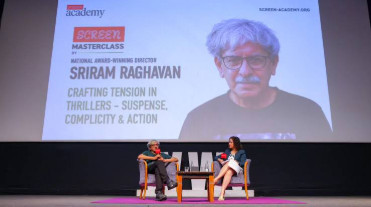
Mumbai, October 23, 2026: Acclaimed Bollywood filmmaker Sriram Raghavan, known for directing thrillers such as Ek Hasina Thi, Johnny Gaddaar, Badlapur and Andhadhun, shared his insights into storytelling, cinematic realism and filmmaking during a SCREEN Academy Masterclass at Whistling Woods International in Mumbai.
Addressing aspiring filmmakers, Raghavan explained why storytelling in cinema does not always have to follow the same rules as real life.
The filmmaker recalled advice he received from directors Ram Gopal Varma and Kundan Shah, explaining how their observations helped shape his approach to filmmaking.
He also discussed the challenges of creating thrillers, choosing actors, using popular cultural references and experimenting with filmmaking techniques.
Sriram Raghavan Explains Film Logic and Real-Life Logic
During the masterclass, Raghavan discussed the difference between what audiences expect in real life and what they are willing to accept within a fictional story.
He explained that young filmmakers sometimes become overly concerned about whether every development in a screenplay is completely realistic.
According to Raghavan, cinematic storytelling requires a different approach because viewers respond to emotional conviction, narrative structure and the presentation of events.
A sequence that might appear unlikely in reality can still work in a film if it is presented convincingly.
He emphasised that filmmakers must first believe in the scenes they create before expecting audiences to accept them.
The discussion highlighted the importance of balancing creative freedom with believable storytelling.
Ram Gopal Varma’s Advice Helped Shape Ek Hasina Thi
Raghavan recalled an important lesson from filmmaker Ram Gopal Varma during the production of his 2004 directorial debut, Ek Hasina Thi.
The thriller featured Urmila Matondkar and Saif Ali Khan in leading roles.
While developing a sequence involving Urmila’s character taking Saif’s gangster character to a cave at gunpoint, Raghavan became concerned about its practical feasibility.
He wondered how the characters could travel through the city without encountering police checkpoints.
When he shared the concern with Varma, the producer encouraged him to focus on making the scene convincing.
Raghavan explained that audiences subsequently questioned several aspects of the film but did not raise the specific logistical concern that had troubled him.
The experience taught him that cinematic credibility depends on how effectively a director establishes the story’s internal logic.
Why Audience Conviction Matters More Than Perfect Realism
One of Raghavan’s central messages was that successful filmmaking requires convincing audiences to accept the fictional world presented on screen.
The director explained that cinematic situations do not always need to mirror everyday experiences.
Instead, the actions of characters must remain believable within the story’s established atmosphere.
For thrillers, this becomes particularly important because unexpected developments and surprising decisions are essential elements of suspense.
If filmmakers focus only on real-world practicality, they may limit opportunities for creative storytelling.
However, cinematic freedom still requires careful execution.
Raghavan suggested that directors must develop confidence in their creative choices before presenting them to audiences.
Kundan Shah Influenced the Storytelling of Johnny Gaddaar
Raghavan also remembered advice from veteran filmmaker Kundan Shah, known for directing Jaane Bhi Do Yaaro and Kabhi Haan Kabhi Naa.
The discussion concerned Raghavan’s 2007 thriller Johnny Gaddaar.
The filmmaker had developed the basic plot from the French novel Les Mystifiés by Alain Reynaud-Fourton.
He narrated the story to Shah, hoping to receive encouragement and assistance in approaching an actor.
However, Shah was initially unimpressed with the plot.
According to Raghavan, Shah believed that the narrative needed more of the unpredictability found in real life.
The observation encouraged Raghavan to rethink his approach to the story and develop a more engaging narrative.
The experience became another important lesson in balancing carefully constructed plots with spontaneous human behaviour.
Agent Vinod’s Raabta Sequence Emerged From Creative Experimentation
Raghavan also discussed the making of the popular Raabta sequence from his 2012 spy thriller Agent Vinod.
The film starred Saif Ali Khan and Kareena Kapoor.
According to the filmmaker, music composer Pritam had presented him with the melody of Raabta after a substantial portion of the film had already been shot.
Raghavan liked the composition but initially struggled to find a suitable place for a romantic song within the action-heavy narrative.
While filming several action sequences, he developed the idea of combining an action scene with the song.
The resulting sequence became one of the film’s memorable creative experiments.
Raghavan explained that the single-take approach was influenced by filmmaker John Woo’s work in the Hong Kong action film Hard Boiled.
The sequence was completed over two days and demonstrated how unexpected creative ideas can become important elements of a film.
Sriram Raghavan Reflects on Agent Vinod’s Challenges
Although Agent Vinod featured ambitious action sequences and international settings, Raghavan acknowledged that the film presented significant challenges.
The director explained that making a large-scale spy thriller required a different approach from the smaller, character-driven films he had previously directed.
He reflected on the difficulty of managing a project with an extensive production schedule and numerous action sequences.
Raghavan also suggested that a filmmaker’s creative strengths do not automatically translate to every type of production.
His comments offered aspiring directors an insight into the importance of understanding the scale and demands of a project.
Filmmaker Warns Against Excessive Pop Culture References
During the discussion, Raghavan addressed the influence of classic films and popular culture on his work.
The director is known for incorporating references to cinema, literature and music into his thrillers.
However, he acknowledged that filmmakers can sometimes include too many references.
While discussing Johnny Gaddaar and Agent Vinod, Raghavan explained that excessive references may distract from the main story.
He also noted that incorporating existing songs and other copyrighted material can create practical and financial challenges.
The director encouraged young filmmakers to allow their influences to emerge naturally rather than deliberately filling their films with tributes.
According to his broader message, references should support the narrative instead of becoming an exercise understood only by a limited audience.
Sriram Raghavan Advises Filmmakers on Casting Actors
Another important topic during the masterclass was the process of selecting actors.
Raghavan advised students against choosing performers solely because of their commercial popularity.
He explained that an actor’s previous box-office success does not guarantee that their next film will perform equally well.
Instead, the director considers the performer’s interest in a project and suitability for the character.
The discussion highlighted the importance of casting decisions that support the story.
For Raghavan, an actor’s connection with the role matters more than assumptions about market demand.
His comments offered young filmmakers a practical perspective on making creative decisions in an industry where commercial considerations often influence casting.
SCREEN Academy Masterclass Encourages Young Filmmakers
The masterclass was organised under SCREEN Academy, a not-for-profit initiative associated with The Indian Express Group and SCREEN.
The initiative focuses on identifying, nurturing and supporting emerging filmmakers and storytellers.
The session at Whistling Woods International brought Raghavan together with students interested in filmmaking.
Through examples from his career, he discussed storytelling, creative decision-making and the challenges of film production.
The interaction provided students with an opportunity to understand how established directors approach narrative problems.
Raghavan’s experiences demonstrated that filmmaking often involves experimentation, unexpected solutions and lessons learned from unsuccessful decisions.
Sriram Raghavan’s Contribution to Indian Thriller Cinema
Sriram Raghavan has established a distinctive reputation in Hindi cinema through thrillers that combine suspense, dark humour and complex characters.
His films frequently explore betrayal, crime, moral ambiguity and unexpected consequences.
He made his feature directorial debut with Ek Hasina Thi in 2004, followed by Johnny Gaddaar in 2007.
His later projects include Agent Vinod, Badlapur, Andhadhun and Merry Christmas.
Across these films, Raghavan has demonstrated an interest in unconventional narratives and surprising developments.
His masterclass reflected the creative principles that have influenced his filmmaking career.
What Can Aspiring Filmmakers Learn From Sriram Raghavan?
Raghavan’s discussion offered several lessons for students and emerging directors.
One important takeaway was that storytelling requires more than strict adherence to real-world logic.
A filmmaker must establish a believable cinematic world and present the narrative with confidence.
The director also highlighted the importance of learning from experienced filmmakers while developing an individual creative approach.
His examples from Ek Hasina Thi, Johnny Gaddaar and Agent Vinod illustrated how storytelling decisions can evolve during production.
The session additionally emphasised thoughtful casting, careful use of cinematic references and openness to unexpected creative opportunities.
SCREEN Academy Masterclass: Key Highlights
Filmmaker Sriram Raghavan shared his approach to storytelling during a SCREEN Academy Masterclass at Whistling Woods International in Mumbai.
He explained the difference between real-life logic and cinematic storytelling, emphasising the importance of convincing audiences through effective presentation.
The director recalled advice from Ram Gopal Varma during Ek Hasina Thi and Kundan Shah while developing Johnny Gaddaar.
He also discussed the creative process behind Agent Vinod’s Raabta sequence and the challenges of making a large-scale spy thriller.
Raghavan encouraged aspiring filmmakers to prioritise storytelling, choose actors based on their suitability for roles and avoid excessive cinematic references.
The session offered a practical look at the creative decisions and experiences that have shaped his career in Hindi cinema.
Source – The Indian Express, SCREEN Academy Masterclass (October 23, 2026), Whistling Woods International
Supreme News Network