
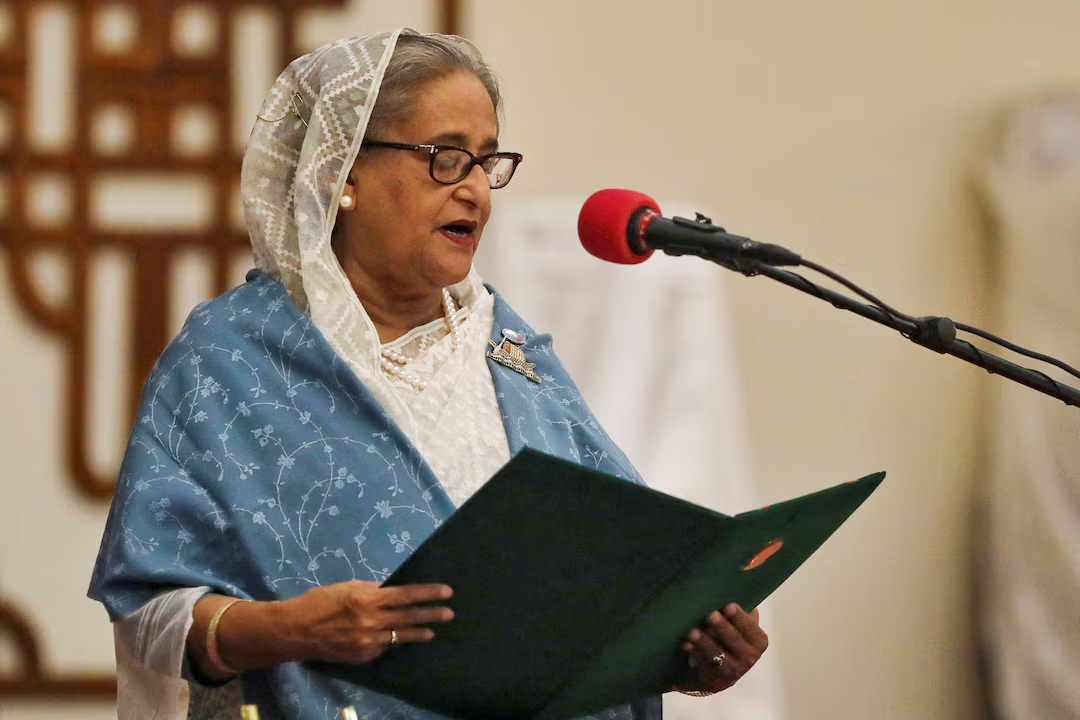
Dhaka, November 23, 2026: Bangladesh has warned that former Prime Minister Sheikh Hasina will be arrested and sent to prison immediately if she returns from India, as her plans to come back to the country in December trigger fresh political tensions and street protests.
Bangladesh’s State Minister for Foreign Affairs, Shama Obaed Islam, confirmed the government’s position in an interview with Reuters, stating that authorities would take Hasina into custody upon her arrival.
The Bangladesh government is also seeking her extradition from India under an existing bilateral treaty.
Hasina has been living in India since August 2024, when she fled Bangladesh following a student-led uprising that ended her long rule.
The latest warning comes amid renewed violence, protests and political disagreements surrounding her proposed return.
Bangladesh Warns Sheikh Hasina of Immediate Arrest
Bangladesh’s government has made it clear that former Prime Minister Sheikh Hasina will face legal consequences if she returns to the country.
State Minister for Foreign Affairs Shama Obaed Islam said authorities would arrest Hasina immediately upon her entry into Bangladesh.
The minister explained that the government intends to enforce existing judicial decisions rather than allow the former leader to return without facing legal proceedings.
Dhaka has also reiterated its demand that India hand Hasina over under the bilateral extradition agreement.
The statement comes as Bangladesh prepares for the possibility of Hasina attempting to return in December 2026.
Sheikh Hasina Plans to Return to Bangladesh in December
Sheikh Hasina has previously announced her intention to return to Bangladesh after spending more than two years in India.
In July 2026, the former prime minister told Reuters that she planned to return with senior members of her Awami League party around December.
She indicated that she wanted to appear before the country’s judicial authorities.
However, Bangladesh’s current government has maintained that she would be arrested immediately rather than permitted to return without detention.
The planned return has become a major source of political controversy.
Authorities are concerned that large gatherings of supporters and opponents could create further security challenges.
Bangladesh Demands Hasina’s Extradition From India
The Bangladesh government has renewed its request for India to extradite Sheikh Hasina.
Shama Obaed Islam said Dhaka expects New Delhi to respect the existing extradition treaty between the two countries.
The minister argued that Hasina should be returned to Bangladesh to face the consequences of the judicial proceedings against her.
Bangladesh has repeatedly raised the matter through diplomatic channels.
India’s Ministry of External Affairs previously stated that the extradition request was under examination.
However, no final decision on the request had been publicly announced as of November 23.
The issue remains a sensitive subject in bilateral relations.
Why Is Sheikh Hasina Facing Arrest in Bangladesh?
Sheikh Hasina faces a death sentence imposed by Bangladesh’s International Crimes Tribunal following proceedings related to the violent suppression of the 2024 student-led uprising.
The court convicted her in absentia of crimes against humanity.
The proceedings concerned the actions of security forces during the protests that ultimately ended her government.
According to United Nations estimates, as many as 1,400 people were killed during the unrest.
Hasina has rejected the allegations and described the verdict as politically motivated.
The Bangladesh government maintains that the judicial process must be enforced.
The disagreement has become one of the most significant political and legal disputes in the country.
Sheikh Hasina Has Lived in India Since August 2024
Sheikh Hasina left Bangladesh on August 5, 2024, after widespread demonstrations against her government.
The protests began with student-led demands and developed into a nationwide movement calling for her resignation.
As political unrest intensified, Hasina stepped down and travelled to India.
Her departure ended more than 15 consecutive years in power.
She has remained in India since then.
Her continued presence has become an important issue between New Delhi and Dhaka, particularly after the Bangladesh government formally sought her extradition.
Bangladesh Rejects Hasina’s Passport and Identity Card Requests
Ahead of her planned return, Sheikh Hasina sought a new Bangladeshi passport and national identity card.
According to Reuters, the current government rejected both requests.
These documents would ordinarily be important for international travel and identity verification.
The rejection has created additional uncertainty surrounding the practical arrangements for her proposed return.
Bangladesh’s government has indicated that the former prime minister should be returned through the established extradition process.
Hasina’s representatives have continued to pursue her planned homecoming, despite the possibility of immediate detention.
Awami League Supporters Launch Protests
The possibility of Sheikh Hasina’s return has triggered demonstrations by supporters of her Awami League party.
The party announced a series of protests and rallies during November in support of the former prime minister.
The demonstrations culminated in a nationwide lockdown call on November 19.
Authorities have reported incidents of political unrest in several parts of Bangladesh.
The Awami League has been banned under measures introduced following Hasina’s removal from power.
Despite the restrictions, supporters have continued organising political activities and demanding her return.
The demonstrations have increased pressure on the country’s security agencies.
Bomb Blasts and Arson Reported Across 28 Districts
Bangladesh has experienced renewed incidents of violence amid growing political tensions.
According to local media reports cited by Reuters, police recorded dozens of crude bomb explosions and arson attacks targeting vehicles across at least 28 districts during the preceding ten days.
Several police officers and civilians were injured.
Vehicles were damaged in attacks, while security personnel responded to incidents in different parts of the country.
The violence has raised concerns about public safety and the risk of further confrontation between political groups.
Authorities have stepped up monitoring and enforcement measures in response to the unrest.
Government and Awami League Exchange Allegations
The Bangladesh government and Awami League representatives have offered conflicting explanations for the recent violence.
State Minister Shama Obaed Islam accused Hasina’s party of using unrest to maintain political influence.
However, senior Awami League official Khalid Mahmud Chowdhury blamed the current political establishment for the disturbances.
The competing allegations reflect the deep political divisions surrounding Hasina’s possible return.
Responsibility for individual incidents has not been conclusively established in all cases.
The situation remains sensitive as authorities investigate the violence and political groups continue their activities.
India Yet to Announce Final Decision on Extradition
India has not publicly announced a final decision regarding Bangladesh’s latest demand for Sheikh Hasina’s extradition.
In April 2026, India’s Ministry of External Affairs said it was examining the request.
New Delhi did not immediately respond to Reuters’ request for comment on the latest statements from Bangladesh.
Extradition matters typically involve legal and diplomatic considerations, including the provisions of applicable treaties.
The case is particularly sensitive because Hasina is a former head of government who faces a death sentence in her home country.
The eventual decision will depend on the legal process and diplomatic discussions between the two countries.
Bangladesh Seeks Balanced Relations With India
Despite the disagreement over Hasina, Bangladesh’s government has stated that it wants to maintain balanced relations with India.
Shama Obaed Islam emphasised that bilateral engagement should respect Bangladesh’s national interests and sovereignty.
The minister also said there had been no official discussions with India about arranging an aircraft to transport Hasina back to Bangladesh.
India and Bangladesh share extensive economic, cultural and geographical ties.
Cooperation between the two countries covers trade, connectivity, energy, border management and regional security.
However, the dispute surrounding Hasina’s extradition has become a major issue in their diplomatic relationship.
Sheikh Hasina’s Return Could Intensify Political Tensions
The possibility of Sheikh Hasina returning in December has created uncertainty about Bangladesh’s political and security situation.
Her supporters have called for her return, while the government has insisted that the existing judicial decisions must be enforced.
The possibility of demonstrations involving opposing political groups has raised concerns about maintaining public order.
Bangladesh’s security agencies may face additional challenges if large gatherings take place around her arrival.
However, no confirmed date or final travel arrangement for Hasina’s return has been announced.
The situation will depend on legal decisions, political developments and any further communication between India and Bangladesh.
Who Is Sheikh Hasina?
Sheikh Hasina is the daughter of Sheikh Mujibur Rahman, Bangladesh’s founding leader.
She has been one of the most influential figures in the country’s political history.
As president of the Awami League, she served multiple terms as Bangladesh’s prime minister.
Her most recent period in power began in 2009 and ended in August 2024.
During her leadership, Bangladesh experienced substantial economic and infrastructure development, while her government also faced criticism over political freedoms, elections and human rights.
Her removal from office followed one of the most significant protest movements in Bangladesh’s recent history.
She has continued to reject the legal accusations against her since leaving the country.
What Happens Next in Sheikh Hasina’s Extradition Case?
The Bangladesh government is expected to continue pressing India for Sheikh Hasina’s extradition.
New Delhi will need to consider the request under the applicable bilateral treaty and domestic legal framework.
Meanwhile, Hasina’s stated intention to return in December remains a source of uncertainty.
Bangladesh’s authorities have indicated that she will be detained if she enters the country.
Political parties and security agencies will also be monitoring the possibility of further demonstrations.
The dispute could remain an important issue in India-Bangladesh relations until the legal and diplomatic questions surrounding Hasina’s return are resolved.
Sheikh Hasina Arrest Warning: Key Highlights
Bangladesh has confirmed that former Prime Minister Sheikh Hasina will be arrested if she returns from India.
State Minister for Foreign Affairs Shama Obaed Islam reiterated the government’s position in an interview reported on November 23, 2026.
Hasina has been living in India since August 2024 and has announced plans to return to Bangladesh in December.
She faces a death sentence following a conviction in absentia related to the 2024 protest crackdown, a verdict she rejects as politically motivated.
Bangladesh has requested her extradition from India under the existing bilateral treaty.
The dispute has coincided with protests, crude bomb explosions and arson incidents across multiple districts.
India has not announced a final decision on the extradition request.
The coming weeks will be important in determining whether Hasina attempts to return and how both countries address the legal and diplomatic dispute.
Source – Reuters (November 23, 2026), The Times of India, The Economic Times, Associated Press, Bangladesh Foreign Ministry Statements
Supreme News Network