
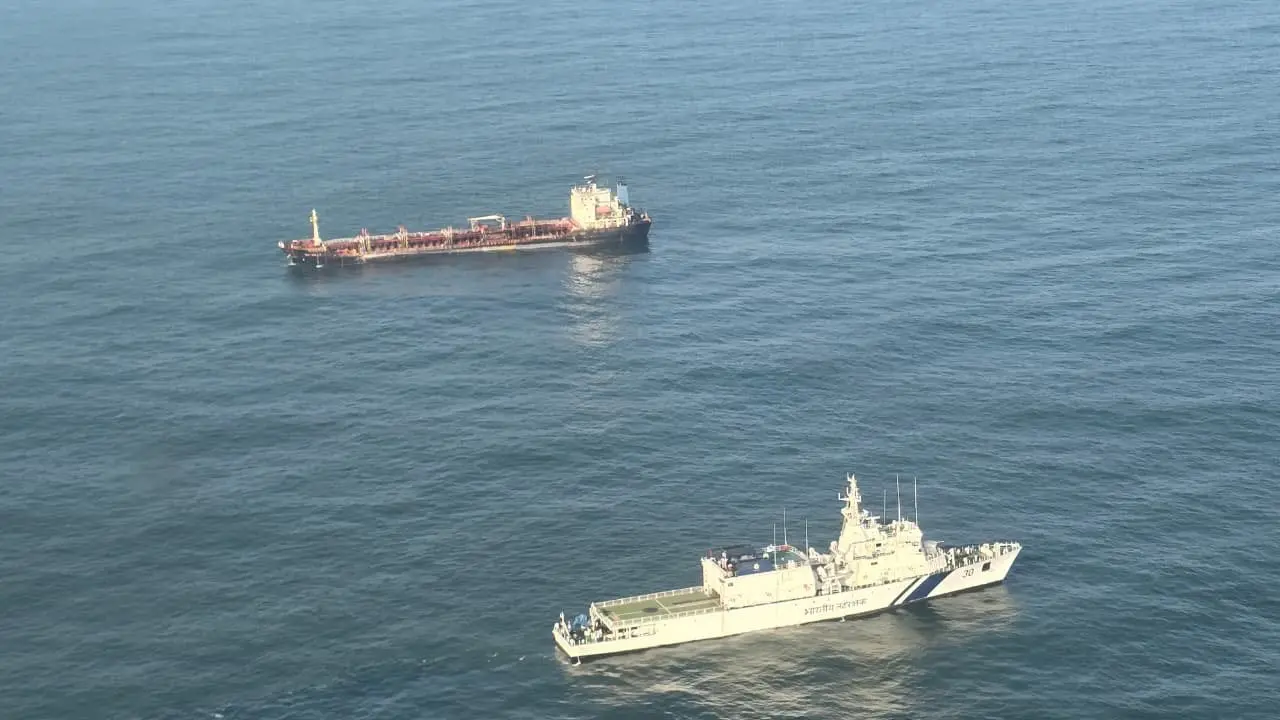
NEW DELHI, September 29: The Indian Coast Guard has prevented a major maritime disaster off the Odisha coast after successfully stabilising a distressed foreign tanker carrying 23 crew members and around 9,000 metric tonnes of palm oil.
The Belize-flagged vessel MT Seagull 9 developed engine failure and rapid flooding in its ballast tanks, causing it to tilt dangerously around 37 nautical miles east-southeast of Paradip.
Tanker Sends Emergency Distress Call
The tanker issued an urgent distress call at around 7:30 am on September 27 after its main engine stopped functioning.
At the same time, seawater began entering its ballast system, causing the vessel to develop a dangerous list.
With 23 crew members aboard and thousands of tonnes of cargo, there were concerns that the vessel could capsize if the flooding was not brought under control quickly.
ICGS Vishwast Rushed to Rescue Vessel
The Indian Coast Guard immediately deployed ICGS Vishwast to assist the distressed tanker.
A specialised damage-control team boarded the unstable vessel despite challenging conditions at sea.
The team began emergency operations aimed at controlling the flooding and restoring the tanker’s stability.
Pumps Used to Remove Water
Coast Guard personnel deployed submersible de-flooding pumps to remove seawater that had accumulated inside the ballast tanks.
The operation was carried out while the tanker remained tilted and vulnerable to further instability.
Removing the water helped reduce the vessel’s list and prevented the situation from deteriorating further.
Damaged Sea Pipelines Sealed
The rescue team identified damaged seawater pipelines as part of the flooding problem.
Two damaged pipelines were sealed, while another fractured line was contained as part of the emergency response.
These measures helped stop additional water from entering the vessel and allowed the tanker to gradually stabilise.
All 23 Crew Members Safe
All 23 crew members aboard MT Seagull 9 were reported safe following the Coast Guard operation.
No major injuries were reported during the emergency.
The successful stabilisation of the vessel also reduced the need for a large-scale evacuation at sea.
Tanker Was Carrying 9,000 Tonnes of Palm Oil
MT Seagull 9 was transporting approximately 9,000 metric tonnes of palm oil when the emergency occurred.
The large amount of cargo increased concerns that a capsizing or sinking could have created a significant marine pollution incident.
Authorities therefore carried out pollution-control operations alongside the rescue mission.
Pollution Control Vessel Deployed
A dedicated pollution-control vessel and another offshore patrol vessel were diverted to the area as a precaution.
Coast Guard aircraft also conducted aerial surveillance to monitor the vessel and surrounding waters.
The additional deployment ensured that authorities were prepared to respond quickly if cargo began leaking into the sea.
Minor Palm Oil Sheen Detected
A minor palm-oil sheen was initially observed near the distressed tanker.
Subsequent aerial surveillance confirmed that the sheen had completely dissipated, reducing concerns about a major pollution incident.
Pollution-response teams nevertheless continued monitoring the area as a precaution.
Dornier Aircraft Conducts Aerial Surveillance
A Coast Guard Dornier aircraft was deployed from Bhubaneswar to provide aerial monitoring during the operation.
The aircraft helped authorities assess the condition of the tanker and monitor any possible pollution around the vessel.
Aerial surveillance continued while emergency teams worked onboard the ship.
Tanker Taken Under Tow
After MT Seagull 9 was successfully stabilised, the vessel was taken under tow toward the anchorage area off Paradip.
The Paradip Port Authority tug Dolphin was used to tow the tanker to a safer location.
The Coast Guard continued to provide operational support while the vessel was moved.
Main Engine Repairs Underway
Work has also begun on repairing the tanker’s failed main engine.
Technical personnel are assisting with the repairs while the vessel remains under close observation.
Restoring propulsion will be necessary before the tanker can safely resume normal operations.
Coast Guard Maintains Watch Over Vessel
ICGS Vishwast and other deployed assets continue to monitor the tanker.
The Coast Guard is maintaining an active watch to ensure that flooding does not resume and that no additional pollution threat develops.
The vessel will remain under observation until authorities are satisfied that it can operate safely.
Major Maritime Accident Averted
The combination of engine failure, ballast-tank flooding and the tanker’s dangerous tilt created a potentially serious emergency.
Quick deployment of specialised personnel, pumps, surveillance aircraft and pollution-control assets prevented the situation from escalating into a capsizing or sinking.
The operation ensured the safety of all 23 crew members while also protecting the marine environment from a potentially significant cargo spill.
Source – Indian Coast Guard / PTI / Times of India The Times of India
Supreme News Network