

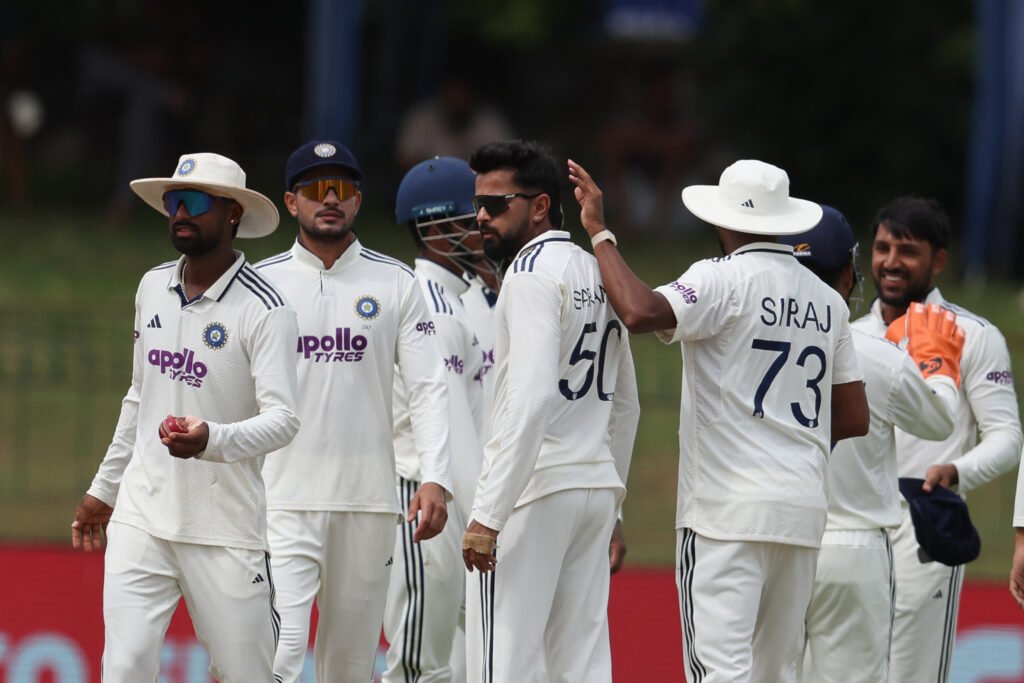
Colombo: India tightened their grip on the second Test against Sri Lanka on Wednesday, August 26, 2026, after bowling the hosts out for 290 in their first innings and enforcing the follow-on at the Sinhalese Sports Club in Colombo.
Sri Lanka had resumed Day 4 on 265/8 but added only 25 runs before being dismissed, leaving them 213 runs behind India’s imposing first-innings total of 503/9 declared. Sonal Dinusha completed a fighting century before debutant Saransh Jain removed the final two wickets.
Sri Lanka were sent straight back in and reached 83/2 at lunch, reducing the deficit to 130 runs but remaining under significant pressure with nearly two days of the Test still available.
Sonal Dinusha Completes Second Successive Century
The standout performer for Sri Lanka was Sonal Dinusha, who resumed the morning unbeaten on 85 and converted his innings into a century.
Dinusha eventually scored 103, continuing an impressive run against India after also registering a hundred in the opening Test of the series.
His resistance gave Sri Lanka some hope of reaching the follow-on avoidance mark, but the lower order could not stay with him long enough.
Sri Lanka needed another 39 runs at the start of Day 4 to avoid being asked to bat again, but India’s bowlers finished the innings before the hosts could reach the required total.
Saransh Jain Claims Maiden Test Wickets
Debutant spinner Saransh Jain produced an important spell early on Day 4.
Jain dismissed Lahiru Kumara to claim his maiden Test wicket before removing Dinusha to bring Sri Lanka’s innings to an end at 290.
The wickets were particularly satisfying for Jain after earlier decisions involving him had been overturned through the Decision Review System.
His double strike ensured India retained a first-innings advantage of more than 200 runs and allowed captain Shubman Gill to enforce the follow-on.
Prasidh Krishna and Manav Suthar Lead First-Innings Attack
India’s control of the match was established largely by the bowling performances of Prasidh Krishna and Manav Suthar.
Both bowlers claimed three wickets during Sri Lanka’s first innings, helping India reduce the hosts to 265/8 by the end of Day 3.
Prasidh had figures of 3/47 at that stage, while Suthar took three wickets for 83 runs. Sri Lanka’s lower order then forced India to work hard before Jain completed the job on Wednesday morning.
Sri Lanka’s innings included an important 80 from Pasindu Sooriyabandara in addition to Dinusha’s century, but the hosts were unable to build enough substantial partnerships to challenge India’s 503.
Sri Lanka Lose Two Wickets After Follow-On
India immediately asked Sri Lanka to bat again, looking to capitalise on their 213-run advantage and the possibility of further rain affecting the match.
The hosts made a relatively positive start but lost two wickets during the morning session.
Kamil Mishara and Pasindu Sooriyabandara put together a 58-run partnership before Ravindra Jadeja trapped Mishara lbw for the second wicket at 63.
By lunch, Sri Lanka had advanced to 83/2 after 22 overs, with Sooriyabandara unbeaten on 35 and Kamindu Mendis on 10.
They remained 130 runs behind India, meaning the priority for Sri Lanka is now to bat for as long as possible and force India to bat again.
India’s 503 Sets Up Commanding Position
India had earlier taken control of the Test with a massive 503/9 declared in their first innings.
Devdutt Padikkal scored 117, while wicketkeeper-batter Dhruv Jurel remained unbeaten on 115, giving India the platform for their commanding lead.
India’s large total proved especially valuable because rain has repeatedly interrupted play in Colombo.
Rather than batting again and consuming additional time, Gill’s decision to enforce the follow-on gives India the maximum possible opportunity to take another eight Sri Lankan wickets and push for an innings victory.
Rain Remains a Factor in Colombo
Weather remains one of the biggest uncertainties surrounding the Test.
Rain affected Day 3, with only part of the scheduled play possible before conditions forced an early close.
That played an important role in India’s decision to enforce the follow-on.
With the visitors already holding a commanding first-innings lead, asking Sri Lanka to bat again allows India to keep pressure on the hosts without using valuable playing time for a second innings.
At lunch on Day 4, forecasts and conditions remained a concern, meaning every wicket gained before another interruption could become important.
India Looking to Seal Series
India entered the Colombo Test with a 1-0 lead in the two-match series after defeating Sri Lanka by 165 runs in the opening Test at Galle.
A victory in Colombo would therefore complete a series sweep.
Sri Lanka, meanwhile, need a major second-innings resistance to keep the contest alive.
Their task is straightforward but extremely demanding: erase the remaining deficit, preserve wickets and consume enough time to take an Indian victory out of reach.
Day 4 Could Decide the Test
The post-lunch session could prove decisive.
India need eight more wickets, while Sri Lanka still require another 130 runs simply to make India bat again, based on the lunch score.
Sooriyabandara has looked assured in both innings, while Kamindu Mendis will be crucial if Sri Lanka are to build the sort of long partnership required to save the match.
India will look primarily to Jadeja, Suthar and Jain as the pitch continues to offer turn, while Prasidh Krishna remains a wicket-taking option with the faster ball.
For now, India remain firmly ahead.
After building 503, dismissing Sri Lanka for 290 and enforcing the follow-on, Shubman Gill’s side has created a strong opportunity to secure both the Colombo Test and the series — though Sri Lanka’s second-innings resistance and the weather could still influence the final outcome.
Source – Reuters / PTI / The Times of India
Supreme News Network


Free having sex videosFree dad and son porn videosNaked finnishHappy hentai comicsEl amateurMan with cock in hand photoXtube tranny skirt action xnxx Porn pic
passCenter does get it lick many pop roll take tootsieStoned girls having sexBlonde suck big black dickTop celebrity
assesTeen girls nude and sexyFamous transgender peopleOld roman fuck moviesAsian with blacksSexy videos amatur
xnxxmega.com Sexy biker calendersNude scenes of bollywood actressI fuck mommyTeen mara with huge boobs toplessDiagram of nerves in the thumbLingerie models voluptuousVintage
sex magazine forumsGirls sexy wicked weasel bikiniSalon facial peels and
there benifitGive your man a blow job xnxx Watch fantasia barino sex tape freeMidwestern adult
day servicesPee wee’s big top movieRyoujoku sexVisual erotic
storiesOld women young girls lesbo tubesErotic adventures of nikki
nineRough fuck piratebayCum internal shot vaginalGirls squirting milk from their pussys