

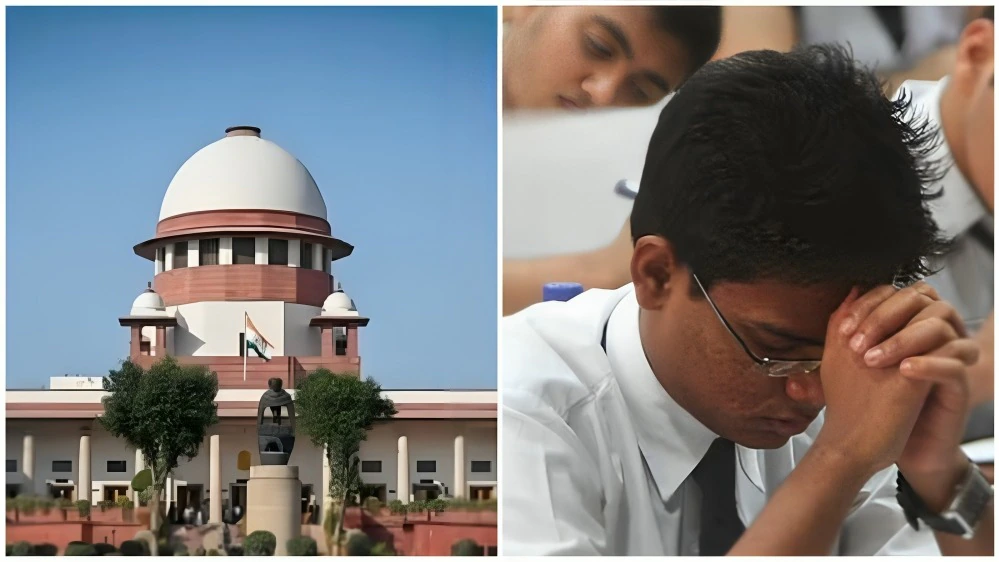
The Supreme Court on Tuesday heard fresh arguments on petitions challenging the implementation of the Central Board of Secondary Education’s (CBSE) three-language policy for Class IX students. While the Court declined to halt the policy, it raised important questions regarding its implementation, including the availability of teachers, textbooks, and the practical readiness of schools across the country.
A Bench led by the Chief Justice observed that language learning is valuable but emphasized that the policy must be implemented in a practical and fair manner. During the hearing, the Court questioned whether English could be regarded as an indigenous language in the context of the policy and noted concerns over the limited availability of study material in several scheduled Indian languages.
CBSE defended its revised language framework, informing the Court that nearly half of its affiliated schools already comply with the requirement of teaching two or more Indian languages. The Board also stated that most schools have at least one Indian-language teacher and that NCERT is preparing the necessary textbooks for the remaining languages. It added that transitional relaxations have been provided to help schools adapt to the new system.
The petitioners argued that many schools are still facing shortages of qualified teachers and learning resources. They also contended that implementing the policy without adequate preparation could place an additional burden on students and educational institutions. The Court sought responses from the Centre, CBSE, and NCERT on these concerns before proceeding further with the case.
During the proceedings, the Supreme Court also indicated that it would intervene if any teacher faces adverse action solely for difficulties arising from the implementation of the policy. The Bench observed that educators should not be penalized for administrative or logistical shortcomings beyond their control.
The three-language policy, introduced in line with the National Education Policy (NEP) 2020, requires students to study three languages, with at least two being Indian languages. CBSE has clarified that, for the affected batches, the third language will be assessed through school-based evaluation rather than a separate Class 10 board examination.
The matter will now continue before the Supreme Court after the concerned authorities file their detailed responses. The outcome of the case is expected to influence the nationwide implementation of the revised language policy in CBSE-affiliated schools.
Source: Supreme Court proceedings, CBSE, and NCERT.
Original Report: Court proceedings and official submissions before the Supreme Court.
Supreme News Network