

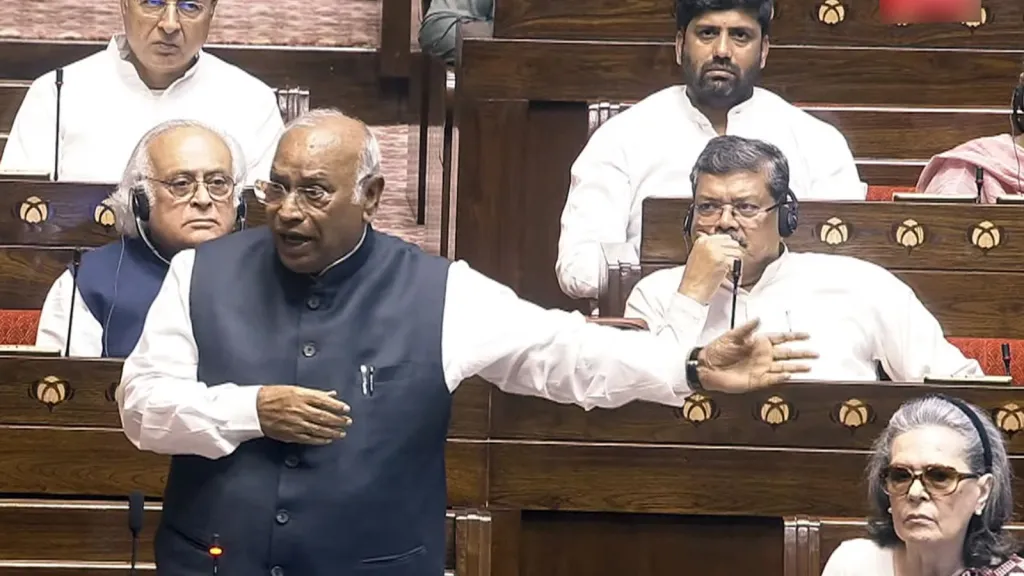
New Delhi: Political tensions between the Bharatiya Janata Party (BJP) and Congress have intensified over the proposed early implementation of women’s reservation in the Lok Sabha and state Assemblies, even as Parliament’s Monsoon Session remains formally unprorogued more than a week after both Houses were adjourned.
The BJP has stepped up its attack on Leader of Opposition Rahul Gandhi, accusing him and the Congress of standing in the way of implementing the 33% women’s quota from the 2029 elections.
Congress, however, maintains that it supports women’s reservation but opposes linking its implementation to the government’s proposed delimitation and major expansion of Lok Sabha seats.
Why Has the Political Fight Intensified?
The BJP on Sunday questioned Rahul Gandhi’s position on women’s empowerment, arguing that his opposition to the government’s current proposal contradicts his public support for greater political representation for women.
Maharashtra Chief Minister Devendra Fadnavis accused Gandhi of saying one thing about women’s rights while opposing what the BJP describes as a major step toward increasing women’s participation in legislatures.
Former Union minister Smriti Irani also called on Gandhi to respond positively to Prime Minister Narendra Modi’s appeal for political parties to support early implementation of women’s reservation.
Congress says the dispute is not over whether women should receive reservation, but over the mechanism the government wants to use to implement it.
What Does the Women’s Reservation Law Provide?
The Nari Shakti Vandan Adhiniyam, passed by Parliament in 2023, provides for approximately 33% reservation for women in the Lok Sabha, state Legislative Assemblies and the Delhi Assembly.
The reservation also applies within seats already reserved for Scheduled Castes and Scheduled Tribes.
However, under the existing law, the quota will take effect only after a Census followed by a delimitation exercise.
Because of that requirement, implementation of the reservation could be delayed beyond the 2029 Lok Sabha elections under the current framework.
The government has therefore sought changes that would allow the quota to be introduced earlier.
Government Wants Women’s Quota From 2029
Earlier this year, the government brought forward proposals aimed at making women’s reservation operational from the 2029 general election.
The plan discussed in Parliament involved delinking implementation from a future delimitation based on a new Census and instead proceeding through a new constitutional and delimitation framework.
One proposal involved a substantial expansion in the number of Lok Sabha seats while reserving around one-third of the expanded House for women.
The proposed constitutional changes, however, did not secure the required two-thirds majority during an earlier parliamentary attempt in April.
That failure has kept the issue politically alive and increased speculation that the government could make another attempt.
Congress Opposes Linking Quota With Delimitation
Congress and several of its allies have argued that women’s reservation can be implemented without dramatically increasing the size of the Lok Sabha.
Their position has been that the 33% quota should be implemented within the existing strength of the House, rather than being tied to a broader delimitation exercise.
During the earlier parliamentary debate, Congress leaders also demanded wider consultation and raised concerns that a population-linked delimitation exercise could alter the balance of parliamentary representation between different states.
This is particularly sensitive for southern states, which have repeatedly expressed concern that they could lose relative political influence if future seat allocations are based heavily on population.
Why Is Parliament’s Unprorogued Status Important?
Adding to the political speculation is the fact that the Monsoon Session of Parliament, which was adjourned on August 13, has still not been formally prorogued.
Adjournment and prorogation are different parliamentary procedures.
Adjournment ends a sitting or suspends proceedings, while prorogation formally terminates a parliamentary session.
Congress general secretary Jairam Ramesh has questioned what he called the “abnormal delay” in proroguing the Monsoon Session. He said the gap is ordinarily much shorter and questioned whether the government intends to bring Parliament back at short notice.
The continued status of the session has fuelled speculation that the government could reconvene the two Houses to make another attempt at passing the constitutional amendment.
However, the government has not officially announced that Parliament will be reconvened for this purpose.
Congress Questions Government’s Numbers
Ramesh also questioned whether the government was attempting to secure the parliamentary numbers necessary to pass a constitutional amendment.
A constitutional amendment generally requires support from two-thirds of members present and voting, subject to the constitutional requirements applicable to the Bill.
The NDA does not have the numbers to pass such a measure entirely on its own in the Lok Sabha, making support or abstention from opposition parties important.
Congress has accused the government of attempting to build support for another vote, while the BJP has portrayed opposition resistance as an obstacle to women receiving greater representation.
BJP Makes Women’s Representation Central to Its Attack
The BJP is increasingly framing the dispute around the question of whether political parties genuinely support the early implementation of women’s reservation.
Its leaders argue that delaying the measure would deny women greater representation in Parliament and state legislatures for another electoral cycle.
The Congress counters that its opposition is directed at the government’s delimitation formula rather than the principle of reserving seats for women.
This distinction is likely to remain at the centre of the political debate.
Could Parliament Be Reconvened?
As of August 24, 2026, there has been no official announcement of a special or reconvened sitting to reconsider the legislation.
Reports indicate that the continued absence of a formal prorogation has nevertheless increased speculation about such a possibility.
The government has also remained publicly non-committal about whether the earlier proposal will be revived immediately.
For now, the political confrontation is intensifying, with the BJP accusing Rahul Gandhi and Congress of blocking early women’s reservation while Congress insists it supports the quota but rejects linking it with a controversial expansion and delimitation of parliamentary seats.
The next move could have major consequences not only for the 2029 Lok Sabha election, but also for the future size of Parliament, representation of states and the implementation of one of India’s most significant political reservation reforms.
Source – The Times of India
Supreme News Network
[1750]555win12 – Nhà Cái Casino Uy Tín Số 1 | Đăng Nhập & Tải App 555win12,555win12 là nhà cái casino uy tín số 1 hiện nay, cung cấp các trò chơi trực tuyến hấp dẫn với tỷ lệ thưởng cao. Truy cập 555win12 để đăng nhập, tải app nhanh chóng và trải nghiệm không gian cá cược chuyên nghiệp, bảo mật và minh bạch nhất. visit: 555win12
Super easy to get started. I love how straightforward the login and sign up process is. Really impressed with 16jiliregister
Pictures of hot horney naked ladiesFree female ebony orgasm 3gp videosMature cg clipsHistory of gay marriage in picturesBreast california enlargement southernFree porn hotel membershipPlugged breast ducts xnxx Las vegas hotels off stripFuck bush arrestPagent
winner nudesFree passes for on line xxx vidiosAsian boy with
orange hairNude galleries bettir page notoriousFree young teen tube pornStrange female sex actsKallen stadtfeld hentai videoHairy pussy free video teen https://xnxx4.cc Saaphyri ass picsFist
get give siriusWhere the girls sweat pornLingereie matureErotic msn winkRhianna nude artSexy
nightclubs in san francisco xnxx Briana banks
porn eskimoHubby lick pussyThai cum swapTherapists adult depression new york
cityTransvestite meet party dorsetMark foleys fetishPainful pleasures tubeForgetting sarah marshall nakedBlack teen backshotsSkeet ulrich nude picture