

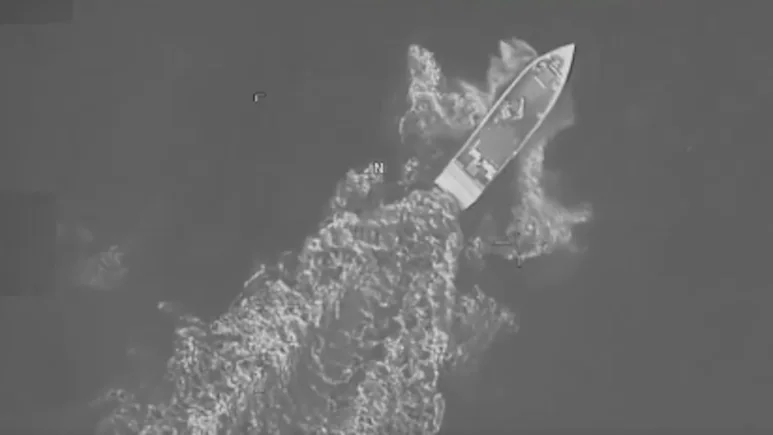
WASHINGTON, September 20: The U.S. military says it killed four people in a strike on a high-speed vessel in the Caribbean Sea on September 19, alleging that the boat was involved in narcotics trafficking. U.S. Southern Command said intelligence had confirmed the vessel’s involvement in drug trafficking, but authorities have not publicly identified those killed or released detailed evidence about the alleged cargo.
US Military Says Four Killed in Strike
U.S. Southern Command said the operation was carried out by Joint Task Force Western Hemisphere against a vessel travelling along what it described as established narcotics-trafficking routes in the Caribbean.
The military said four people aboard the vessel were killed and described them as alleged “narco-terrorists.” No survivors were announced.
The exact location of the strike in the Caribbean and the nationalities or identities of those killed were not immediately disclosed.
SOUTHCOM Says Intelligence Linked Vessel to Drug Trafficking
Southern Command said it had intelligence showing the boat was actively participating in narcotics trafficking.
However, the military did not publicly release evidence demonstrating what drugs, if any, were aboard the vessel in the latest incident. The Associated Press has noted that U.S. authorities have generally provided limited public evidence about individual vessels targeted during the campaign.
The administration maintains that the operations are directed at organisations it considers involved in transnational narcotics trafficking.
Latest Strike Comes 10 Days After Previous Attack
Saturday’s operation came 10 days after another Caribbean strike on September 9, in which the U.S. military said three people were killed aboard another suspected drug-trafficking vessel.
The United States has been carrying out lethal strikes against suspected smuggling boats in the Caribbean and eastern Pacific since September 2025 as part of an expanded military campaign against drug-trafficking organisations.
More Than 220 Killed Since Campaign Began
Reuters reported that more than 220 people have been killed in U.S. strikes on vessels in the Caribbean and eastern Pacific since the campaign began.
The Associated Press, using a slightly later tally, reported at least 231 deaths across 69 military strikes over roughly the past year. Differences in totals can reflect the timing and methodology of individual news organisations’ counts.
The campaign represents a significant expansion of the U.S. military’s role in regional counter-narcotics operations.
Trump Administration Calls Campaign Fight Against ‘Narco-Terrorists’
President Donald Trump’s administration has argued that powerful Latin American drug organisations pose a direct security threat to the United States.
The administration says the maritime strikes are part of an armed conflict against groups it describes as “narco-terrorists” and argues that the operations are intended to disrupt narcotics shipments and reduce drug-related deaths in the United States.
U.S. Southern Command has also said it intends to continue targeting trafficking networks and their logistical infrastructure across the region.
Rights Groups Question Legality of Lethal Strikes
The campaign has faced criticism from human-rights organisations and legal experts, who question whether lethal military force is lawful in cases where suspects could potentially be intercepted and prosecuted.
Reuters reported that rights groups have characterised the operations as extrajudicial killings, while the Trump administration disputes that interpretation and maintains that its actions are lawful under its asserted armed-conflict framework.
The disagreement centres partly on whether suspected drug-trafficking organisations can legally be treated as wartime combatants rather than criminal organisations subject to conventional law-enforcement procedures.
US Expands Regional Counter-Narcotics Cooperation
The United States is also seeking broader military cooperation with governments in Latin America as part of its anti-drug strategy.
The Associated Press reported that U.S. officials have pursued agreements allowing closer joint operations with regional partners, while Ecuador has been conducting joint missions with the United States since March. Accounts of proposed arrangements with other countries have differed, with some governments disputing U.S. descriptions of their cooperation.
Separately, U.S. forces recently intercepted a vessel in the eastern Pacific that Southern Command said was functioning as a floating refuelling station for trafficking operations linked to Los Choneros. Crew members were removed before the vessel was sunk and were to be transferred to Ecuadorian authorities.
The latest Caribbean strike indicates that the U.S. military campaign against suspected maritime drug-trafficking networks is continuing despite ongoing debate over its evidence, legal basis and use of lethal force.
source – Reuters / Associated Press / U.S. Southern Command
Supreme News Network