

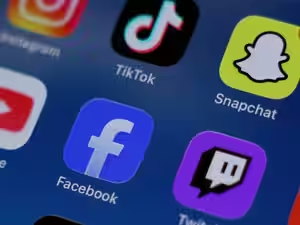
Wellington: New Zealand Prime Minister Christopher Luxon has announced plans to introduce legislation that would ban children under the age of 16 from accessing social media, placing responsibility on technology platforms to verify users’ ages or face potentially enormous financial penalties.
Under the proposed law, social media companies that fail to comply could be fined as much as 10% of their global annual revenue, making the measure one of the toughest proposed child-safety regulations targeting social media companies worldwide.
The proposal was announced on Monday, August 24, 2026, as Luxon’s government seeks to address concerns about the impact of social media on children’s mental health, education and family life.
Social Media Platforms Would Have to Verify Users’ Ages
A major feature of the proposed legislation is the requirement for social media companies to take effective steps to ensure children under 16 cannot create or maintain accounts.
Platforms would be expected to introduce age-verification systems rather than simply asking users to enter their date of birth.
According to Reuters, possible verification methods could include technologies such as:
- Facial age estimation
- Digital identification
- Other age-assurance technologies
The government wants responsibility for enforcing the restriction to rest primarily with social media companies rather than children or their parents.
The exact technical requirements are expected to be developed as the legislation moves through the parliamentary process.
Fines Could Reach 10% of Global Revenue
One of the strongest elements of the proposal is the potential penalty for platforms that fail to meet their obligations.
Companies found to be non-compliant could face fines worth up to 10% of their global revenue.
For major international technology companies, such a penalty could potentially amount to billions of dollars.
The size of the proposed fines indicates that New Zealand wants platforms to treat age restrictions as a serious regulatory obligation rather than a voluntary child-safety measure.
Why Does New Zealand Want an Under-16 Ban?
Luxon said the government is concerned about the harm social media can cause young people.
New Zealand officials have previously highlighted concerns including:
- Online bullying
- Exposure to harmful content
- Social media addiction
- Effects on mental health
- Disruption to education
- Pressure on family relationships
In May 2025, Luxon said the response from parents to proposals for restricting social media access had been overwhelmingly positive and tasked Education Minister Erica Stanford with examining how an under-16 restriction could work.
The government has since studied approaches being taken by Australia and other countries considering tighter regulation of children’s social media use.
Luxon Acknowledges System May Not Be Perfect
The Prime Minister acknowledged that no age-verification system would completely prevent every child from attempting to bypass the restriction.
However, he argued that difficulties in achieving perfect enforcement should not prevent the government from acting.
The proposed system aims to significantly reduce children’s access rather than guarantee that circumvention becomes technically impossible.
Age-verification technology has become a major issue internationally because governments must balance child protection with concerns about users’ privacy and the collection of identity information.
Coalition Partner New Zealand First Opposes Proposal
The legislation could face a significant political challenge before becoming law.
New Zealand First, one of the parties supporting Luxon’s coalition government, has announced that it opposes the planned restriction.
Foreign Minister and New Zealand First leader Winston Peters criticised the proposal and argued that decisions over children’s social media use should primarily remain the responsibility of parents rather than the government.
Peters also criticised Australia’s experience with similar legislation, describing its approach as unsuccessful.
The disagreement means passage of the bill cannot currently be considered guaranteed.
New Zealand Has Already Been Debating an Under-16 Restriction
The idea of restricting social media for children is not entirely new in New Zealand.
National Party MP Catherine Wedd introduced a separate Social Media (Age-Restricted Users) Bill in October 2025.
That member’s bill is intended to regulate social media access for people under 16, but according to New Zealand Parliament’s current record, it has been introduced and has not yet completed its first reading.
Luxon’s latest announcement represents a broader government-backed effort to move the policy forward.
Australia Has Already Taken Similar Action
New Zealand’s proposal follows a wider international push to restrict children’s social media access.
Neighbouring Australia has already introduced legislation targeting social media use among children under 16.
Other governments in Europe and elsewhere have also considered stronger age restrictions as concerns increase about addictive platform design, harmful content and children’s online safety.
New Zealand’s proposal stands out because of the potential penalties tied to a company’s global revenue, significantly increasing the financial risk for large platforms that fail to comply.
What Happens Next?
The proposed legislation must still pass through New Zealand’s Parliament before it can become law.
That process normally includes parliamentary debates, committee examination and opportunities for lawmakers and members of the public to provide feedback.
Important details—including which platforms would fall under the restrictions, acceptable age-verification methods and how enforcement would work—are likely to receive significant scrutiny.
The opposition from New Zealand First also means the government will need sufficient parliamentary support to advance the measure.
For now, the announcement signals that New Zealand is preparing to join a growing international movement seeking to impose much stronger rules on how children interact with social media.
If passed, the legislation could fundamentally change how platforms verify young users in New Zealand—and expose companies that fail to comply to penalties worth as much as 10% of their worldwide revenue.
Source – Reuters / New Zealand Parliament
Supreme News Network



If you love Jili slots, this is the spot. The jackpot feels reachable and the loading speed is impressive. Check abjilislot