

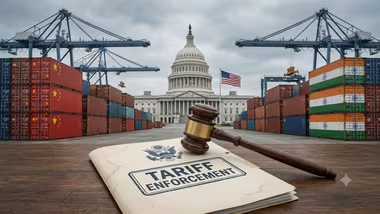
Washington, November 25, 2026: The United States is preparing to introduce another round of import tariffs targeting India, China, the European Union and several other major trading partners as President Donald Trump’s administration intensifies efforts to address what it considers unfair industrial subsidies and excess manufacturing capacity.
According to reports by Reuters, The Wall Street Journal and the Associated Press, the Office of the United States Trade Representative (USTR) could release the findings of a months-long trade investigation as early as this week.
The investigation covers 16 major trading partners, including India, China, Japan, South Korea, Vietnam and the European Union.
US Trade Representative Jamieson Greer is expected to announce the investigation’s findings, potentially paving the way for additional duties on imported goods.
China could face comparatively higher tariffs, while India and Vietnam may also face steeper duties than some other trading partners.
However, the new tariff rates have not been finalised or officially announced as of the latest reports on November 25.
The development has raised concerns about renewed international trade tensions, higher import costs and the future of ongoing trade negotiations between the United States and its economic partners.
Trump Administration Plans New Round of Import Tariffs
The Trump administration is considering higher duties on goods imported from several major economies.
The proposed measures follow a US investigation into foreign government subsidies and industrial policies.
American authorities argue that certain countries support manufacturing industries in ways that create unfair competition for US companies.
According to reports, the administration intends to use the investigation’s findings to justify additional tariffs.
The measures could affect a wide range of imported products, although the final list of goods has not been released.
The timing of the announcement remains subject to change.
India Among 16 Trading Partners Under Investigation
India is one of the economies covered by the United States’ investigation into industrial overcapacity and government subsidies.
The review examines whether government policies in foreign economies contribute to excess production and harm American manufacturers.
Apart from India, the investigation covers China, the European Union and several other major trading partners.
Reports indicate that the administration is considering different tariff levels based on individual countries’ circumstances and existing trade arrangements.
The final duties applicable to Indian goods remain uncertain.
Any new measures could influence the ongoing India–US trade negotiations.
Which Countries Could Face Higher US Tariffs?
The reported tariff plans cover 16 major trading partners, counting the European Union as one economy.
Countries and economies identified in reporting include:
- India
- China
- European Union
- Japan
- South Korea
- Vietnam
- Mexico
- Taiwan
- Malaysia
- Thailand
- Indonesia
- Cambodia
The investigation also covers additional economies identified in the US trade review.
The exact scope of new tariffs will depend on the final announcement from American authorities.
Not every country is necessarily expected to face the same rate.
Why Is the US Considering Fresh Tariffs?
The central issue is Washington’s concern about industrial subsidies and excess manufacturing capacity.
Industrial subsidies can take different forms, including direct financial assistance, preferential financing and government support for production.
The Trump administration argues that some foreign policies allow manufacturers to produce goods at prices that place American companies at a competitive disadvantage.
The investigation is intended to determine whether such practices justify additional trade measures.
However, affected countries may dispute the US assessment or argue that their industrial policies serve legitimate economic objectives.
The question of whether a subsidy constitutes an unfair trade practice depends on the relevant legal and economic framework.
China Could Face Higher Tariffs Than Other Countries
China is expected to receive particular attention in the proposed tariff measures.
According to The Wall Street Journal, US officials believe China’s industrial subsidies are especially extensive.
Washington has raised concerns about production capacity in sectors such as electric vehicles, solar panels, cement and steel.
The administration could therefore consider higher duties on Chinese products than those applied to some other economies.
However, the proposed measures are also expected to account for the existing trade understanding between Washington and Beijing.
The final tariff structure remains unconfirmed.
What Could the New Tariffs Mean for India?
India could face higher import duties on certain products exported to the United States.
Reports indicate that the tariffs applied to India and Vietnam may be higher than those faced by the European Union, Japan and South Korea.
However, these comparisons are based on preliminary reporting rather than a final government notification.
The eventual impact on Indian exporters will depend on which products are covered, the applicable rates and whether exemptions are provided.
Companies exporting to the United States may need to review pricing and supply-chain arrangements if additional tariffs take effect.
Businesses will also be watching whether India and the United States can negotiate mutually acceptable trade terms.
India–US Trade Agreement Negotiations Continue
The proposed tariff measures come while India and the United States are engaged in negotiations over their bilateral trade relationship.
The two countries have discussed an interim arrangement intended to establish more predictable trade conditions.
However, the broader negotiations remain unfinished.
India has sought favourable treatment for its exporters and greater certainty over the duties applied to Indian products.
On November 15, Union Commerce Minister Piyush Goyal said the United States had agreed to provide Indian goods with a comparative tariff advantage over competing economies under the proposed agreement.
The latest reports have introduced additional uncertainty into those negotiations.
The eventual outcome will depend on official announcements and discussions between the two governments.
US Supreme Court Ruling Reshaped Trump’s Tariff Policy
The current developments follow a major legal setback for the Trump administration earlier in 2026.
In February, the US Supreme Court struck down sweeping tariffs imposed using the International Emergency Economic Powers Act.
The ruling affected the administration’s earlier approach to applying broad import duties.
Following that decision, the White House pursued alternative legal mechanisms to support its trade agenda.
The latest investigation into industrial subsidies forms part of that effort.
The administration is considering trade measures grounded in statutory powers different from those used for the invalidated tariffs.
What Is a Section 301 Trade Investigation?
Section 301 of the Trade Act of 1974 provides the United States with a mechanism to investigate certain foreign trade practices.
The US Trade Representative may examine whether a foreign government’s actions are unreasonable, discriminatory or otherwise burden US commerce.
Where the applicable legal requirements are met, the United States may impose trade-related responses, including additional duties.
The current investigation focuses on alleged excess industrial capacity and government support for manufacturing.
The administration is expected to rely on the investigation’s findings when determining possible tariff actions.
The process remains subject to applicable legal procedures and official decisions.
US Trade Representative Jamieson Greer Expected to Announce Findings
US Trade Representative Jamieson Greer is expected to play a central role in the forthcoming announcement.
The USTR has been examining industrial policies across major trading partners for several months.
According to Reuters, the administration could release its findings imminently.
Greer previously indicated that the investigation would be completed before the end of 2026.
The timing and details of any announcement could still change.
The findings will help determine whether additional tariffs are introduced and which products are targeted.
Will the New Tariffs Be Added to Existing Duties?
One important question is whether the proposed tariffs will be imposed in addition to existing import duties.
According to reporting by The Wall Street Journal, new tariffs could be layered onto certain duties already in place.
In July 2026, the Trump administration introduced tariffs of approximately 10% to 12.5% on numerous trading partners over concerns about enforcement against goods produced using forced labour.
Additional measures could therefore increase the overall tariff burden on some imports.
However, the final treatment of existing duties, exemptions and overlapping trade measures has not been officially detailed.
Exporters will need to review the final rules when they are announced.
Steel, Aluminium and Automobiles May Be Treated Separately
Not every imported product is expected to be covered in the same manner.
According to Anadolu Agency, steel, aluminium and automobiles are among the product categories that may be excluded from the latest measures because they are already subject to separate national-security tariffs.
The new investigation is focused primarily on industrial subsidies and manufacturing overcapacity.
This suggests that the final tariff schedule could differentiate between products covered by existing trade measures and those subject to the new investigation.
However, exclusions remain subject to confirmation in official documents.
What Could Happen to US Consumer Prices?
Import tariffs are generally paid by importing businesses when goods enter the United States.
Depending on market conditions, companies may absorb some of the cost or pass it on to wholesalers, retailers and consumers.
Higher tariffs can therefore increase prices for certain imported products.
The actual effect depends on competition, supplier contracts, exchange rates and the availability of alternative goods.
Some American manufacturers may benefit from reduced competition from imported products.
Other businesses that depend on foreign components may face higher production costs.
The economic effects of the proposed measures will vary across industries.
Global Financial Markets React to Tariff Uncertainty
Reports of additional US tariffs have contributed to uncertainty in international financial markets.
According to Reuters’ November 25 market coverage, investors were monitoring the possibility of renewed trade tensions as the USTR prepared to publish its findings.
Asian equity markets experienced selling pressure, with technology shares particularly affected by wider concerns about trade policy and investment conditions.
Commodity markets also showed signs of weakness.
However, market movements reflect multiple factors, and it would be inaccurate to attribute every decline solely to the proposed tariff measures.
Investors are awaiting greater clarity from American officials.
Could New Tariffs Affect Global Supply Chains?
Higher import duties can influence decisions about where companies manufacture and source products.
Businesses affected by additional tariffs may consider renegotiating contracts, changing suppliers or adjusting prices.
Some companies could explore alternative manufacturing locations to reduce exposure to trade barriers.
However, shifting production networks involves investment, infrastructure and regulatory considerations.
The proposed tariffs could also affect countries that compete to supply similar products to the American market.
The scale of any disruption will depend on the final tariff rates and product coverage.
US–China Trade Relations Face Another Test
The proposed measures come during a period of continued engagement between Washington and Beijing.
President Donald Trump and Chinese President Xi Jinping previously reached a trade understanding intended to manage tensions between the two economies.
The existing US–China trade arrangement is due for review in January 2027.
New tariffs could complicate future negotiations if either side considers them inconsistent with earlier understandings.
However, officials have indicated that the proposed measures are expected to remain within the framework of the existing arrangement.
The two governments’ responses will become clearer once the tariff findings are formally announced.
What Happens Next in the US Tariff Investigation?
The next major development will be the publication of the USTR’s findings.
The report is expected to provide the administration’s assessment of industrial subsidies and excess capacity in the economies under investigation.
The United States may then outline proposed tariff rates, affected goods and implementation procedures.
Trading partners could respond through diplomatic discussions, trade negotiations or other legal and policy channels.
For India, the announcement will be particularly important because bilateral trade negotiations are still underway.
Until the official findings and tariff schedule are released, the precise financial impact remains uncertain.
US Tariffs on India and China: Key Highlights
The Trump administration is preparing another round of tariffs targeting India, China, the European Union and other major trading partners.
The measures follow a months-long investigation into industrial subsidies and alleged excess manufacturing capacity.
US Trade Representative Jamieson Greer could announce the findings as early as the week of November 25, 2026.
China may face higher tariffs than many other economies.
India and Vietnam could also face relatively higher duties, depending on their trade arrangements with Washington.
The proposals follow the US Supreme Court’s February 2026 ruling against an earlier set of sweeping tariffs.
India–US trade negotiations remain ongoing.
As of the latest reports on November 25, the new tariff rates and implementation dates have not been officially confirmed.
Source – Reuters (November 25, 2026), The Wall Street Journal (November 24, 2026), Associated Press (November 24–25, 2026), The Indian Express (November 25, 2026), Press Trust of India (November 25, 2026)
Supreme News Network