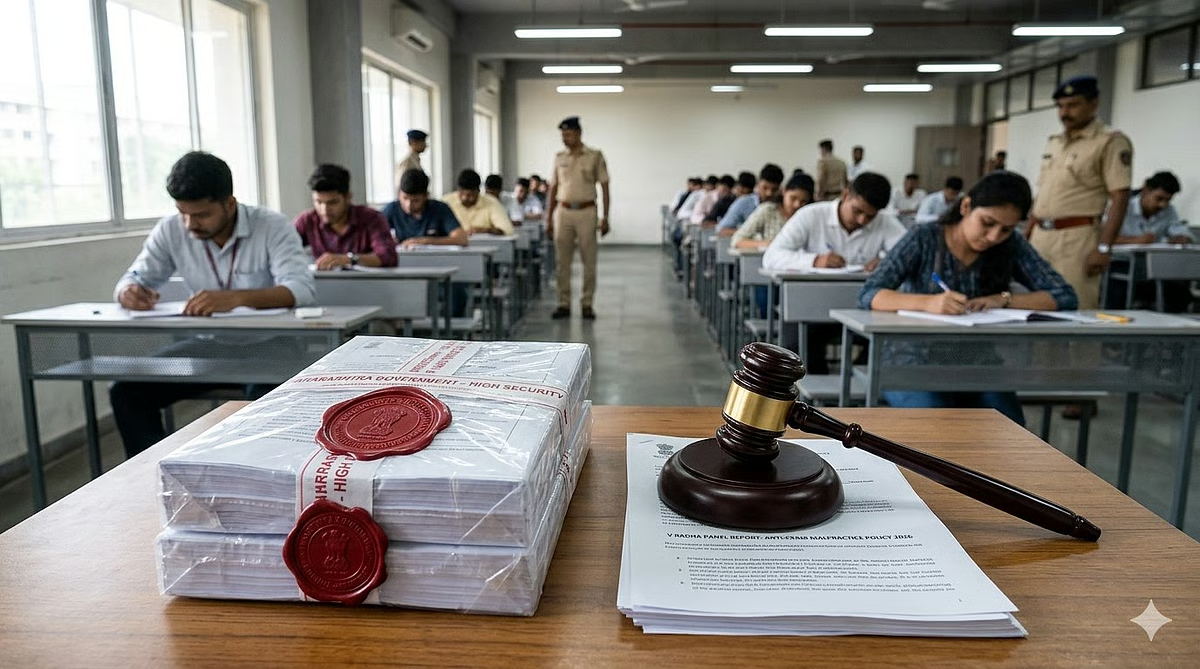
Mumbai, November 25, 2026: A high-level committee appointed by the Maharashtra government has recommended stringent punishments for organised examination paper leaks, including seven to ten years of imprisonment, a minimum fine of ₹10 crore and confiscation of property belonging to those involved.
The committee, headed by senior IAS officer and Additional Chief Secretary V. Radha, submitted its second report to the state government on November 23, 2026.
The recommendations aim to strengthen the Maharashtra Competitive Examination (Prevention of Unfair Means) Act, 2024, and improve transparency in recruitment examinations conducted by the Maharashtra Public Service Commission (MPSC).
The panel has also proposed a dedicated Special Task Force (STF), fast-track courts, stronger cybersecurity arrangements and a complete refund of examination fees for MPSC candidates.
Chief Minister Devendra Fadnavis has indicated that the government intends to introduce legislative amendments during the upcoming Winter Session of the Maharashtra Legislature in Nagpur.
The proposed penalties have not yet become law. They will require legislative approval and the necessary legal formalities before taking effect.
Maharashtra Panel Recommends 7–10 Years in Jail for Paper Leaks
The Maharashtra examination reform committee has recommended substantially increasing penalties for individuals and organisations involved in organised examination malpractice.
Under the proposed amendments, those found guilty of organised paper leaks could face imprisonment ranging from seven to ten years.
The committee has also recommended a minimum financial penalty of ₹10 crore.
Property connected to examination fraud could be confiscated, and offenders could be required to compensate authorities for financial losses caused by their actions.
The recommendations are intended to discourage organised networks involved in leaking question papers and manipulating recruitment processes.
The measures were included in the panel’s second report submitted on November 23.
Minimum ₹10 Crore Fine Proposed for Organised Exam Fraud
One of the most significant recommendations concerns the financial punishment for organised examination offences.
Under the existing state legal framework described in the committee’s report, organised malpractice attracts imprisonment of five to ten years and a minimum fine of ₹1 crore.
The panel wants to increase the minimum fine tenfold to ₹10 crore.
It has also proposed raising the minimum imprisonment period from five years to seven years while retaining the ten-year maximum.
The committee believes stronger penalties could help deter organised examination fraud.
These proposed punishments primarily concern organised offences and should not be confused with the separate penalties recommended for individual candidates using unfair means.
Maharashtra Exam Paper Leak: Existing and Proposed Penalties
The reform committee has suggested changes across several categories of examination-related offences.
| Offence | Existing provision | Proposed punishment |
|---|---|---|
| Organised examination malpractice | 5–10 years’ jail; minimum ₹1 crore fine | 7–10 years’ jail; minimum ₹10 crore fine |
| Individuals using unfair means | 3–5 years’ jail; fine up to ₹10 lakh | 5–10 years’ jail; fine up to ₹50 lakh |
| Examination service providers | Fine up to ₹1 crore | Fine up to ₹5 crore |
| Service provider blacklisting | Up to 4 years | Up to 8 years |
| Involved directors or managers of service providers | Subject to applicable existing provisions | 5–10 years’ jail and fines up to ₹5 crore |
The committee has additionally recommended recovering financial losses and confiscating assets connected to organised offences.
The final provisions may change during the legislative process.
Property Confiscation and Recovery of Financial Losses Proposed
The committee has recommended expanding the state’s ability to confiscate property connected to examination malpractice.
According to the report, the proposed definition of property would cover both physical and non-physical assets.
These could include land, buildings, movable assets, intellectual property rights and digital or virtual assets.
The objective is to prevent individuals or organisations from retaining financial benefits obtained through illegal examination activities.
The panel has also recommended that those responsible for organised offences compensate authorities for resulting losses.
Such measures would require clear legal procedures and safeguards before implementation.
MPSC Service Providers Could Face ₹5 Crore Fine
The committee has proposed stronger accountability measures for companies contracted to conduct recruitment examinations.
Examination service providers may be responsible for activities such as technical administration, examination logistics and supporting systems.
Under the recommendations, agencies involved in malpractice could face fines of up to ₹5 crore.
This would represent a fivefold increase from the existing maximum of ₹1 crore.
The proposed blacklisting period would also increase from four years to eight years.
Directors, managers and other responsible officials found involved in wrongdoing could face imprisonment of five to ten years and financial penalties of up to ₹5 crore.
The measures aim to strengthen accountability among organisations handling sensitive examination processes.
Special Task Force Recommended to Investigate Paper Leaks
The reform panel has called for the creation of a dedicated Special Task Force to investigate serious examination-related offences.
The proposed STF would have specialised jurisdiction to examine complex cases involving organised fraud.
Paper leak investigations can involve multiple individuals, digital communication systems, financial transactions and examination service providers.
A specialised team could bring together the necessary technical and investigative expertise.
The committee has also recommended that investigations be conducted by senior police officers.
In districts, officers handling such cases should be of at least Additional Superintendent of Police rank.
In commissionerate areas, investigations should be led by officers of at least Deputy Commissioner of Police rank.
Fast-Track Courts Proposed for Examination Fraud Cases
The committee has recommended establishing special fast-track courts for cases registered under the examination malpractice law.
These courts would focus on the timely disposal of cases involving paper leaks and related offences.
According to the recommendations, pending cases under the Act should be transferred to the proposed special courts.
The panel has suggested a three-month disposal period.
However, this remains a proposed procedural target rather than an existing guarantee.
Its implementation would require appropriate legal arrangements, judicial resources and coordination with relevant authorities.
MPSC Candidates Could Receive Full Examination Fee Refunds
Beyond stricter punishment, the reform committee has proposed financial relief for candidates appearing in Maharashtra Public Service Commission examinations.
One recommendation calls for a complete refund of examination fees to candidates regardless of whether they qualify.
The panel has also proposed refunding fees charged for challenging provisional answer keys when objections are found to be valid.
The recommendations are intended to reduce the financial burden on candidates and improve confidence in the recruitment system.
Chief Minister Devendra Fadnavis has indicated that the government will consider the proposal.
However, the refund system has not yet been implemented statewide under the newly recommended framework.
District Collectors May Receive Greater Examination Responsibilities
The panel has suggested strengthening district-level administration during recruitment examinations.
It recommends establishing a permanent examination branch in every District Collector’s office.
A district-level coordination committee chaired by the Collector would oversee examination preparations.
The committee would include senior police officials and representatives from departments such as education, transport and treasury.
This structure is intended to improve communication between agencies and strengthen accountability for examination arrangements.
The recommendations also aim to address logistical problems that can affect candidates on examination days.
Three-Tier Examination Monitoring System Proposed
The report recommends establishing a three-tier examination command and control system.
The proposed arrangement would include a central monitoring centre at the Maharashtra Public Service Commission headquarters.
Each district would have an independent examination command centre.
Individual examination venues would also maintain control rooms on examination days.
These facilities would coordinate monitoring, operational communication and responses to suspected irregularities.
The proposed system is intended to provide authorities with better oversight of examination activities across the state.
Cybersecurity Measures to Prevent Digital Cheating
The committee has highlighted the growing role of technology in examination malpractice.
It has recommended stronger security arrangements to detect and prevent the use of unauthorised electronic devices.
These may include miniature communication devices, wearable cameras and other technologies used for cheating.
The panel has also called for cybersecurity measures developed in consultation with MahaCyber.
A dedicated technology and cybersecurity cell would help MPSC monitor emerging threats.
The commission has also been advised to appoint a Chief Information Security Officer.
These recommendations aim to improve the security of examination systems and protect candidates’ personal information.
Venue Bank of Examination Centres Recommended
Another proposal involves creating a statewide database of suitable examination centres.
The proposed system, called a Venue Bank, would maintain information about school and college buildings that could be used for recruitment examinations.
Details would include seating capacity, infrastructure and accessibility arrangements for candidates with disabilities.
District authorities would use this information to identify appropriate venues.
The committee has recommended empowering Collectors to arrange the use of suitable buildings for examinations at prescribed rates.
The objective is to improve logistical planning and reduce last-minute examination disruptions.
Annual MPSC Examination Calendar Proposed by October
The committee has also addressed concerns about uncertainty surrounding examination schedules.
It has recommended that MPSC publish its annual examination calendar for the following year by October.
Government departments would be expected to submit vacancy requirements by the end of September.
The proposals seek to improve recruitment planning and provide candidates with more predictable schedules.
A centralised digital portal for vacancy requisitions has also been recommended.
Such a system could help improve coordination between recruiting departments and MPSC.
MPSC Aspirant Protests Prompt Examination Reforms
The Maharashtra government formed the high-level committee after allegations of irregularities in government recruitment examinations and protests by aspirants.
The committee was formally constituted on September 4, 2026.
It includes senior administrative, police, technology and academic representatives.
The panel has consulted candidates and other stakeholders to identify problems affecting recruitment examinations.
The concerns raised included suspected paper leaks, examination security, recruitment delays and transparency.
The recommendations are intended to address these issues through legal, administrative and technological reforms.
Panel Also Recommends More Than 16,000 Group-C Vacancies
The examination reform committee’s work extends beyond the prevention of paper leaks.
In its earlier report, it recommended increasing the number of vacancies for the MPSC Group-C Combined Preliminary Examination 2026 to more than 16,000.
It also recommended a one-time relaxation of one year in the upper age limit for recruitment examinations.
According to reported government action, the age-relaxation recommendation was accepted following the first report.
The proposals reflect concerns among candidates about recruitment opportunities and delays in examination schedules.
The latest report focuses more heavily on strengthening legal safeguards and administrative oversight.
Devendra Fadnavis Announces Plans for Stricter Legislation
Maharashtra Chief Minister Devendra Fadnavis responded to the committee’s recommendations on November 24.
He indicated that the state government intends to introduce changes to the examination malpractice law during the upcoming Winter Session of the state legislature in Nagpur.
Fadnavis said the government wanted to strengthen measures against paper leaks and irregularities in competitive examinations.
He also indicated that the government would consider the proposed examination fee refunds.
The announcement signals the administration’s intention to act on the committee’s findings.
However, introducing a bill and passing it into law are separate legislative steps.
What Happens Next for Maharashtra’s Anti-Paper Leak Proposals?
The Maharashtra government will now consider the committee’s recommendations and prepare proposed amendments.
The changes may be introduced during the upcoming legislative session.
Lawmakers will have an opportunity to examine the provisions before any final decision.
The proposed penalties, special investigation mechanisms and administrative reforms will depend on the final legal and government framework.
For examination candidates, the immediate development is a set of recommendations rather than a change to existing application procedures.
Students should continue following official MPSC notifications for examination dates, vacancies, fees and recruitment instructions.
Maharashtra Exam Paper Leak Reforms: Key Highlights
The Maharashtra government’s examination reform committee has recommended seven to ten years of imprisonment for organised paper leaks.
The panel has proposed a minimum fine of ₹10 crore, property confiscation and recovery of financial losses.
It has also recommended higher penalties for individual cheating and examination service providers.
A dedicated Special Task Force and special fast-track courts have been proposed.
The committee wants stronger cybersecurity measures, district-level monitoring and improved examination venue management.
It has also suggested full examination fee refunds for MPSC candidates and annual examination calendars published by October.
Chief Minister Devendra Fadnavis has indicated that the government intends to introduce legislation during the upcoming Winter Session.
As of November 25, 2026, the stricter penalties remain proposals and have not yet been enacted.
Source – The Indian Express (November 25, 2026), Hindustan Times (November 25, 2026), NDTV Education (November 25, 2026), Akashvani News (November 24, 2026)
Supreme News Network