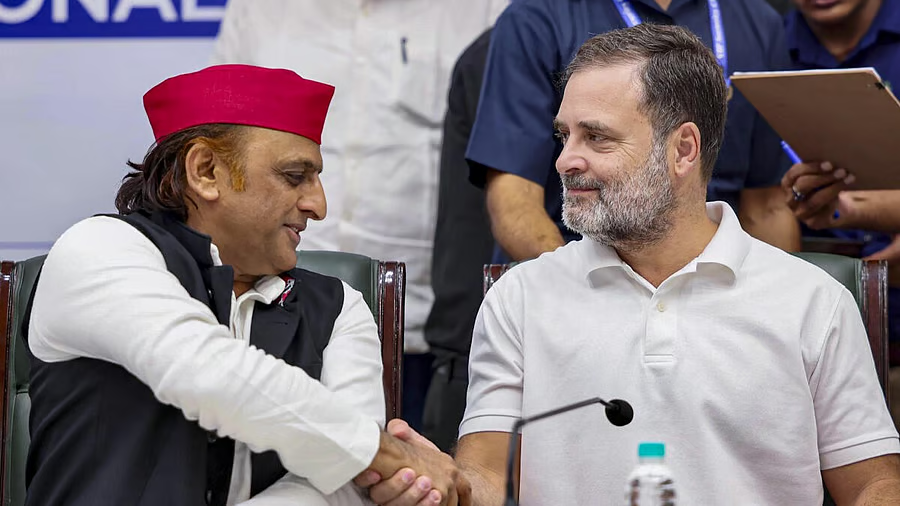
Lucknow, November 25, 2026: Political tensions between the Samajwadi Party (SP) and Congress have intensified ahead of the 2027 Uttar Pradesh Assembly elections after Akhilesh Yadav’s party announced its first five candidates while seat-sharing negotiations between the two INDIA bloc allies remained unresolved.
The announcement, made late on November 24, followed disagreements over the number of Assembly constituencies Congress should contest.
According to reports published on November 25, the Samajwadi Party offered Congress 26 seats in the 403-member Uttar Pradesh Assembly, considerably fewer than the national party had sought.
The unilateral candidate announcement has reportedly upset several Congress leaders, particularly because the list includes constituencies in western Uttar Pradesh that the party had hoped to contest.
The Bharatiya Janata Party (BJP), meanwhile, has criticised the apparent disagreement between the opposition allies.
Samajwadi Party Announces First Five Candidates
The Akhilesh Yadav-led Samajwadi Party released its first list of five candidates for the 2027 Uttar Pradesh Assembly elections on Tuesday evening.
The announcement came while negotiations with Congress were continuing.
The candidates announced were:
| Constituency | SP Candidate |
|---|---|
| Behat | Umar Ali |
| Saharanpur | Aashu Malik |
| Kairana | Nahid Hasan |
| Amroha | Mahbub Ali |
| Lalitpur | Jyoti Lodi |
Four of the five candidates represent constituencies in western Uttar Pradesh, while Lalitpur is located in the Bundelkhand region.
The decision has created friction because Congress was reportedly interested in contesting some of the same constituencies.
Congress Upset Over Candidate Announcement
According to NDTV, several Congress leaders expressed dissatisfaction with the timing of the Samajwadi Party’s announcement.
The two parties had been engaged in negotiations to establish a mutually acceptable seat-sharing arrangement.
However, the SP released its first candidate list before those discussions concluded.
Congress leaders reportedly questioned why their alliance partner had announced candidates without reaching a final understanding.
The disagreement is particularly significant in Saharanpur, where Congress MP and Uttar Pradesh working president Imran Masood has an established political presence.
The party had reportedly been interested in securing Assembly constituencies within that region.
Imran Masood Questions Samajwadi Party’s Decision
Congress leader Imran Masood publicly questioned the Samajwadi Party’s decision to announce candidates before completing alliance discussions.
According to NDTV, Masood criticised the announcement and questioned whether the SP was serious about reaching an agreement.
He also suggested that Congress could announce candidates in constituencies already claimed by the Samajwadi Party.
Such a move, if carried out, could create direct contests between the two parties.
However, Congress had not formally announced a decision to contest against the SP in those constituencies at the time of reporting.
The disagreement reflects differences over electoral representation and influence within the proposed alliance.
Seat-Sharing Talks Hit Deadlock Over 26-Seat Offer
The central disagreement concerns the number of constituencies Congress should contest in the 2027 Assembly elections.
According to The Indian Express, Congress initially presented a demand covering 131 constituencies during formal discussions.
The Samajwadi Party responded by offering 26 seats.
Subsequent reports indicated that Congress reduced its demand, although the reported revised figures varied as negotiations continued.
The SP maintained that constituency allocation should depend on each party’s electoral strength and the likelihood of victory.
Congress, meanwhile, sought a larger share based on its political presence, previous electoral performances and plans to strengthen its organisation in Uttar Pradesh.
No final seat-sharing agreement had been announced by the morning of November 25.
Akhilesh Yadav Calls for Unity and Winnability
Before the candidate announcement, Samajwadi Party president Akhilesh Yadav published a message urging Congress to approach the negotiations through a shared electoral strategy.
He argued that the parties should focus on identifying candidates with the strongest prospects in individual constituencies.
Yadav suggested that the final arrangement should be based on electoral calculations rather than simply dividing seats according to predetermined quotas.
He also called for consensus between the alliance partners.
His message emphasised the importance of cooperation in challenging the BJP during the 2027 elections.
However, the subsequent announcement of five SP candidates renewed concerns among Congress leaders about the direction of the negotiations.
BJP Criticises SP–Congress Disagreement
The Bharatiya Janata Party responded to the developments by questioning the coordination between the two opposition parties.
BJP legislator Rajeshwar Singh criticised the difference between Akhilesh Yadav’s public appeal for consensus and the Samajwadi Party’s decision to announce candidates independently.
In a social media post, Singh argued that the announcement exposed contradictions in the alliance’s approach.
His comments were political criticism rather than an independent assessment of the alliance’s prospects.
The BJP is the principal governing party that both SP and Congress are seeking to challenge in Uttar Pradesh.
The disagreement has therefore become part of the wider political debate surrounding the next Assembly elections.
Why Western Uttar Pradesh Matters
Western Uttar Pradesh has become an important point of disagreement in the seat-sharing discussions.
The Samajwadi Party’s first list includes Behat, Saharanpur, Kairana and Amroha.
These constituencies are politically significant because of their local electoral histories, demographic composition and party organisations.
Congress leaders have been seeking opportunities to rebuild the party’s presence in the region.
The SP, however, has existing MLAs and organisational networks in several of these constituencies.
Determining which party should contest each seat has therefore become a difficult aspect of the negotiations.
The dispute illustrates how alliance discussions can involve disagreements over individual constituencies as well as the total number of seats.
Amethi and Rae Bareli Also Become Points of Contention
The disagreement is not limited to western Uttar Pradesh.
Congress leaders have also expressed concern about the SP’s initial allocation of constituencies in the Amethi and Rae Bareli parliamentary regions.
The two areas have longstanding political associations with the Gandhi family.
However, the Samajwadi Party has argued that Assembly election results should guide seat allocation.
In the 2022 Uttar Pradesh Assembly elections, the SP won six of the ten Assembly constituencies falling within the two parliamentary seats, while the BJP won the remaining four.
Congress did not win any of those ten seats.
This difference between parliamentary-level political influence and Assembly-level electoral performance has complicated negotiations.
INDIA Bloc Faces Coordination Challenge
Both the Samajwadi Party and Congress are members of the INDIA opposition alliance.
Their cooperation in Uttar Pradesh is important because the state has 403 Assembly constituencies and 80 Lok Sabha seats.
The parties contested the 2024 Lok Sabha elections through a seat-sharing arrangement.
Their performance in that election demonstrated the significance of coordination between opposition parties.
However, Assembly elections involve different local political conditions and candidate considerations.
The present disagreement shows the challenges involved in translating parliamentary cooperation into an Assembly election strategy.
Whether the parties can reach a mutually acceptable arrangement remains unresolved.
Ram Gopal Yadav Says Further Discussions Will Continue
Senior Samajwadi Party leader Ram Gopal Yadav has been leading the party’s negotiating team.
Following discussions with Congress representatives, he indicated that further meetings would be held.
According to The Indian Express, Yadav expressed confidence that an agreement could be reached after additional rounds of negotiations.
Congress representatives also indicated that discussions would continue.
Despite the disagreements, neither party had formally announced the termination of alliance negotiations as of November 25.
This distinction is important because a dispute over seat allocation does not necessarily mean that the political alliance has ended.
What Happens Next in the SP–Congress Seat-Sharing Talks?
The next stage will involve further discussions between senior leaders from both parties.
The principal unresolved issues include the total number of constituencies allocated to Congress and the selection of candidates for disputed seats.
The parties may also need to address the concerns raised by Congress leaders in western Uttar Pradesh.
Any final agreement will require both sides to reconcile local electoral calculations with their broader political objectives.
For now, the Samajwadi Party’s announcement of five candidates has increased pressure on the negotiations.
The outcome of further talks will determine whether the two parties can agree on a joint electoral arrangement for the 2027 Uttar Pradesh Assembly elections.
SP–Congress Seat-Sharing Dispute: Key Highlights
The Samajwadi Party announced its first five candidates for the 2027 Uttar Pradesh Assembly elections on November 24, 2026.
The list includes candidates from Behat, Saharanpur, Kairana, Amroha and Lalitpur.
The announcement came while seat-sharing negotiations between SP and Congress remained unresolved.
Congress leaders have reportedly expressed dissatisfaction with the timing of the announcement.
The SP initially offered Congress 26 of Uttar Pradesh’s 403 Assembly constituencies.
Akhilesh Yadav has emphasised the importance of selecting candidates according to their electoral prospects.
BJP leaders have criticised the disagreement between the opposition allies.
Further negotiations are expected, and no final seat-sharing agreement had been confirmed by the morning of November 25.
Source – NDTV (November 25, 2026), The Indian Express (November 24–25, 2026), The New Indian Express (November 25, 2026)
Supreme News Network