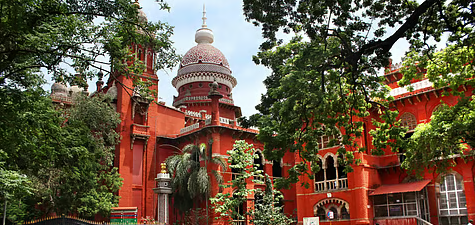
Madurai, November 11, 2026: The Madras High Court has directed Tamil Nadu’s Directorate of Vigilance and Anti-Corruption (DVAC) to register a First Information Report (FIR) into alleged irregularities in the procurement of books for public libraries, including concerns about fake, plagiarised and AI-generated publications.
The court also ordered the freezing of bank accounts belonging to Agal Vilakku Publications, its proprietor Mohan and other persons found involved in the alleged irregularities.
The directions were issued by the Madurai Bench on November 10 during the hearing of a contempt petition concerning the government’s failure to implement earlier orders on transparent book procurement.
Madras High Court Orders Immediate FIR
A division bench comprising Justices G.R. Swaminathan and M.D. Sumathi questioned why the DVAC had not registered an FIR despite allegations of large-scale irregularities.
The court instructed the anti-corruption agency to initiate a criminal investigation and examine the possible involvement of public officials and private publishers.
It also directed the authorities to determine how much public money had been spent on the disputed books.
The proceedings are at the investigation stage, and criminal responsibility has not yet been established.
Publisher’s Bank Accounts Ordered Frozen
The High Court ordered authorities to freeze the accounts of Agal Vilakku Publications, its proprietor Mohan and others connected to the alleged procurement irregularities.
The measure is intended to protect the investigation and prevent possible movement of disputed funds.
The order does not constitute a final finding of criminal guilt against the publisher or other individuals.
Fake and AI-Generated Books Under Scrutiny
The controversy intensified after Tamil writer Perumal Murugan raised concerns about the quality and authenticity of books supplied to public libraries.
Reports alleged that some publications contained fabricated information, questionable authorship and material generated using artificial intelligence.
The court also examined concerns about books falsely attributed to established writers and scholars.
Questions have been raised about whether established works were repackaged or published under misleading titles and author names.
The allegations will require further examination of publishing records, procurement documents and the books themselves.
Periyar Arivulagam Library Controversy
The dispute has drawn particular attention to the Periyar Arivulagam library project in Coimbatore.
The facility became the focus of criticism after concerns emerged about the books purchased for its collection.
Political parties have also questioned which officials and departments were responsible for approving the procurement.
The controversy has expanded into a broader examination of book purchasing practices across Tamil Nadu’s public library system.
Court Questions Violation of 2024 Order
The latest proceedings followed a contempt petition filed by advocate V. Ramasubbu.
The petition alleged that the authorities failed to comply with a June 19, 2024, High Court order intended to ensure transparency in library book purchases.
That earlier order required measures including public disclosure of procurement information and scrutiny of the book-selection process.
The judges questioned why those safeguards had not been implemented effectively.
Officials Face Possible Disciplinary Action
The court instructed the Director of Public Libraries to identify officials responsible for questioned procurement decisions over the previous two years and beyond.
The state government was directed to initiate appropriate disciplinary proceedings, including suspension where warranted.
The court also sought an affidavit detailing the sequence of procurement decisions, the officials involved and the expenditure incurred.
These directions are intended to establish accountability while the investigation proceeds.
Disputed Books to Be Removed From Public Access
The High Court directed librarians to prepare an inventory of suspect publications and prevent them from being made available to readers pending further scrutiny.
The judges highlighted the importance of ensuring that public libraries provide accurate and reliable information.
The court also referred to the standards under the Tamil Nadu Public Libraries Rules, 1950, which address the suitability and quality of books acquired for public collections.
DMK Seeks Separate Probe Into Alleged ₹50 Crore Irregularities
In a related development reported on November 11, the DMK approached the Madras High Court seeking a DVAC investigation into alleged misappropriation of approximately ₹50 crore in book purchases for Periyar Arivulagam.
The petition raised concerns about publishers allegedly producing unusually large numbers of titles within short periods.
However, the ₹50 crore figure is an allegation raised in the petition, not a loss conclusively established by investigators or the court.
The separate legal proceedings add another dimension to the wider procurement controversy.
What Happens Next?
The DVAC must act on the court’s direction to register an FIR and examine the suspected irregularities.
Authorities must also identify officials involved in the purchasing process, provide relevant records and account for the funds spent.
The court listed the contempt matter for further hearing on November 11.
The findings of the investigation will determine whether criminal charges or additional administrative measures are warranted.
Tamil Nadu Library Scam Raises Questions About Public Spending
The High Court’s intervention has intensified scrutiny of how public funds are used to purchase books for government libraries.
The allegations involving questionable authorship, fabricated content and weak procurement oversight have raised concerns about transparency and the quality of educational resources.
While the court has ordered an investigation and immediate protective measures, the full extent of any wrongdoing remains to be determined.
Sources: Press Trust of India, November 10–11, 2026; Bar & Bench, November 10; NDTV, November 11; The New Indian Express, November 11
Supreme News Network